

Home Blog Page 11

Ethereum 2.0: What You Need to Know About the Next Phase


Ethereum 2.0: What You Need to Know About the Next Phase

Ethereum, the second-largest cryptocurrency by market capitalization, is undergoing a significant transformation with the rollout of Ethereum 2.0, also known as ETH 2.0 or Serenity. This upgrade aims to improve the scalability, security, and sustainability of the Ethereum network.

What is Ethereum 2.0?

Ethereum 2.0 is a series of upgrades to the Ethereum blockchain that intends to enhance its performance and user experience. It will transition Ethereum from a Proof of Work (PoW) consensus mechanism to a Proof of Stake (PoS) system, which is designed to be more energy-efficient.

Key Features of Ethereum 2.0

  • Proof of Stake: PoS allows validators to create new blocks and confirm transactions based on the amount of ether they hold and are willing to “stake” as collateral.
  • Shard Chains: This feature will improve scalability by allowing multiple chains to operate simultaneously, increasing the overall throughput of the network.
  • Beacon Chain: The Beacon Chain coordinates the network, manages validators, and ensures the security of PoS.
  • Improved Security: Ethereum 2.0 will use advanced cryptographic techniques to enhance the security of the blockchain.

Benefits of Ethereum 2.0

With its new features and mechanisms, Ethereum 2.0 is expected to bring numerous benefits, including:

  • Increased Scalability: The introduction of shard chains can potentially increase transaction throughput from 30 transactions per second (TPS) to thousands.
  • Lower Fees: Improved scalability is likely to lead to reduced transaction fees, making Ethereum more accessible to users.
  • Environmental Impact: Transitioning to PoS significantly lowers the energy consumption of the network compared to the PoW system.

Timeline for Ethereum 2.0

The Ethereum 2.0 upgrade is being rolled out in multiple phases:

  • Phase 0: Launched in December 2020, this phase introduced the Beacon Chain and the staking mechanism.
  • Phase 1: Expected in 2022, this phase will introduce shard chains to enhance scalability.
  • Phase 1.5: This phase will see the merger of Ethereum 1.0 into Ethereum 2.0, transitioning from PoW to PoS.
  • Phase 2: This phase will further enhance Ethereum’s functionality and fully realize the sharding mechanism.

Conclusion

Ethereum 2.0 represents a significant evolution in the blockchain landscape, with ambitious goals aimed at addressing the current limitations of the Ethereum network. As Ethereum transitions to this next phase, it promises to become a more scalable, secure, and sustainable platform for decentralized applications and financial systems.

Stay informed about the developments of Ethereum 2.0, as they have the potential to reshape not just the Ethereum community but the entire cryptocurrency ecosystem.


Twins Turn to Joe Ryan to Neutralize Jays in Split-Seeking Showdown


Joe Ryan already has had one impressive win against the Toronto Blue Jays this season, a two-hit, seven-inning gem.

The host Twins would like to see a repeat performance from the 2025 All-Star right-hander Sunday as they attempt to split the four-game series in Minneapolis.

Toronto feasted on Minnesota’s beleaguered bullpen for an eight-run eighth inning Saturday in an 11-4 victory.

Ryan (2-3, 3.76 ERA) held the Blue Jays to two runs and one walk with five strikeouts on April 11 in the middle game of a three-game set in Toronto. The 7-4 win helped the Twins take the series and improve Ryan’s numbers to 3-1 with a 4.20 ERA in five career starts against Toronto.

Toronto is scheduled to start Trey Yesavage (1-0, 0.00), who has not faced Minnesota. The rookie right-hander will make his second start after opening the season on the injured list with a shoulder impingement.

In his season debut Tuesday, he held the Boston Red Sox to four hits and no walks while striking out three in 5 1/3 scoreless innings.

Another lengthy outing by Ryan would help the Twins’ bullpen problems. Luis Garcia, released by the New York Mets in April, and Anthony Banda could not get the job done in the eighth Saturday, failing to retire the first eight batters.

“Nothing that went right,” Twins manager Derek Shelton said. “We gave up, what, eight runs with no outs? We gave up five hits, walked two or three guys, and made an error. That’s about as bad of an inning as it can go — because we did a good job before that.”

As expected, Toronto had a positive feeling about the crooked inning.

“The eighth inning was a good representation of passing the baton,” Toronto manager John Schneider said. “I thought we took some really, really good swings throughout the day and especially the eighth.”

The Blue Jays had concern in the third when George Springer was hit on the left foot by a slider from Twins starter Connor Prielipp. Springer went down in pain and was removed from the game. He returned this week from a stint on the injured list after fracturing his left big toe on a foul ball on April 11 with Ryan pitching. X-rays on Saturday were negative.

“He’s all right,” Schneider said. “I love that the X-rays are negative. There’s nothing else going on with his toe. We’ll just see how he is. I was going to give him the day (Sunday) anyway, with the early game for the old man. … He was back in the dugout being himself. That’s a good sign. Hopefully, he’ll be all right in a day or so.”

The Twins’ bullpen woes worsened Saturday when right-hander Cole Sands, one of their better relievers, was put on the injured list with a forearm strain.

Right-hander John Klein was promoted from Triple-A St. Paul and pitched a perfect ninth in his major league debut.

“The thing that is probably the most frustrating is we haven’t been consistent,” Shelton said. “It’s like one or two good outings, and then two inconsistent outings. I think the thing about it is, yes, the ability is there. and we’ve seen the ability to do it. We just have to figure out a way to get it done.”

–Field Level Media

Copyright 2026 STATS LLC and Field Level Media. Any commercial use or distribution without the express written consent of STATS LLC and Field Level Media is strictly prohibited.


Source link

$600K in Stolen Home Depot Tools Recovered by CHP at SoCal Swap Meet


California Highway Patrol investigators have dismantled a high-value theft operation that turned stolen construction tools into a lucrative swap meet business.

What we know:

The Southern Division’s Organized Retail Crime Task Force successfully linked two suspects to a systematic “fencing” operation targeting Home Depot stores across Southern California.

According to officials, rather than stealing the items themselves, these individuals acted as intermediary purchasers, buying stolen inventory and reselling it at a Los Angeles County swap meet. 

A raid on the suspects’ home today yielded more than $600,000 in recovered merchandise.

What we don’t know:

The specific Home Depot locations targeted have not been listed, and authorities have not yet identified the individual shoplifters who supplied the suspects with the stolen tools. 

SUGGESTED:

The names of the two arrested individuals are currently being withheld pending further investigative steps.

What’s next:

While the primary resale hub has been shuttered, the CHP indicates the “investigation is ongoing” as they look to identify other links in the organized crime chain. 

The recovered tools will likely be processed as evidence before being handled through official channels for return or disposal.

The Source: This report is based on information from the California Highway Patrol.

Crime and Public SafetyLos Angeles CountyLos Angeles


Source link

Cryptocurrency Scams: How to Protect Your Digital Wealth


Cryptocurrency Scams: How to Protect Your Digital Wealth

Introduction

As the popularity of cryptocurrencies continues to surge, so does the prevalence of scams targeting unsuspecting investors. Whether you are a seasoned trader or new to digital currency, understanding the types of scams and how to safeguard your digital assets is essential.

Common Types of Cryptocurrency Scams

1. Ponzi Schemes

These scams promise high returns with little risk. Early investors are paid returns from the investments of new participants, creating the illusion of a profitable business.

2. Phishing Attacks

Scammers use fake websites or emails that resemble legitimate exchanges to steal your login credentials. Always verify URLs and be cautious of unsolicited communications.

3. Fake ICOs (Initial Coin Offerings)

Fraudsters promote fake ICOs claiming to offer unique investment opportunities. Research and due diligence are crucial before investing in any new cryptocurrency.

4. Pump and Dump Schemes

In this scheme, the price of a low-value coin is artificially inflated through misleading promotion, only for the promoters to sell at the peak, leaving other investors with worthless assets.

How to Protect Your Digital Wealth

1. Conduct Thorough Research

Before investing, research the project, team, and community feedback. A legitimate project usually has detailed information publicly available.

2. Use Secure Wallets

Store your cryptocurrencies in safe wallets. Hardware wallets are typically more secure than software wallets. Always enable two-factor authentication (2FA).

3. Be Wary of Unrealistic Promises

If an investment opportunity seems too good to be true, it probably is. Exercise skepticism and perform due diligence.

4. Educate Yourself

Stay updated on cryptocurrency regulations and security practices. Knowledge is your best defense against scams.

Conclusion

While the world of cryptocurrency holds vast potential, it also presents risks. By understanding common scams and implementing protective measures, you can safeguard your digital wealth and invest with confidence.

© 2023 Cryptocurrency Awareness. All Rights Reserved.

Amazon River Serenity: A Space Perspective – April 30, 2026


(Image credit: NASA/Jessica Meir)

NASA astronaut Jessica Meir snapped a striking photo of a river snaking through the Amazon rainforest from space.

International Space Station.


Source link

Decentralization Explained: The Core Principle Behind Cryptocurrencies


Decentralization Explained: The Core Principle Behind Cryptocurrencies

Published on: October 10, 2023

What is Decentralization?

Decentralization refers to the distribution of authority, governance, or control away from a central point. In the context of cryptocurrencies, it means that no single entity—be it a person, organization, or government—has complete authority over the cryptocurrency network.

The Rise of Decentralization

The decentralization concept gained immense popularity with the advent of Bitcoin in 2009. The idea was to create a currency that operates without intervening authorities like banks or governments. It was a response to financial crises that highlighted the vulnerabilities of centralized systems.

The Importance of Decentralization in Cryptocurrencies

Decentralization offers several critical benefits:

  • Increased Security: Decentralized networks are usually more resilient to attacks or failures since there is no single point of failure.
  • Transparency: Transactions on decentralized ledgers are public, allowing anyone to verify the records.
  • Empowerment: Users have full control over their transactions and data without reliance on third parties.
  • Reduced Censorship: Government or institutional interference is minimized, allowing for free and open transactions globally.

How Decentralization Works in Practice

In cryptocurrencies, decentralization is achieved through a technology called blockchain. A blockchain is a distributed ledger that records transactions across many computers. Some key components include:

  • Nodes: Computers that participate in the network and maintain a copy of the blockchain.
  • Consensus Mechanisms: Protocols that allow all nodes to agree on the legitimacy of transactions (e.g., Proof of Work, Proof of Stake).
  • Smart Contracts: Self-executing contracts that run when predetermined conditions are met, enabling trustless transactions.

Challenges to Decentralization

Despite its advantages, decentralization also faces challenges:

  • Scalability: As networks grow, maintaining speed and efficiency can become difficult.
  • Regulatory Scrutiny: As cryptocurrencies gain popularity, governments may seek to impose regulations, threatening decentralization.
  • Security Risks: Although decentralized networks are generally secure, they are not immune to breaches or attacks.

The Future of Decentralization in Finance

Decentralization is reshaping the financial landscape, leading to a new paradigm in how we think about money, investing, and transactions. As more projects focus on decentralized finance (DeFi), decentralized applications (dApps), and other blockchain innovations, the concept will continue to evolve.

Royals vs. Mariners: Game Thread XXXIII


Having gone 2-2 in their first four games on the road, the Royals have a prime opportunity to take at least one of the next two and end their road trip 3-3. That record would be all anyone could have expected when the Royals headed west. However, if they win today, they’ll have guaranteed that record and given themselves a shot to actually gain some ground by completing a sweep of the Mariners tomorrow. Still, that all starts tonight.

Seth Lugo will take the mound tonight. Last time out, he had easily his worst start of the season; he allowed 6 runs in the first 2 innings. But he buckled down and got through 4.1 more innings and only allowed a lone additional run. That gave the Royals a chance to chip away at the Angels’ lead and eventually walk it off in the tenth. Today, he will probably need to pitch a bit better early on.

Lugo did face the Mariners last year and he put together one of his better performances of the season, striking out 7 and allowing 1 run on 8 baserunners over 6 innings to earn a victory and give the Royals a 4-game split in Seattle. A similar performance could be very meaningful for a Royals offense that appears to have found some of its mojo in the last couple of weeks.

That offense has a tall task ahead of it, facing Emerson Hancock. Hancock was a moderately well-regarded prospect before he debuted in 2023, but seems to have finally figured himself out in the early-going of this season at age 27 with a 2.86 ERA in 34.2 innings across 6 starts. You’ll not that averages out to fewer than 6 innings a start, however. And he has had trouble with the long ball this year; he’s already allowed 7 in this short season.

I was fascinated by this TJStats pitching summary. It seems that while he’s been very good at putting his four-seamer and sinker in the strike zone, all of his other pitches are often outside the zone, and only his four-seamer gets any whiffs – and even that is only high for its pitch type. The fastball isn’t even that fast by modern standards, averaging 95. So I went back to his FanGraphs summary, and I figured out what’s going on. He has stranded 95.4% of runners. The league average is usually in the mid-70s, and so far this year, it’s 71.9%. His 2.86 ERA is stellar, but his 4.61 FIP tells the story of a still-mediocre pitcher. The regression alarms could hardly be louder. That doesn’t mean he’ll implode on this start. But hey, we can hope!

The Royals will use an identical batting order to last night’s for the first time since April 20 and 21 against the Orioles. They’re 1-0 using this one, so why not try it again? For those who are curious, the Royals have used 23 different lineups in their 33 games to start the year. Q really is trying to figure out the best way to deploy his 13 position players to their greatest effect.

The Mariners reorganize a bit with a righty on the mound. Luke Raley and Dominic Canzone will be in for Connor Joe and Mitch Garver. That means Lugo will only get two right-handers to do battle with, and it’s not like Julio Rodríguez or Randy Arozarena are exactly easy outs. Still, it’s his job to get the opponents out and he’ll need to if KC wants to win.


Source link

Cardinals Triumph Over Dodgers with Gorman and Burleson Home Runs


ST. LOUIS — Before he saw the gaudy chain around the neck of Cardinals third baseman following a first-inning home run on Friday night at Busch Stadium, had no idea that it existed.

By the time he launched his own homer two innings later, Burleson at least knew what to expect.

“By then, I knew [it existed],” Burleson said. “But I had no idea what it was.”

Burleson seemed to sense that I was well-intentioned in getting to the bottom of it — but despite being one of two players to wear the chain on Friday, he didn’t know how to help.

“I don’t even know who to tell you to ask about it,” Burleson called out from across the room as he headed out of the Cardinals’ clubhouse after their 7-2 win over the Dodgers.

As far as utility man Thomas Saggese knew, catcher Yohel Pozo was the man to ask regarding the team’s new home run celebration accessory.

But Gorman, who debuted the gimmick after launching his fifth home run of the season as part of a three-run Cardinals first inning, pointed this reporter in another direction.

“Yeah, me and [José] Fermín had talked about getting something,” Gorman said. “We’ve been barking a lot in the dugout, for whatever reason. So, yeah, he went ahead and got a cool little chain for us to put on.”

So that explains why the chain has a dog on it with the accompanying inscription, “GOT THAT DAWG IN ME.”

But — barking? Gorman didn’t seem to know where that came from.

“Obviously, we didn’t have anything,” Fermín said of the realization that the Cardinals were perhaps behind the times in the props department. “So, since we’ve been barking and stuff, I tried to find something. So, I went on Amazon, tried to get, like, a dog thing.

“And then I saw the chain because it was like, ‘I got that dog in me.’ I showed it to a couple guys, and they liked it. I’m like, all right, that’s a new thing, I guess.”

So, we’ve figured out the chain — but again, with the barking?

Apparently, the brainchild of Cardinals rookie outfielder Nathan Church.

“He started growling and barking,” Fermín said. “One day, someone hit a homer and he started doing it. We all liked it and joined, so, that’s a new thing now.”

How long can one continue to describe the Cardinals as a team that doesn’t profile to hit for much power before it’s time to reconsider one’s priors?

Because now that the Cardinals have broken out the home run chain, it might be time for this reporter to capitulate.

St. Louis’ two blasts by Gorman and Burleson in Friday’s win brought the Cardinals to 43 home runs on the season. That’s tied with the Angels for fourth in the Major Leagues behind only the Yankees (50), Dodgers (45) and Braves (45).

Gorman pounded a 3-2 Emmet Sheehan fastball that came in at 92.9 mph. The pitch was above the zone, but Gorman timed it up with an authoritative upper-cut swing for a two-run home run.

“I think that’s just kind of a part of what I attacked this offseason,” Gorman said. “Being able to get pitches up there and, when that happens, they’ve got to respect it a little bit more. … It was a little bit higher than I thought it was, but ended in a good result.”

He mashed the tater with an exit velocity of 107.6 mph, and promptly donned the apparent accessory now associated with the team’s home run prowess.

On paper, the preseason supposition of home runs being hard to come by for the Cardinals — in a ballpark that has historically suppressed them — could be forgiven, right?

In 2025, the Cardinals had just one player (Willson Contreras) reach the 20-home run plateau, and they traded him to the Red Sox.

Adding Ramón Urías’ 50 lifetime long balls during Spring Training immediately placed Urías, at the time, second on the roster’s career homer leaderboard. Gorman, who entered the year with 74 big league blasts to his name, sat in the perch.

But a lack of ample prior home run history won’t keep this team from hitting them, with an approach that doesn’t necessarily seek them out.

“I think it’s a result of taking good at-bats and swinging at the right pitches,” Gorman said. “I don’t think any of us are really trying to hit the homers.

“But we’re swinging at the right pitches, and we’ve got guys that can do damage in this lineup, whether it looks like it on paper or not.”


Source link

NFTs Unveiled: The Intersection of Art, Culture, and Cryptocurrency


NFTs Unveiled: The Intersection of Art, Culture, and Cryptocurrency

The rise of Non-Fungible Tokens (NFTs) has transformed the way we view and interact with art, culture, and digital assets. NFTs, unique digital certificates based on blockchain technology, have opened new avenues for creators and collectors, merging the realms of finance, culture, and art.

What are NFTs?

At their core, NFTs represent ownership of a distinct asset on the blockchain. Unlike traditional cryptocurrencies such as Bitcoin or Ethereum, which are fungible and can be exchanged for one another, NFTs are unique and cannot be divided or exchanged on a one-to-one basis. This uniqueness allows digital art, music, virtual real estate, and even tweets to be tokenized and sold as verifiable assets.

The Cultural Impact of NFTs

The cultural landscape has been significantly influenced by the emergence of NFTs. Artists can now reach global audiences without intermediaries, directly monetizing their work. Platforms like OpenSea and Foundation allow artists to showcase their work while retaining royalties on future sales, empowering them in ways traditional art markets never could.

Moreover, NFTs have democratized art ownership, allowing individuals to invest in and own high-value pieces previously inaccessible to the average collector. This shift has spurred discussions around originality, intellectual property, and the very nature of art itself.

Challenges and Controversies

Despite their potential, NFTs have faced criticism. Concerns regarding copyright issues, environmental impacts of blockchain technologies, and speculative market behaviors have sparked debates. Critics argue that the carbon footprint of minting NFTs is significant, with some blockchains requiring vast amounts of energy. This has led to calls for more sustainable approaches to the technology.

Moreover, the volatility of the NFT market raises questions about the future value of digital assets. As prices soar, some fear a bubble that will eventually burst, leaving many investors at a loss.

Future of NFTs

The future of NFTs appears promising yet uncertain. As technology advances, we might see greater integration of NFTs in everyday life, from digital identity verification to ticketing for events. Collaborations between artists and brands are increasing, enabling the blending of virtual and physical experiences.

Education around NFTs is also crucial. As the medium matures, artists, collectors, and consumers will need to navigate the complexities of the market, from understanding blockchain to protecting intellectual property.

Conclusion

NFTs represent more than just a trend; they signify a cultural shift in how we conceive ownership and value in the digital age. As the dialogue around art, culture, and cryptocurrency continues to evolve, one thing is clear: NFTs are reshaping our future in extraordinary ways.

For readers and art lovers, embracing this new frontier may lead to exciting possibilities and deeper engagement with the ever-evolving landscape of art and technology.

Hilary Duff’s Northwestern Commencement Speech Sparks Online Debate


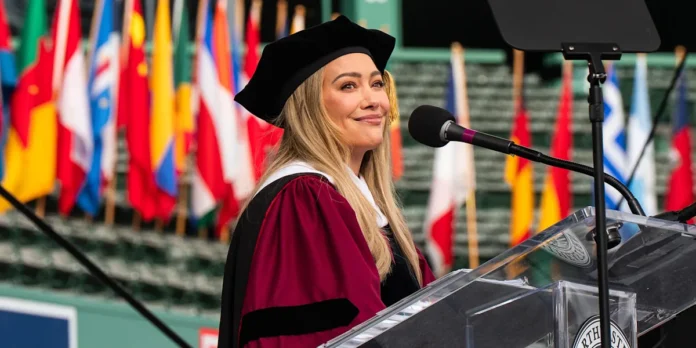
  • Hilary Duff delivered the commencement address during Northeastern University’s graduation ceremony on April 29.

  • In the speech, The Lizzie McGuire star gave graduates advice on how to approach their future, and encouraged them to be cautious about saying yes to every opportunity.

  • The speech divided the internet, with some saying that her advice was solid, while others noted that saying no is a sometimes a privilege reserved for the wealthy.

Hilary Duff is a pro at delivering commencement speeches, thanks to her epic graduation speech as seen in The Lizzie McGuire Movie. So when it came time to deliver a real life one, the star pulled out all the stops and said some truly memorable words—which later divided the internet once the speech hit social media.

Hilary gave the commencement address during Northeastern University’s graduation ceremony at Fenway Park in Boston on April 29, and in her time onstage, she encourage the graduates to stay true to themselves and be cautious about accepting opportunities before thinking it through.

“Just because something is a good opportunity or a good paycheck doesn’t mean it’s right,” she told the graduates and families in attendance. “By simply accepting what the world was offering to me, I was losing my own voice; I was reacting, instead of asking myself what I really wanted. That realization was a paradigm shift for me.”

“I knew I had to change my pattern of saying ‘yes,’ so I took a break from making music,” she continued. “Not because I didn’t know exactly what kind of album I wanted to make or what kind of stories I wanted to tell through my music, because I knew precisely what I wanted. But I somehow knew that I couldn’t authentically make it, yet.”

“So I made a choice, and I took a step back. I pivoted. I rebuilt myself, I refilled my tank, I put effort into my relationships, into building my family and building a business,” Hilary added. “I waited until I was ready to meet the moment. I realized that saying ‘no’ wasn’t rejection, it was redirection… I took back control of what I was building, and I reclaimed my story. And I realized my own agency. I’m grateful I had the ability to take that pause… the key is that I was choosing where my energy went instead of letting others choose for me. Don’t forget to pause and appreciate how far you’ve come.”

Though our fav actress-pop star’s advice was solid—um, why couldn’t she have spoken at MY graduation???—opinions on the speech were surprisingly divided, with some fully embracing Hilary’s message and praising her for being levelheaded in her career, while some noted that the “saying no” aspect of the speech is reserved for the privileged class only.

“I’m so happy for @hilaryduff for doing things on her terms, staying true to herself, and taking a step back when necessary,” one fan of the Younger star wrote on Instagram. “Everything I’ve seen of her recently has been so powerful, moving and motivating. She’s successfully balanced owning her past and reality and living fully and being present.” Another commenter added, “Saying no it also opens other doors, maybe one that matches your energy and happiness better.”

Those on the opposing camp noted that having a certain amount of money offers more opportunities to say no. “I love her but people in the real world can’t afford to say no to certain opportunities as freely. That’s a freedom that comes with having money,” one person wrote, while another user commented, “Many times we just don’t have any other choice, right? Having the choice to say NO…it’s a privilege.”

The discussion continued on Reddit, with a top comment reading, “Sadly, without financial freedom “every opportunity” is usually exactly one opportunity if that, and there is no luxury to be able to say no.” In response, another Redditor wrote, “I was at the ceremony and the people behind me were not having it 🤣 but yea 100% when you work some childhood and had success then you can afford a break later.”

I, personally, teared up hearing Hilary’s words (that is a separate conversation for my therapist), but you can listen to the speech in full and decide for yourself:

You Might Also Like


Source link