asohij.com
Thursday, May 14, 2026
No menu items!
Home Blog Page 22

Is Bitcoin the New Gold? Analyzing Its Role as a Safe Haven Asset


Is Bitcoin the New Gold? Analyzing Its Role as a Safe Haven Asset

Introduction

In recent years, Bitcoin has gained significant attention as a potential alternative to gold, often referred to as “digital gold.” This article delves into Bitcoin’s role as a safe haven asset and compares it to the traditional safe haven status of gold.

Understanding Safe Haven Assets

Safe haven assets are investments that are expected to retain or increase in value during times of market turmoil or economic uncertainty. Investors often flock to gold during these periods due to its historical stability and intrinsic value.

Bitcoin’s Emergence

Since its inception in 2009, Bitcoin has evolved from a niche digital currency into a significant financial asset. Advocates argue that its limited supply, decentralized nature, and increasing adoption make it an attractive alternative to gold.

Bitcoin vs. Gold: Key Comparisons

1. Volatility

One of the most significant contrasts between Bitcoin and gold is volatility. Bitcoin’s price can fluctuate dramatically in short periods, while gold has maintained relatively stable prices over the long term.

2. Supply Dynamics

Gold mining involves complex processes and resource depletion, limiting its supply. In contrast, Bitcoin has a capped supply of 21 million coins, introducing a predictable scarcity that appeals to investors.

3. Market Perception

The market perceives gold as a reliable store of value backed by thousands of years of history. Bitcoin, while gaining notoriety, still faces skepticism from some traditional investors regarding its long-term viability.

Market Trends and Institutional Adoption

Recent years have seen increased institutional adoption of Bitcoin, with major companies and investment firms adding it to their portfolios. This growing acceptance is paving the way for Bitcoin to be viewed more seriously as a safe haven asset.

The Role of Bitcoin in Economic Downturns

In times of economic instability, Bitcoin’s behavior has not consistently mirrored that of gold. During some market downturns, Bitcoin has suffered greater losses, suggesting it may not yet fulfill the safe haven role as effectively as gold.

Conclusion

While Bitcoin has shown promise as a new form of safe haven asset, it is crucial to recognize its unique characteristics and challenges. As the financial landscape evolves, Bitcoin may carve out its niche alongside gold, offering investors diverse options in times of economic uncertainty.

© 2023 Cryptocurrency Insights. All rights reserved.

Convincing Connor: The Oilers’ Playoff Challenge


EDMONTON — Connor McDavid meant it as a compliment.

The best hockey player on earth, speaking the day before his team was scheduled to start what it hopes to be a third consecutive two-month odyssey to the bitter end of the Stanley Cup playoffs, was asked how the 2025-26 iteration of the Edmonton Oilers compares with the past few.

“I’ve felt good about each and every group we go in with, honestly,” McDavid said, “and this group is no different.”

It was the savvy answer. It was the diplomatic answer. It might have even been the correct answer.

And that last bit is the one that should terrify Edmonton Oilers fans. All parties involved need to hope that something has changed, even after six months of largely uninspired hockey that screamed otherwise. The Oilers finished in second place in the drab Pacific Division, good enough for home ice in the first round against the Anaheim Ducks. McDavid on Sunday called his team’s regular season “monotonous,” and boy, was he right.

Despite that, he is, as ever, a singularly unparalleled force in modern hockey, one who finished the season on a post-Olympic, 1.8 point-per-game scoring bender that propelled his team out of danger, propelled him to another Art Ross Trophy and should propel him to a fourth Hart Trophy.

He’s also the same guy who, in October, signed a two-year, $25 million, dual-purpose contract extension. Was it a ludicrously team-friendly move by the player, designed to give general manager Stan Bowman more space to operate? Yes. Was it McDavid telling Bowman, in effect, that he was on the clock? Also, yes.

That’s what the Oilers’ still-in-the-gates 2026 postseason is about, and why there’s a certain sense of dread hanging over the proceedings. They can either close the deal after two straight years of agonizing failure, or they can somehow fall short in a way that doesn’t suggest a team stuck on a treadmill as the stopwatch ticks. The degree of difficulty on both might be equally high.

It shouldn’t be. For more than a decade, across multiple front offices, the Oilers have relied on a pair of all-time greats to an irresponsible, unfair, unnecessary degree. McDavid and Leon Draisaitl dragged them to the doorstep of the Cup in 2024 against the Florida Panthers, then came nearly as close in last spring’s rematch.

The summer, in turn, brought nothing of consequence, as Bowman leaned even further into a forward group whose value was dangerously concentrated at the top. McDavid and Draisaitl are elite. Zach Hyman and Ryan Nugent-Hopkins are quality support. Beyond them, best case was a group of question marks and lottery tickets. Even with Nugent-Hopkins, Edmonton’s middle-six forwards entered 2025-26 with a combined Net Rating of minus-12. The rest of The Athletic’s top five teams in projected points all averaged a plus-5.

Wholly unaddressed were the team’s goaltending problems. Stuart Skinner had followed a below-average regular season by getting pulled in Game 5 of the Cup Final last year, and Calvin Pickard was a career backup.

By March 13, Andrew Mangiapane, Bowman’s best attempt at adding a depth forward, had played his way onto the waiver wire, and Tristan Jarry — acquired from Pittsburgh in December for Skinner, a second-round pick and defenseman Brett Kulak — had taken the goaltending from bad to terrifying.

“They’ve been to the Cup (Final) twice because of three or four guys. If you had given them any kind of depth on the forwards or if their goalie wasn’t Stuart Skinner, they’re probably two-time Stanley Cup champions. So what do they do? They go out and get a goalie who might not be as good as Skinner,” an executive told The Athletic before the playoffs, in a contender-ranking exercise that put Edmonton between the Buffalo Sabres and Montreal Canadiens. “It’s astounding to me that they haven’t fixed any of the holes.”

Edmonton had started to buckle under that weight, losing four straight going into the Olympic break and five of nine coming out of it. From there, things seemed to devolve. Draisaitl’s regular season ended in a March 15 win over the Nashville Predators. After a 5-2 loss to the Tampa Bay Lightning on March 22, McDavid correctly noted that poor play across the Pacific Division was the main thing keeping the Oilers afloat.

“We’re fortunate to play in this division,” McDavid said. “A lot of teams are fortunate to play in this division. It’s a bit of a pillow fight right now.”

Post-“pillow fight,” McDavid averaged two points per game (10 goals, 12 assists), and the Oilers went 7-2-2. In five of those wins, he had goals. In another, he had four assists. Relatively improved goaltending and defensive play count for something; McDavid counts for a whole lot more.

“Five or six weeks ago, it was a little bit dire, obviously, with some health questions and fighting for a playoff spot,” McDavid said on Sunday. “We’ve earned the opportunity to be in this position. Pacific Division or not, we’re here.”

Indeed they are — and their situation, given how things looked a month ago, couldn’t realistically be much better.

Draisaitl’s return from a lower-body injury is imminent, as is that of Jason Dickinson, a defensively impactful third-line center added at the deadline by Bowman to play behind his two Hall of Famers. Matt Savoie, a skillsy winger drafted at No. 9 by Buffalo in 2022, has popped on McDavid’s line, and Hyman seems ready to roll as well. The defensive group, led by 95-point stud Evan Bouchard, goes three pairs deep. Connor Ingram took control of the goaltending job by default and has acquitted himself well, playing in 22 of Edmonton’s last 27 games and, after the Olympic break, putting up a .901 save percentage.

If the Oilers find themselves in a better spot in June (and that, of course, would only mean one thing), you can imagine the path they’d take. There’s secondary scoring, if you squint hard enough, and a forward group that, overall, looks better than the one the Oilers took into the 2025 first round against the Los Angeles Kings.

“About five minutes before I got out here, we were actually looking at our Game 1 lineup (from 2025),” coach Kris Knoblauch said on Sunday. “We were (saying), “Wow. What was going on? What were we thinking?’” He views the current group as one with more proven commodities, and it’s tough to disagree. It’s also tough not to grade on a curve.

Just as clear, too, is a second, uglier route, one that ends with a Cup-less McDavid entering a de facto walk year on a roster weak in predictable spots and doomed for the same, stale reasons. On March 9, The Athletic’s Pierre LeBrun wrote that while “the feeling is (McDavid) will give the Oilers one more season next year in this contention window,” he also couldn’t discount how McDavid would feel about a postseason flame-out.

Edmonton’s first step toward avoiding its nightmare scenario can come on Monday against the Ducks. The road to real change, and a happy ending, is a whole lot longer.




Source link

Kalshi Intensifies Efforts Against Political Insider Trading


Today, we’re releasing notices related to three enforcement investigations. 

Just like in traditional financial markets, bad actors will try to cheat. Regulated exchanges must constantly evolve and adapt their systems to address insider threats. These three cases are an example of how developing proactive engineering solutions can help identify illicit trading activity.

Case 1: Minnesota Democratic Primary

Our systems alerted us to a candidate in the Democratic Primary for Minnesota’s 2nd Congressional District who had traded a small amount on the outcome of his own election. 

After running its investigation, the surveillance team used internal information obtained from the trader and open source intelligence to confirm that the identity of the trader was the same as the candidate. The candidate was then alerted to the rule violation and quickly negotiated a settlement. As part of that settlement, he acknowledged that the trading activity violated Kalshi exchange rules, agreed to pay a fine of $539.85, and to a suspension from Kalshi for a period of 5 years.

Case 2: Texas Republican Primary

We also caught suspicious trading from a candidate in the Republican Primary for Texas’s 21st Congressional District. He traded a slightly larger amount on the outcome of his own election than the first case, but still fairly small. 

Same scenario as above: our systems screened the person and saw that he was trying to trade on his own election. We pre-emptively blocked the trader and ran a full investigation. When we contacted the trader, he was fully cooperative with the investigation and agreed to settle acknowledging the rule violation, paying a fine of $784.20, and accepting a 5-year suspension.

Case 3: Virginia Democratic Primary

We found a candidate for the Democratic Primary for Virginia’s U.S. Senate election who traded in two markets related to his campaign. The first was a market on individuals who would run for public office in 2026. This person placed a trade on himself in this market. Then, once the trader announced himself as a candidate for the Democratic Primary election for Virginia U.S. Senate, he again traded on his own candidacy. 

Kalshi surveillance and enforcement teams conducted an investigation and determined both trades violated our rules. We confirmed the identity of the trader using internal information and open source intelligence. We contacted the trader, who initially acknowledged being a candidate and violating the rules, but later stopped all communication with our team and did not comply with requests to respond or settle the matter. We fined him $6,229.30 and gave him a 5-year suspension from our platform.

A few key points on these cases

Context matters, and cooperation pays off. Two of these cases were settlements, but one was a disciplinary action. The difference was cooperation: we granted settlements to traders who immediately acknowledged they violated the rules. In the other case, the trader did not accept responsibility, despite clear evidence he violated the rules. The consequence was a harsher penalty. 

These cases violate Kalshi’s CFTC-approved exchange rules. When a trader violates our exchange rules, they will be subject to exchange discipline. For more serious matters, we refer cases to the CFTC or DOJ for further investigation and prosecution, which didn’t happen here.

Cases like these demonstrate Kalshi’s commitment to policing all types of unfair or improper trading on our platform. Regardless of the size of a trade, political candidates who can influence a market based on whether they stay in or out of a race violate our rules. No matter how small the size of the trade, any trade that is found to have violated our exchange rules will be punished.

The Kalshi Enforcement team is hard at work monitoring markets and investigating trading violations 24/7. We’ll be back with more to say soon.


Source link

5 Emerging Cryptocurrencies You Should Watch in 2023


5 Emerging Cryptocurrencies You Should Watch in 2023

The cryptocurrency market is constantly evolving, with new players emerging and innovative technology reshaping the landscape. As we delve into 2023, several cryptocurrencies are catching the eye of investors and tech enthusiasts alike. Here are five emerging cryptocurrencies that you should keep on your radar this year.

1. Solana (SOL)

Solana has gained significant attention due to its lightning-fast transaction speeds and lower fees compared to Ethereum. With its unique Proof of History consensus mechanism, Solana is poised to handle a vast number of transactions, making it an appealing option for decentralized applications and DeFi projects.

2. Avalanche (AVAX)

Avalanche is another competitor to Ethereum, offering high throughput and customizable blockchain networks. Its innovative architecture allows developers to create tailored smart contracts and applications. With a growing community and increasing partnerships, Avalanche has the potential to expand its market presence significantly in 2023.

3. Polkadot (DOT)

Polkadot aims to facilitate interoperability between various blockchains, allowing them to communicate and share data securely. Its unique parachain technology is gaining traction as more projects look for ways to leverage multiple networks efficiently. As blockchain technology matures, Polkadot’s role could become increasingly vital.

4. Cosmos (ATOM)

Cosmos offers a decentralized network of independent blockchains that can interact with each other. This interoperability is crucial for the future of blockchain technology, as it allows different platforms to cooperate and scale efficiently. With ongoing developments and partnerships, Cosmos is worth monitoring in 2023.

5. Cardano (ADA)

Cardano has been steadily growing its ecosystem, focusing on sustainability and scalability. With the rollout of smart contract functionality and ongoing upgrades to its platform, Cardano is targeting sectors like education, finance, and healthcare. Its methodical development approach has many anticipating its future success.

Conclusion

As the cryptocurrency space continues to innovate and evolve, these emerging players stand out due to their unique propositions and solid technology. Whether you’re a seasoned investor or just starting, keeping an eye on these cryptocurrencies could offer potential opportunities as we progress through 2023.

Astros Acquire Peter Lambert


Right-hander Peter Lambert will start for the Astros on Friday, with Chandler Rome of The Athletic among those to relay the update. Lambert is not currently on the roster, so he’ll need to be formally added prior to the game.

It’s an early birthday present for Lambert, who turns 29 on Saturday. When he takes the ball, he’ll be making his first major league appearance for a team other than the Rockies. Lambert made 74 appearances for Colorado from 2019 to 2024, throwing 243 2/3 innings and allowing 6.28 earned runs per nine.

At the end of the 2024 season, the Rockies outrighted Lambert off their roster and he elected free agency. He then signed with the Yakult Swallows of Japan’s Nippon Professional Baseball. He gave the Swallows 116 1/3 innings over 21 starts with a 4.26 ERA. That may seem like a passable mark but NPB has been a pitcher-friendly league in recent years. Last year’s league-wide ERA was 2.97 in the Central League and 3.04 in the Pacific League, the two main leagues of NPB.

He landed a minor league deal with the Astros in November. He opted out of that deal at the end of camp but re-signed on a fresh minor league deal. He has thrown 14 2/3 Triple-A innings this year over three appearances, allowing three earned runs via 11 hits, three walks and hitting two batters while striking out 12. In that small sample, his 20.3% strikeout rate is subpar but his 5.1% walk rate and 53.7% ground ball rate are strong figures. His four-seamer has averaged 94.5 miles per hour this year and he has also thrown a sinker, cutter, slider, curveball and changeup.

The Astros have been doing a lot of improvising on their pitching staff lately. Hunter Brown and Cristian Javier both landed on the injured list due to shoulder strains. Not long after, Tatsuya Imai hit the IL due to arm fatigue, meaning Houston quickly lost three fifths of the five Opening Day rotation. That forced them to turn to contingency plans but one of those also got bit with the injury bug, as back inflammation put Cody Bolton on the IL.

There’s never a good time for a team to lose four starters but the timing was especially unfortunate in this case as the Astros began a stretch of 13 straight games last Friday. Imai started the first game but lasted just a third of an inning, forcing J.P. France and others to soak up the rest. Lance McCullers Jr. and Mike Burrows are still around from the season-opening group. McCullers took the ball on Saturday and Burrows on Sunday. Bolton went on Monday but lasted just one inning. Colton Gordon was recalled this week and started on Tuesday, giving the club 3 2/3 innings. Spencer Arrighetti was recalled to start Wednesday and went six.

Just now in Thursday’s contest, they effectively did a bullpen game. Ryan Weiss, who had been pitching in long relief, started and went 3 2/3. Christian Roa then absorbed 1 1/3, followed by two frames each from AJ Blubaugh and Kai-Wei Teng.

The Astros still have six more games to get through before their next off-day. Lambert will take the ball tomorrow, followed by McCullers and Burrows. Houston could then perhaps go back to Gordon and Arrighetti in the next two. The final game could again be Lambert, though he is out of options. Depending on how things go tomorrow, it’s possible he may need to be bumped off the roster for a fresh arm. In that case, perhaps another bullpen game headlined by Weiss would be the move, depending on who gets used in the interim.

For tomorrow, as mentioned, corresponding moves will be required to get Lambert onto the roster. The Astros have several guys on the IL and perhaps one of them could be moved to the 60-day IL to open up a 40-man spot if the Astros don’t expect them back anytime soon. The list of pitchers currently on the 15-day IL includes Brown, Javier, Imai and Bolton but also Josh Hader, Nate Pearson and Bennett Sousa. If the club doesn’t want to lock any of those guys into a lengthy IL stint, someone else would have to be bumped off the 40-man. In terms of opening an active roster spot, most of their guys can be optioned, with McCullers, Bryan Abreu, Enyel De Los Santos and Steven Okert the only exceptions.

Photo courtesy of Sam Navarro, Imagn Images


Source link

The Environmental Impact of Cryptocurrency: A Look at Sustainable Mining Practices


The Environmental Impact of Cryptocurrency: A Look at Sustainable Mining Practices

The rise of cryptocurrency has rapidly transformed the financial landscape, yet it comes with significant environmental concerns. Cryptocurrency mining, particularly for Proof of Work (PoW) coins like Bitcoin, requires enormous amounts of energy and has raised alarms regarding carbon footprints and ecological disturbances.

Understanding Cryptocurrency Mining

Cryptocurrency mining is the process by which new coins are generated and transactions are verified on a blockchain. This process often involves solving complex mathematical problems, which requires substantial computational power and, consequently, a significant amount of electrical energy.

The Environmental Consequences

Critics argue that traditional mining practices contribute to:

  • High energy consumption that rivals that of entire countries.
  • Increased carbon emissions due to reliance on fossil fuels.
  • Negative impacts on local ecosystems, including land degradation and water shortages.

As the demand for cryptocurrencies grows, so does the potential for environmental degradation, prompting the need for more sustainable practices.

Shifting Towards Sustainable Mining Practices

In response to growing concerns, many companies and miners are actively seeking to introduce sustainable practices in their operations. Some of the key strategies include:

  • Renewable Energy Sources: Utilizing solar, wind, and hydroelectric power helps reduce reliance on fossil fuels.
  • Geothermal Mining: This innovative method harnesses the earth’s heat, providing a constant energy source.
  • Efficient Hardware: New mining equipment is designed to be more energy-efficient, requiring less electricity to perform calculations.
  • Carbon Offsetting: Some companies invest in carbon credits to counterbalance their emissions.

Promoting Policy and Regulation

In addition to individual efforts, regulatory frameworks can play an essential role in promoting sustainable mining practices. Governments can incentivize the use of renewable energy in mining operations and implement stricter regulations on energy consumption.

The Future of Cryptocurrency Mining

The future of cryptocurrency mining must pivot towards sustainability. As more stakeholders recognize the urgency of environmental issues, the industry is likely to evolve, integrating innovative technologies and practices that align with global sustainability goals.

Conclusion

While cryptocurrency offers exciting possibilities for the future of finance, its environmental impact cannot be overlooked. By embracing sustainable mining practices, the industry can mitigate its ecological footprint and create a balance between innovation and environmental stewardship. As we move forward, the integration of sustainability into cryptocurrency mining practices will be crucial for the longevity of both the industry and the planet.

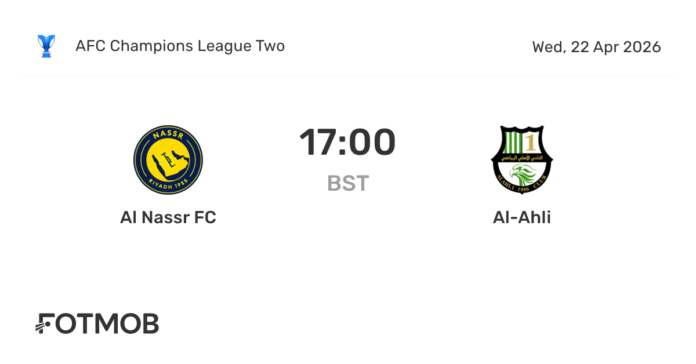
Clash of Giants: Al Nassr FC vs Al-Ahli Showdown


Al Nassr FC faces Al-Ahli at Zabeel Stadium on Wed, Apr 22, 2026, 16:00 UTC. This match is part of the AFC Champions League Two. You can check the recent head-to-head encounters, as well as full H2H record on this page to see how Al Nassr FC and Al-Ahli have fared against each other in the past. On FotMob, you can follow the Al Nassr FC vs Al-Ahli live score with a full set of match features, including:

  • Live updates: Every goal, card, substitution and key moment instantly delivered on FotMob.

  • Real-time extensive stats powered by Opta: Possession, shots, corners, big chances created, xG, momentum, and shot maps.

  • The lineups are:
    Al Nassr FC (4-4-2): Bento KrepskiNawaf Al-Boushail, Mohamed Simakan, Abdulelah Al Amri, Iñigo MartínezKingsley Coman, Marcelo Brozovic, Ângelo, Sadio ManéJoao Félix, Cristiano Ronaldo.
    Al-Ahli (4-2-3-1): Marwan BadreldinRobin Tihi, William Troost-Ekong, Ayoub Amraoui, Michel VlapIbrahima Diallo, Driss FettouhiSekou Yansané, Amidou Doumbouya, Julian DraxlerErik Expósito.

  • Unavailable players for Al Nassr FC: Mubarak Al Buainain (injury), Raghed Najjar (injury), Sami Al-Najei (injury). Al-Ahli does not have any unavailable players.

  • Team form & Head-to-head history: Compare recent results and see how Al Nassr FC and Al-Ahli have performed against each other.

  • TV and streaming info: Find out where to watch the match. This match is broadcast live on Youtube UK (Great Britain), The AFC Hub YouTube (Ireland), RCTI+ (Philippines), HOY TV (Hong Kong), sooka (Malaysia), Astro Go (Malaysia).

  • Live standings: Follow league tables and tournament info in real time.

  • Live odds & insights: Track match favorites and before, during and post match.

  • Commentary & ticker: Rich text commentary for major matches to follow the action even if you can’t watch.

  • All of these features make FotMob the best way to follow Al Nassr FC vs Al-Ahli, whether you’re checking the scores or diving into detailed stats. FotMob also covers every team and competition worldwide, with fixtures, results, and squad info available on team pages.

    FotMob is available on the web and as a free app for iOS and Android. Install the app to get notifications, live scores, and full match coverage so you never miss a moment.


    Source link

    Severe Weather Forces Cancellation and Postponement of Fiesta Events


    SAN ANTONIO – Severe weather upended some Fiesta celebrations this week, including the Texas Cavaliers River Parade on Monday.

    Fiesta said the following changes were also made in Tuesday’s programming:

    • Fiesta de los Reyes at Market Square will open at noon.

    • Eva’s Heroes announced it is postponing its popular “Ain’t Gonna Resta ’Til After Fiesta” dance. The event has been rescheduled for 6-8:30 p.m. on Monday, May 4, at the Espee Pavilion.

    • Disability SA confirmed it has canceled its Celebration Day event at the Fiesta Carnival. Organizers did not indicate plans for rescheduling but expressed appreciation for the community’s continued support.

    • Army Day at the Alamo announced the cancelation of its military celebration due to weather on Facebook.

    On Monday, the City of San Antonio decided to cancel the River Parade and Fiesta De Los Reyes due to a flash flood warning.

    “The City appreciates the cooperation of the Fiesta Commission, Consejos and Texas Cavaliers and understands the disappointment of our residents, but safety is a prime concern to avoid loss of life,” a news release stated.

    According to Your KSAT Weather Authority, Monday’s rainfall resulted in five-day totals topping 5 inches in San Antonio.

    Spotty light showers will continue Monday morning; however, any heavy rain will push east of the area. A flood threat remains for those from Gonzales to Hallettsville. Rain chances will decrease by the afternoon.

    Click here for the latest forecast. This story will be updated if more canceled or postponed events are announced.

    Read also:

    Copyright 2026 by KSAT – All rights reserved.


    Source link

    How Blockchain Technology is Transforming Industries Beyond Finance


    How Blockchain Technology is Transforming Industries Beyond Finance

    Blockchain technology, initially developed as the backbone for cryptocurrencies like Bitcoin, is now being recognized for its broad potential to transform various industries beyond just finance. Its characteristics—decentralization, transparency, and immutability—are proving beneficial across sectors such as supply chain, healthcare, real estate, and more.

    1. Supply Chain Management

    In supply chain management, blockchain enhances transparency and traceability. Each transaction or movement of goods can be securely recorded on a blockchain, providing stakeholders with a tamper-proof digital ledger. This allows for:

    • Improved tracking of products from origin to consumer.
    • Reduced fraud and errors by ensuring data integrity.
    • Faster resolution of disputes through transparent records.

    2. Healthcare

    The healthcare sector is adopting blockchain to enhance patient data security and interoperability. It offers a secure way to store and share sensitive medical information. Key benefits include:

    • Enhanced patient privacy and data security.
    • Simplified consent management for data sharing.
    • Reduction of fraudulent activities in insurance claims.

    3. Real Estate

    Blockchain technology is streamlining real estate transactions by reducing the need for intermediaries. Digital ledgers can facilitate quicker and more secure property transfers. The advantages include:

    • Lower transaction costs through smart contracts.
    • Increased transparency in property records.
    • Reduced fraud risks in property sales and leasing.

    4. Voting Systems

    Voting systems can benefit greatly from the implementation of blockchain technology. It ensures the integrity and transparency of electoral processes. Key points include:

    • Improved voter turnout through secure remote voting options.
    • Unalterable records of votes to prevent tampering.
    • Enhanced trust in the democratic process.

    5. Intellectual Property Protection

    Blockchain provides a solution for protecting intellectual property by establishing proof of ownership and originality. Benefits include:

    • Secure records of creation and ownership timestamps.
    • Facilitation of licensing agreements.
    • Streamlined royalty distribution processes.

    Conclusion

    As blockchain technology continues to evolve, its application across various industries shows immense promise. By enhancing transparency, security, and efficiency, blockchain stands to reshape not only financial systems but also fundamental aspects of business operations in sectors such as supply chain management, healthcare, real estate, and beyond. The future holds tremendous potential for blockchain, making it a key player in the broader technological landscape.

    U.S. Military Actions Against Climate Change: A Silent Initiative


    Defense Secretary Pete Hegseth boasted last year that on his watch, the military would ignore the climate crisis, which the former Fox News host derided as “crap.” Unfortunately, he meant it: At Hegseth’s behest, the Pentagon scrapped several dozen research studies related to global warming and removed references to climate change from the 2025 National Security Strategy.

    The trouble is, U.S. military officials can’t simply pretend that the effects of the climate crisis aren’t real simply to satisfy the secretary’s ideological crusade. To be effective, they have to deal with reality as it exists, not the one Hegseth imagines.

    And so many military officials are, in fact, taking steps to prepare for the effects of the climate crisis, even as they avoid using the word “climate.”

    Bloomberg reported, for example, on preparations underway at Florida’s Tyndall Air Force Base, which was severely damaged by a hurricane in 2018 and will soon be home to new facilities designed to anticipate sea-level rise as global temperatures continue to climb. It’s not the only effort of its kind. From the article:

    [A]s Tyndall shows, the Defense Department is still engaged on one front of the climate fight: steeling its bases against the effects of a warming atmosphere, such as higher seas, fiercer storms and deadlier fires. A new flood wall is rising at the U.S. Naval Academy in Maryland; a low-lying Air Force runway is being elevated in Virginia; and projects are underway to reduce wildfire risk around various military sites in Hawaii.

    Those involved in these projects can’t admit that they’re preparing for deteriorating climate conditions, so their official line is that they’re ensuring “resilience” and “readiness,” which are not words that trigger objections from the Republican administration.

    John Conger, a past director of the nonprofit Center for Climate and Security and a senior Defense Department official during the Obama administration, told Bloomberg, “Ultimately, the military is a very pragmatic institution. It wants to maintain mission capability. Whether we’re going to call it ‘climate,’ not ‘climate,’ whatever — if I can’t get to the base because the road is flooded, that’s a problem.”

    Political figures have the luxury of ignorance. Military leaders, however, tend to focus on solving problems, not scratching ideological itches.


    Source link