Home Blog Page 122

Mega Millions Jackpot Soars to $216 Million for August 19, 2025

play

The Mega Millions jackpot rose to $216 million for the drawing on Tuesday, Aug. 19, after no one matched all the winning numbers in the drawing on Friday, Aug. 15.

If someone matches all six numbers, they will have the option of a one-time cash payment of $97.0 million.

There have been four Mega Millions winners this year, with the most recent being the June 27 win in Virginia, which claimed a jackpot of $348 million. Before then, on April 18, an Ohio player took home a $112 million jackpot, a lucky lottery ticket holder in Illinois took home a $344 million jackpot on March 25 and another lucky person hit the Mega Millions jackpot on Jan. 17 for $113 million.

Here are the winning numbers from the Mega Millions drawing on Tuesday, Aug. 19, 2025.

Mega Millions winning numbers for 8/19/25

The winning numbers for Tuesday, Aug. 19: 10-19-24-49-68 and the gold Mega Ball: 10

Winning lottery numbers are sponsored by Jackpocket, the official digital lottery courier of the USA TODAY Network.

Did anyone win the Mega Millions?

Any Mega Millions winners will be posted here once announced by lottery officials.

To view the list of past winners, visit the Mega Millions website.

How to play the Mega Millions

To play the Mega Millions, you have to buy a ticket. You can do this at a variety of locations, including your local convenience store, gas station or even grocery store. In some states, Mega Millions tickets can be bought online.

Once you have your ticket, you need to pick six numbers. Five of them will be white balls with numbers from 1 to 70. The gold Mega Ball ranges from 1 to 24.

If you’re feeling especially unlucky or don’t want to go through the hassle of picking, you can ask for a “Quick Pick“ or an ”Easy Pick.” These options let the computer randomly generate numbers for you.

Mega Millions tickets now include a built-in multiplier, which increases non-jackpot prizes by two, three, four, five, or 10 times. Before, players had to pay an extra dollar to add the “Megaplier.”

Where can you buy lottery tickets?

Tickets can be purchased in person at gas stations, convenience stores and grocery stores. Some airport terminals may also sell lottery tickets.

You can also order tickets online through Jackpocket, the official digital lottery courier of the USA TODAY Network, in these U.S. states and territories: Arizona, Arkansas, Colorado, Idaho, Maine, Massachusetts, Minnesota, Montana, Nebraska, New Hampshire, New Jersey, New York, Ohio, Oregon, Puerto Rico, Washington, D.C., and West Virginia. The Jackpocket app allows you to pick your lottery game and numbers, place your order, see your ticket and collect your winnings all using your phone or home computer.

Jackpocket is the official digital lottery courier of the USA TODAY Network. Gannett may earn revenue for audience referrals to Jackpocket services. Must be 18+, 21+ in AZ and 19+ in NE. Not affiliated with any State Lottery. Gambling Problem? Call 1-877-8-HOPE-NY or text HOPENY (467369) (NY); 1-800-327-5050 (MA); 1-877-MYLIMIT (OR); 1-800-981-0023 (PR); 1-800-GAMBLER (all others). Visit jackpocket.com/tos for full terms.

Fernando Cervantes Jr. is a trending news reporter for USA TODAY. Reach him at fernando.cervantes@gannett.com and follow him on X @fern_cerv_.

To learn more-  The Mega Millions jackpot has climbed to $216 million for the August 19, 2025 drawing, giving players a chance to win life-changing prizes in one of the nation’s biggest lotteries.

California Lottery Results for August 18, 2025: Powerball and Daily 3 Midday Winning Numbers


The California Lottery has announced the latest winning numbers for Monday, August 18, 2025, giving players across the state another chance at life-changing prizes. The draws included the much-anticipated Powerball jackpot as well as the Daily 3 Midday game, which remains a favorite among local lottery enthusiasts.

Powerball Results – August 18, 2025

The Powerball jackpot continues to capture national attention, with millions of tickets sold both in California and across the country. Players are encouraged to double-check their tickets carefully, as even non-jackpot combinations can yield significant prizes.

Daily 3 Midday Results – August 18, 2025

The Daily 3 game allows players to choose their own numbers and play in different styles such as Straight, Box, or Straight/Box, with the potential to win up to $500 on a single $1 ticket.

Claiming Prizes

Winners of both Powerball and Daily 3 are reminded that lottery prizes must be claimed within 180 days of the draw date for non-jackpot wins, and within one year for jackpot prizes. Smaller prizes can be redeemed at authorized California Lottery retailers, while larger winnings require submission of a claim form at lottery offices.

Responsible Play Reminder

The California Lottery emphasizes playing responsibly. While the games bring excitement and the possibility of big wins, they are designed for entertainment. Players should always set limits and seek help if gambling becomes a concern.

The California Lottery offers multiple draw games for those aiming to win big. Here’s a look at Aug. 18, 2025, results for each game:

Powerball

15-46-61-63-64, Powerball: 01, Power Play: 3

Check Powerball payouts and previous drawings here.

Daily 3

Midday: 1-8-6

Evening: 4-9-0

Check Daily 3 payouts and previous drawings here.

Daily Derby

1st:9 Winning Spirit-2nd:2 Lucky Star-3rd:12 Lucky Charms, Race Time: 1:47.26

Check Daily Derby payouts and previous drawings here.

Fantasy 5

03-13-15-19-37

Check Fantasy 5 payouts and previous drawings here.

Daily 4

1-7-3-9

Check Daily 4 payouts and previous drawings here.

Feeling lucky? Explore the latest lottery news & results

This results page was generated automatically using information from TinBu and a template written and reviewed by a Desert Sun producer. You can send feedback using this form.

For the latest updates, jackpot amounts, and future drawings, visit the official California Lottery website or check with authorized retailers.


Top Caribbean Destinations from Expedia’s Island Hot List


Meagan Drillinger

Global interest in travel to the Caribbbean is on the rise, according to Expedia’s first Island Hot List, which shows searches for island getaways worldwide are up 30% year over year. For travel advisors, the report offers a timely snapshot of where demand is growing and how to guide bookings around key seasonal and experiential trends.

Three Caribbean destinations made the top 10 for overall searches: Aruba, the Dominican Republic and Jamaica. And Expedia said searches were up by double digits for all three, for the year ending May 18: 15% for Aruba and Jamaica, 10% for the Dominican Republic. Each of the island destinations were cited for distinct selling points, according to Expedia: Aruba for year-round sunshine, the Dominican Republic for adventure and Jamaica for cultural depth.

Aruba’s allure

Aruba continues to stand out for its dry climate and consistent sunshine, attracting travelers looking to avoid the uncertainty of Caribbean rainy season. September remains an optimal time for low crowds and favorable rates.

The island got a boost this year when Eagle Beach earned three top spots in TripAdvisor’s 2025 Travelers’ Choice Awards: No. 1 Beach in the Caribbean, No. 2 Beach in TripAdvisor’s 25th Anniversary Awards and No. 3 Best Beach in the World. Eagle Beach is one of the widest beaches in Aruba and stretches for two miles. It’s famous for its white sand, calm water, beautiful sunsets and its array of activities (swimming, snorkeling, Jet Skiing).

D.R.’s natural choice

In the Dominican Republic, the story has been expansion beyond Punta Cana, with the more rugged, experience-driven Samana Peninsula is making a case for itself this year.

The region is celebrating 270 years since the founding of Santa Barbara de Samana, a town settled by Spanish families who came over from the Canary Islands. Samana’s mix of history, biodiversity and conservation is a draw for adventure-seeking travelers: More than 60% of the peninsula is covered in forest, and Samana Bay serves as a humpback whale sanctuary. Los Haitises National Park is also located there; it’s home to Taino cave art and dense mangrove forest.

New accommodations in the area include Ocama, a boutique villa hotel overlooking Rincon Bay, offering private villas with full kitchens and pools. It’s an appealing alternative for high-end travelers seeking privacy away from the resort clusters.

Flight connectivity is improving, too. American Airlines is launching a daily seasonal route from Philadelphia to Santo Domingo starting Dec. 18.

A boost from Bolt

Jamaica is positioning itself as a destination that offers culture, not just coastline — and the approach appears to be drawing attention. Expedia reports a 15% year-over-year increase in travel interest, with December flagged as the top month for visitation.

Helping to fuel the interest, no doubt, is the Jamaica Tourist Board’s latest campaign featuring Usain Bolt, the island’s new global tourism ambassador. In the promo, the eight-time Olympic gold-medal sprinter reflects on how his upbringing in Jamaica has shaped every step of his journey. He highlights Jamaica’s energy, rhythm and resilience, inviting travelers to come experience the island through its people and culture. The campaign rolled out in July and will continue across digital and international markets.

“The building out of experiences is critical,” said Edmund Bartlett, Jamaica’s minister of tourism. “It’s about more attractions, more immersive activities for visitors and more events. We are an event-driven destination with music festivals, food festivals, coffee festivals, rum festivals and a film festival.”

Jamaica wants to be known for more than all-inclusives. For advisors, that opens up opportunities to promote trips that include culinary tours, music festivals and mountain retreats.

While Aruba, the Dominican Republic and Jamaica lead the way on the Expedia, other destinations are seeing growth, as well. St. Thomas has experienced a 30% increase in interest on the site, while Turks and Caicos is up 10%.


For more information.. Check it!

Explore breathtaking beaches, vibrant culture & the best tropical getaway for your next vacation.

SUI Falls Below Critical Support as Momentum Signals Further Decline


  • Sui price extends its losses on Tuesday after closing below an ascending trendline, hinting at a change in market structure.
  • CryptoQuant data shows that SUI’s Spot Taker CVD is in the red, indicating bearish dominance.
  • Technical indicators point to increasing bearish momentum, suggesting further downside correction ahead.

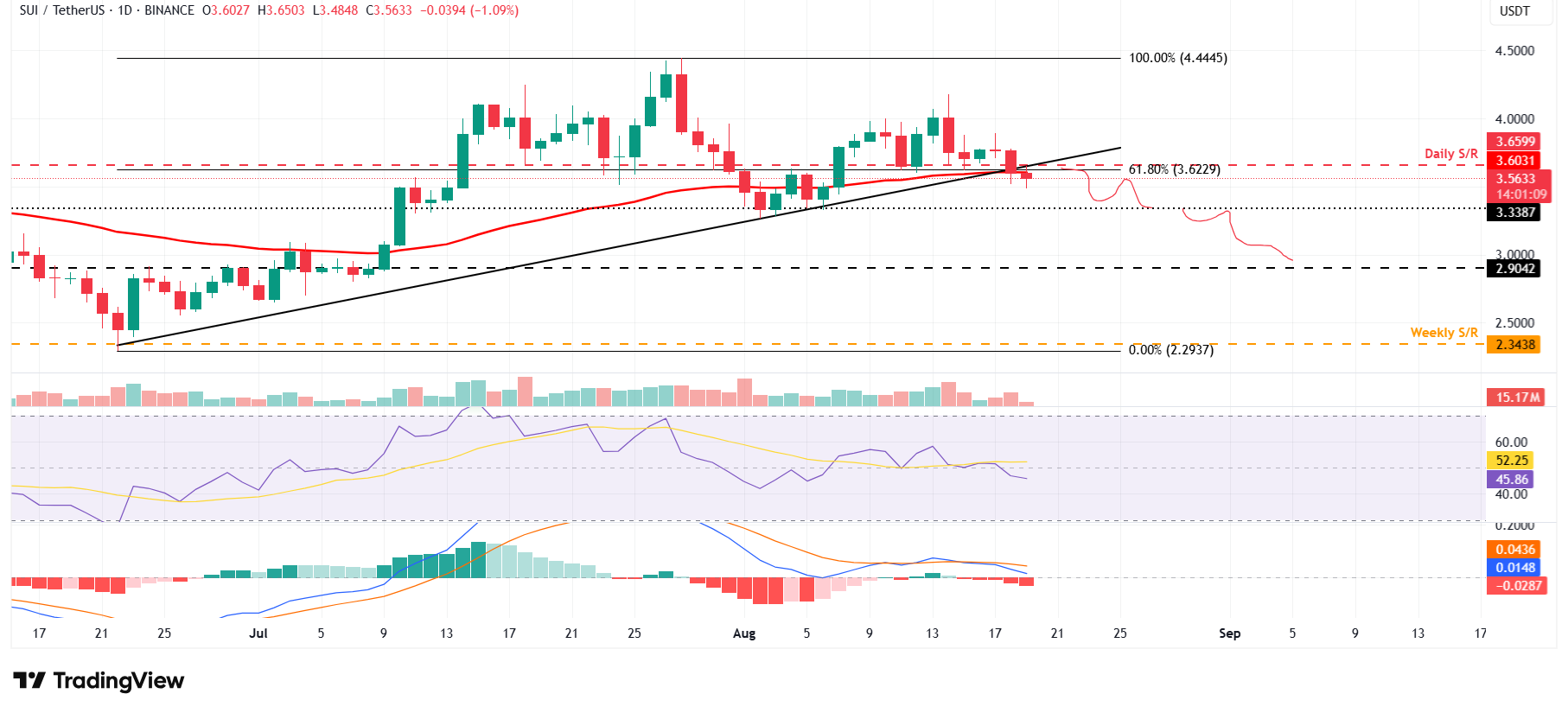
Sui (SUI) continues to trade in red, trading below $3.60 at the time of writing on Tuesday and slipping below a key support level, suggesting a bearish trend ahead. On-chain data shows that SUI’s Spot Taker Cumulative Volume Delta (CVD) is turning red, reflecting bearish dominance. The technical indicators are also pointing to increasing bearish momentum, hinting at a further pullback on the horizon.

Sui’s on-chain data leans bearish

CryptoQuant’s Taker CVD for SUI is negative, and its value has been steadily decreasing since mid-July. 

This metric measures the cumulative difference between market buy and sell volumes over three months. When the three-month CVD is positive and increasing, it suggests the Taker Buy Dominant Phase. A negative and decreasing value, as it is currently happening, indicates the Taker Sell Dominant Phase.

SUI Spot Taker CVD chart. Source: CryptoQuant

Sui Price Forecast: Momentum indicators show weakness

Sui price closed below an ascending trendline (drawn by connecting multiple lows since mid-June) on Monday. It also closed below its daily support at $3.65 and its 61.8% Fibonacci retracement (drawn from the June low of $2.29 to the July high at $4.44) at $3.62, marking a shift in market structure from bullish to bearish. At the time of writing on Tuesday, it continues to trade down below $3.56.

If SUI continues its correction, it could extend the decline toward its daily support at $3.33. A successful close below this level could extend the losses toward its next daily support at $2.90.

The Relative Strength Index (RSI) edges lower and reads 45 on the daily chart, below its neutral level of 50, indicating bearish momentum. The Moving Average Convergence Divergence (MACD) also showed a bearish crossover on Friday, giving a sell signal and suggesting a downward trend ahead.

SUI/USDT daily chart 

SUI/USDT daily chart 

However, if SUI recovers and closes above the daily resistance at $3.65, it could extend the rally toward the August 14 high of $4.18.


More related articles-  SUI has broken below a key support level, raising concerns among traders and investors about the possibility of deeper losses. Technical indicators highlight weakening momentum, with selling pressure outweighing buying interest. Market analysts warn that unless SUI manages to reclaim support and stabilize, the token could face continued downward movement in the coming sessions.

AI & Healthcare: Saving Lives with Intelligent Technologies

AI & Healthcare: Saving Lives with Intelligent Technologies

Introduction

The integration of Artificial Intelligence (AI) into healthcare has revolutionized the way medical professionals diagnose, treat, and monitor patients. With the ability to analyze vast amounts of data swiftly, AI technologies are saving lives and driving significant advancements in the medical field.

The Role of AI in Diagnosis

AI algorithms can process and analyze medical images far more quickly than human radiologists. For example, tools powered by deep learning techniques can detect anomalies in X-rays, MRIs, and CT scans, often with impressive accuracy. As a result, diseases such as cancer can be diagnosed at earlier stages, leading to better outcomes for patients.

Personalized Treatment Plans

Beyond diagnosis, AI helps in creating personalized treatment plans tailored to the individual patient. By analyzing a patient’s health history, genetic information, and even lifestyle factors, AI can predict response to various treatments and suggest the most effective options. This tailored approach is especially beneficial in fields like oncology and pharmacogenomics.

Improving Patient Monitoring

Wearable technology and smart devices equipped with AI algorithms allow for continuous patient monitoring. These devices can alert healthcare providers about significant changes in a patient’s condition, ensuring timely interventions. For chronic disease management, AI can track medication adherence, reminding patients to take their medications and alerting doctors if a patient’s vitals fall outside normal ranges.

Enhancing Administrative Efficiency

AI is not limited to direct patient care. Administrative tasks such as scheduling, billing, and managing patient records are time-consuming. AI tools can streamline these processes, reducing costs and freeing up healthcare professionals to focus more on patient care. By automating mundane administrative tasks, AI improves overall healthcare efficiency.

Ethical Considerations

While the benefits of AI in healthcare are significant, ethical considerations must not be overlooked. Issues regarding data privacy, algorithmic bias, and the potential loss of human touch in patient care are critical discussions in the adoption of AI technologies. It is essential for healthcare stakeholders to balance technological advancements with ethical practices.

Conclusion

Artificial Intelligence is reshaping the landscape of healthcare, making it more efficient, accurate, and personalized. As technology continues to evolve, so too will its applications in medicine, ultimately saving more lives and improving patient outcomes. The future of healthcare is undoubtedly intelligent, driven by the power of AI.

Get more information to know how using intelligent technologies to save lives

© 2025 AI & Healthcare Insights

Exciting Nintendo Direct Tomorrow: Spotlight on Kirby Air Riders


Surprise! A brand new Nintendo Direct focused on Kirby Air Riders will land tomorrow, Tuesday August 19 at 6am Pacific, 9am Eastern, or 2pm UK time.

Once again, Nintendo revealed the show first via its Nintendo Today smartphone app, and promised the broadcast would feature 45 minutes of information about the upcoming Switch 2 game.

Kirby Air Riders is notable for being the first new project in years from Masahiro Sakurai, the famed director of Nintendo’s smash hit Super Smash Bros. series. Tomorrow’s deep dive look at the game is also intriguingly timed, suggesting it may finally be playable at this week’s Gamescom event in Cologne.


To date, Nintendo has kept details of Kirby Air Riders close to its chest, though has said the pink puffball-staring racer should be expected to launch on Switch 2 later this year. It seems likely tomorrow’s Direct will provide a firmer release window.

Announced earlier this year alongside further details of the Switch 2 itself, Kirby Air Riders will be a sequel to the 2003 cult classic Kirby Air Ride for GameCube. Production on the game began in earnest back in 2023, following the end of Sakurai’s time overseeing Super Smash Bros. Ultimate’s lengthy schedule of downloadable content.

There’s no suggestion tomorrow’s show will include any other Switch 2 games beyond Kirby Air Riders (sorry, Metroid fans). Still, more information on what’s next from Sakurai and his talented development team should suffice.

Tom Phillips is IGN’s News Editor. You can reach Tom at tom_phillips@ign.com or find him on Bluesky @tomphillipseg.bsky.social

Exciting Nintendo Direct Tomorrow: Spotlight on Kirby Air Riders

Nintendo fans worldwide are buzzing with anticipation as the company prepares for tomorrow’s Nintendo Direct showcase. The presentation, which has become a hallmark of exciting gaming reveals and announcements, is expected to put a special spotlight on a long-awaited title — Kirby Air Riders.

A Classic Returns

First released in 2003 for the Nintendo GameCube, Kirby Air Ride quickly became a cult classic. Known for its fast-paced gameplay, accessible controls, and unique approach to multiplayer racing, the title carved a special place in the hearts of Nintendo fans. For years, players have been hoping to see the pink puffball’s racing adventures return in a modern form. Tomorrow’s Direct could finally make that dream a reality.

What to Expect

Rumors suggest that Kirby Air Riders will not only revive the beloved racing experience but also bring a fresh wave of innovation. Speculation points to enhanced graphics, expanded online multiplayer modes, and possibly even new game mechanics that take advantage of the Nintendo Switch’s capabilities. A remastered soundtrack and additional courses are also among the fan wishlist.

If confirmed, the game could stand alongside Mario Kart as a vibrant and competitive option for racing fans, while still retaining the charm and accessibility that makes Kirby games so universally loved.

A Big Moment for Nintendo

Beyond Kirby Air Riders, tomorrow’s Nintendo Direct is expected to deliver updates on other upcoming titles, surprise reveals, and possibly even news about Nintendo’s future hardware roadmap. However, the spotlight on Kirby’s racing comeback underscores Nintendo’s commitment to both nostalgia and innovation — celebrating beloved classics while reintroducing them to a new generation of players.

The Countdown Begins

With excitement building, fans are already marking their calendars and setting reminders. Whether it’s a full remake, a reimagined sequel, or a faithful remaster, Kirby Air Riders could be one of the biggest announcements of the year for Nintendo enthusiasts.

One thing is certain: tomorrow’s Nintendo Direct is set to be a must-watch event.

Watch this space for additional updates


2025 Pokémon World Championships: VGC Preview Roundtable Insights


Anaheim, California is once again the focus of the Pokémon universe as the top players battle with hopes of becoming the next World Champion from August 15–17. The Pokémon World Championships are certain to be exciting, with the biggest names in the game ready to claim the title for 2025.

To prepare you for the action, we’ve once again assembled our expert trio of Lou Akcoş-Cromie, Aaron Traylor, and Joe Ugarte—joined by Chris Shepperd of Pokemon.com—to provide us with insights about the top Pokémon and Trainers to watch for.

You can catch all three days of battling action on Twitch.tv/Pokemon. Visit the official Worlds broadcast page for more information.

Shepperd: All right, I think we can get started! I’m excited to get us all together again. Let’s get rolling!

Ugarte: Worlds always comes around so fast, Chris! I feel like every time it ends, I’m super bummed, feeling like it’s going to be away forever—and then before I know it, it’s back again. This season has been a really exciting one, and I think this Worlds will be great!

Shepperd: Same! Worlds just has a totally different vibe. I feel it even in our preview discussions. OK, first topic.

What are the strongest team cores that we’ll see at Worlds? What are the players preparing for?

Traylor: I think we’ve got to start with Shadow Rider Calyrex and Zamazenta, which has been dominating the format all season long.

Ugarte: Shadow Rider Calyrex and Zamazenta is definitely the most consistent core in this format, having a huge share of every tournament meta with a lot of interesting variations that provide unique options. It’s worth mentioning the rise of Smeargle, as it has quickly shot up as one of the duo’s most popular partners.


Akcoş-Cromie: Shadow Rider Calyrex and Zamazenta have been a great duo! It won at the Japan Nationals and has a great balance of special and physical offense.

We definitely have to talk about Smeargle—it’s working so well with a lot of cores and was in the Japan-winning team, piloted by Yuma Kinugawa.

Akcoş-Cromie: I believe it also won with an Ice Rider Calyrex and Lunala core at Taiwan Nationals. It helps so many cores with setup!

Traylor: Smeargle is BACK!

Shepperd: How is Smeargle being used on this team?

Ugarte: Smeargle is incredibly useful, giving Fake Out and Follow Me support so Shadow Rider Calyrex has free turns to get up Nasty Plot.

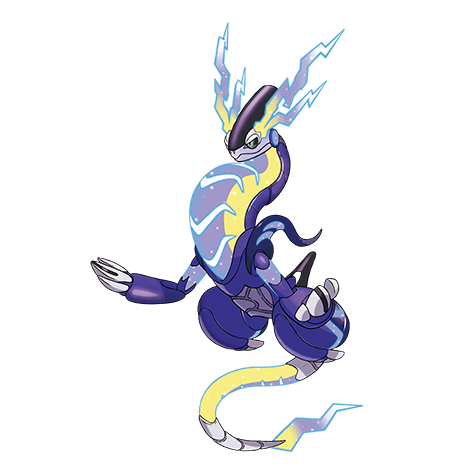
Spore is also an incredibly threatening move, potentially allowing Smeargle to put multiple Pokémon to sleep. It can pair well with Rillaboom, who can override Miraidon’s Electric Terrain so Spore can’t be stopped.

Akcoş-Cromie: Whether it’s enabling Trick Room, Tailwind, Nasty Plot, the fast Fake Out (having the edge over Pokémon like Incineroar in the Fake Out race), Smeargle makes a great asset to restricted Pokémon. It also can pressure Spore to put opposing Pokémon to sleep or give a partner Pokémon a boost with Decorate.

Traylor: Decorate is a new option for Smeargle, making it even harder for opponents to predict what it will do. Will they Fake Out and attack or Protect and Decorate themselves?

Akcoş-Cromie: Honestly, Decorate has been really well-utilized on Ice Rider Calyrex in Trick Room before, but now more Trainers are picking it up with more flexible options. The fact Decorate works even on a partner Pokémon using Protect is always wild to me.

Ugarte: Decorate is such a cool option alongside Shadow Rider Calyrex, because it creates really awkward situations where you can get punished for either double-targeting Smeargle and allowing Shadow Rider Calyrex to use Nasty Plot, or for attacking Shadow Rider Calyrex as it uses Protect and allowing a Decorate for free. It’s a really oppressive strategy at times, and it requires specific answers.

Traylor: Did you know Decorate goes through Protect but not Substitute? I guess the Substitute gets in the way of the icing.

Shepperd: If this core is both strong and really flexible, what can competitors do to prepare for it?

Traylor: Here’s the issue with Smeargle and Shadow Rider Calyrex. If both players in a match are using the duo, it gets REALLY challenging to pull ahead in the game. Because Smeargle nearly always uses Fake Out, and Shadow Rider Calyrex could use Normal–, Ghost–, Dark–, or Fairy–Tera Type, it comes down to some really crazy mind games and Speed ties. It’s a level of horrible ambiguity we haven’t seen since you could pair Smeargle with Xerneas.

I was testing it pretty heavily, but once I realized there wasn’t a way to easily always win in those situations, I realized I would rather just try to be strong against the duo instead of having it for myself.

Ugarte: I definitely think Smeargle can add a huge level of volatility to the mirrors, but I do think for people willing to take the chance, it can be very rewarding. Especially with some Moody Speed boosts!

Traylor: But I want to be World Champion 100 percent of the time! I don’t want to wait around for a Moody boost.

Akcoş-Cromie: Calyrex mirrors are tricky. You can apply a lot of pressure straight away by going for the Dark–Tera Type or Fairy–Tera Type to help combat the Ghost-type weakness. But then you leave yourself vulnerable to damage from Zamazenta or Fairy-type moves (plenty of those out there at the moment). So forcing your opponent to try and burn up that Tera instead and find a counter to Calyrex is recommended. It’s just hard to outspeed it.

Ugarte: To answer your question as well, Chris, fast Taunt with Flutter Mane or Covert Cloak Tornadus with Taunt can work well into Smeargle. You can also just lead two faster Pokémon and remove it from the field the old-fashioned way!

Akcoş-Cromie: Flutter Mane is a great counter to this core, in my opinion.

Traylor: There are two main directions for Shadow Rider Calyrex—supporting Shadow Rider Calyrex  with Pokémon like Smeargle, Incineroar, Rillaboom, and Clefairy as it blows through the opposing team, or having a more well-rounded balance team that uses its damage to open up or close out, which will rely on Pokémon like Chien-Pao, Raging Bolt, Rillaboom, and Ogerpon.

Akcoş-Cromie: Taunt can shut down Smeargle, and you can avoid damage from Body Press if you can catch it on a switch-in. You pressure Calyrex with Shadow Ball or—if they use Dark–Tera Type—Moonblast. It’s hard to contend with its Speed too, especially if it has Booster Energy active.

Ugarte: I think it’s also worth talking about one of the other biggest threats in the format—Ice Rider Calyrex and Miraidon. It’s been the other public enemy in the format!

Traylor: Ice Rider Calyrex and Miraidon are really interesting, because offensively they complement each other really well. The trick is that because their Speed stats are so different, the hard part is actually weaving them together well in a game.

Ugarte: I think the idea of Ice-type and Electric-type pins is incredibly threatening if positioned well. Its struggles come against particular Pokémon with good matchups if they are positioned better. I think another nuanced part of facing the team is whether the Ice Rider Calyrex is running Leftovers with Leech Seed or Clear Amulet with High Horsepower.

Traylor: Ice Rider Calyrex really wants Trick Room (and most players have given up on making it work in Tailwind), but Miraidon can’t really get anything going in Trick Room, which results in a little tension when making game plans. So much so that most Miraidon and Ice Rider Calyrex teams give Miraidon a Choice Scarf so it can outspeed threats like Shadow Rider Calyrex without relying on a Tailwind Pokémon.

Akcoş-Cromie: I think Ice Rider Calyrex has had the biggest character arc this season. A lot of Trainers ran it as hard Trick Room, then a hybrid style started emerging so it wasn’t so dependent on the slower modes. Then Michael Kelsch unleashed the Leftovers / Leech Seed version, which a lot of Trainers picked up and ran with across Regionals and NAIC. Now players are given so many variants to work with ahead of Worlds.

Ugarte: Choice Scarf Miraidon has been such an interesting meta development but makes a lot of sense for the reason Aaron mentioned. Along with the fact that, since you have two restricted Pokémon, the power drawback you get is less bad than if you had used it in a single restricted format.

Traylor: These teams also enable Volcarona, which has been silently dominating the format. Volcarona is one of the best checks to Zamazenta, one of the most challenging Pokémon to defeat in this regulation, and it has the bonus of being able to bother both forms of Calyrex, especially after a Quiver Dance.

Having two restricted Pokémon to fit onto a team makes the team-building problem much harder than just one, in my opinion.

Akcoş-Cromie: Miraidon’s Choice Scarf is also such an interesting point. At one point the only Miraidon we saw was Fairy–Tera Type / Choice Specs, and it just constantly did the “Tera to avoid opposing Draco Meteor and now do big damage.” But then an Electric–Tera Type / Assault Vest variant emerged, and now Choice Scarf is here! Each is used for very specific reasons and board positions—I think that says a lot about the types of situations Trainers keep finding themselves in that they need such significant items or Tera Type choices to stand up to these matchups.

Ugarte: I think there are a lot of combinations, but definitely a defined top three. The final one we hadn’t mentioned yet was Lunala and Miraidon, which ended up winning in NAIC.

Traylor: Federico Camporesi used Lunala and Miraidon to win the North America International Championship. Luca Ceribelli, sitting World Champion, also got Top 16 there.

They paired the duo with Whimsicott, Rapid Strike Style Urshifu, Incineroar, and Ursaluna. It’s proven to be one of the most robust teams in this regulation. I’ve spent a lot of time looking at the different partner Pokémon for this team, and I basically realized that you can’t do better than these supporting Pokémon for this restricted duo, due to the combination of defensive types and offense that they provide.

It’s a really powerful and flexible team, and is still strong despite winning NAIC, so expect to see it at Worlds.

Shepperd: Let’s move on to the next question! Give us some ideas of dark horse combinations and counter-meta cores we might see.

Akcoş-Cromie: Marco Silva told me at NAIC that Terapagos had lost its “aura,” but I’m still rooting for it as an underdog choice! I think with the right support, it can still succeed. Possibly even with Smeargle Decorating around the place, it can enable Terapagos to get a boost and do damage in the same turn, rather than lose time setting it all up itself manually.

Traylor: I do feel like Terapagos is the least explored of the best restricted Pokémon. We’ve seen some cool teams with it, like Francesco Pio Pero’s Miraidon and Sinistcha team, where Terapagos held Electric Seed.

Akcoş-Cromie: Yeah, that team finished Top 8 at NAIC. Seeing Iron Treads and Sinistcha do so well will certainly inspire some more Trainers to pick it up. Being able to have recovery support through Hospitality, or terrain removal through Steel Roller, enables some good disruption options. And Iron Treads also hits hard on the offensive side!

Ugarte: Definitely agree! It’s also been the subject of small, smart adaptations like Life Orb / Electric–Tera Type Miraidon, giving the Miraidon more flexibility!

Traylor: But at the same time, Terapagos is very hard to get going, and players have to make up for its good-but-not-great Special Attack power. Many use Calm Mind and focus on setting it up—a cool set out there is Terapagos with Meteor Beam / Power Herb on more offensive teams.

Ugarte: In terms of other dark horse cores, I think a big one is Miraidon and Shadow Rider Calyrex. At the start of the format, it really had no exploration, and nowadays it feels like a lot more people are trying to crack the core.

Akcoş-Cromie: I always liked the idea of this pairing plus Chi-Yu. Just think of the Special Attack damage potential!

Traylor: Miraidon and Shadow Rider Calyrex is for real for sure, just so much offense. There are also Miraidon and Shadow Rider Calyrex teams that focus on setting up Shadow Rider Calyrex with Clefairy / Incineroar / Rillaboom.

Akcoş-Cromie: It’s definitely not the most flexible or consistent Pokémon out there, but there are enough Terapagos believers out there that I expect to see it still do well.

Ugarte: One thing Shadow Rider Calyrex setup teams struggle with is Spore. Miraidon helps alleviate that, along with giving it a strong tool to use in the mirror with Electric–Tera Type Drift and Snarl.

Akcoş-Cromie: Notably, I feel Koraidon has got a little lost in the meta at the moment. It’s not in the same spotlight it was at the end of EUIC, for example.

Traylor: We have so much to discuss, we could have our own articles about Koraidon, Kyogre, and Groudon, but I would also expect to see a few of these teams perform quite well at Worlds.

Ugarte: I think Koraidon still has a lot of potential, but it definitely requires more exploration. One of the most interesting appearances lately was seeing it get second place in a huge Japanese grassroots tournament, paired with Ice Rider Calyrex! It hasn’t been something we have seen the most frequently, though.

Traylor: Yep, that was World Champion Shoma Honami! His teams always rule. I hope we get to see some great stuff from him at Worlds this year.

Although not counted out by any means, I feel like these Pokémon are the real “dark horses” going by virtue of being up against the solidified metagame threats.

Akcoş-Cromie: I think that’s why we often see Amoonguss or Smeargle on teams with Rillaboom to help counter Miraidon’s terrain and allow Spore to be unleashed again.

Ugarte: Not to mention it also has worked in the past with Lunala and Ursaluna, which are a very strong pair of Pokémon!

Shepperd: Next I’d like to talk about NAIC and its ongoing impact. I imagine the last big event is still on a lot of competitors’ minds. What did we learn at NAIC that will affect players’ approach to Worlds?

Ugarte: NAIC was a big catalyst towards the rest of the format becoming a bit more “solved.”

I wouldn’t say every option has been exhausted yet. But I definitely think it established some of the strongest teams. Federico winning had a huge impact on Lunala and Miraidon becoming one of the format mainstays.

Traylor: I think the big takeaway from NAIC from competitors is that having lots of experience using your team is the most important factor. The finalists both played known “comfort teams,” so given that players had eight weeks to prepare, I think a lot of players are trying to emulate that and just know their team really well.

In my experience, optimizing for comfort and muscle memory is a real double-edged sword, so I’m excited to see whether people can make it work on the world stage. 

Ugarte: I definitely think there is a very important influence of comfort in this format. Since there are quite a few options, it helps people settle on what they like most

Akcoş-Cromie: NAIC is always the last official event before the World Championships. So it gives us a good insight to what the good stuff is, but it’s also so long ago that by the time these Trainers reach the Worlds stage, they’ve had plenty of time to potentially find something new. And they will likely keep them close to their chests for now. That said, consistency was the main lesson I learnt from NAIC. Linking to Aaron’s point there, Federico won with a core he has trusted and utilized for a long time. Consistency and knowledge with a team was the greatest strength.

Shepperd: Has there been significantly less meta movement between NAIC and Worlds than in past years, then?

Ugarte: I would argue that there has been some of the most movement in this part of the cycle, actually.

I think it established the top teams more, but it’s forcing more meta developments and exploration with less popular cores of Pokémon.

Traylor: Hmmm. I agree that players are exploring. That’s what I spent the past few weeks doing.

Akcoş-Cromie: Teams seem a lot less telegraphed at the moment, really relying on instinctive predictions and flexible positions. I wouldn’t be surprised to see Trainers using what they know best. That said, creativity is often in the mind of our top Trainers, so I expect some wild testing to be going on.

Ugarte: I think there is so much potential for Worlds to feature a lot of unique teams and cores.

Traylor: I agree that there’s potential, but the pressure of having to lock a team weighs pretty heavily on every competitor’s head. Are you really going to lock some niche Pokémon in your battle box when there are very strong and consistent compositions out there? A lot of competitors aren’t ready to commit to that decision even after they spend all summer preparing.

Ugarte: That’s always the question, isn’t it. Worlds always has such varied approaches, and I think it’s all about what risks you are willing to take—and whether you find that unique idea soon enough to practice it well and believe in it.

Were there Pokémon that didn’t perform well at NAIC that could have a renaissance at Worlds? Or are they shut out for good?

Traylor: I think Clefairy is up there for real. Koraidon, Kyogre, Groudon are all looking to get a foot (or a flipper, for Kyogre) in the door.

Ugarte: Clefairy is an incredible Pokémon on quite a few teams, for sure.

Akcoş-Cromie: We have occasionally seen some less-utilized Pokémon doing well. But again, it’s what Trainers like to use. Nikolaj Nielsen is always still believing in Sneasler, for example.

Traylor: Yep, he and his brother are always getting up to some Sneasler trickery.

Akcoş-Cromie: Kyogre did win a Regional with Gavin Michaels. But I agree it’s lonely right now.

Ugarte: I think Wide Guard Zamazenta being everywhere provides some difficulty for Kyogre.

Traylor: Many players are opting to use Hydro Pump, though. As someone who got their Zamazenta Hydro Pumped, like, 500 times at NAIC, it’s awful to deal with.

Akcoş-Cromie: I think Chi-Yu is still an untapped asset on teams. It’s not always performing well, but has such potential to support and pressure.

Ugarte: Chi-Yu is definitely strong. I think it just finds itself only on very offensive cores. It loves being next to Koraidon.

Shepperd: We’ve discussed the Ruinous Pokémon quite a bit in past roundtables. Is Chi-Yu the one that’s starting to pull ahead?

Traylor: Chi-Yu will “ruin” me and my blood pressure every time it clicks one of its 90-95% accurate moves. Ting-Lu is also out there! It complements Zamazenta really well, and has found its way onto some Shadow Rider Calyrex and Zamazenta teams.

Ugarte: I think you have to mention Chien-Pao for sure. It’s great next to Zamazenta.

Traylor: Chien-Pao is always a mainstay. For the first time in a while, we’re seeing some cool items on it, like Assault Vest.

Akcoş-Cromie: Chien-Pao has the top spot right now, I believe. Pressure / Sucker Punch is so good into Shadow Rider Calyrex, and it can also do great damage into Grass-types (which is often utilized in Tera Types too) with Icicle Crash. Chi-Yu is more the “not-doing-so-well-but-still-has-potential” option.

Traylor: Ruination combos really well with every restricted as well, especially against Pokémon that resist its attacks.

Ugarte: Not to mention the other move possibilities, which can heavily change matchups with Taunt and Ruination.

Akcoş-Cromie: Yes! Taunt has been on the rise for those person marbles pesky Smeargle (argh autocorrect!).

Ugarte: Yeah exactly. Getting a(n almost) guaranteed 50% of damage, plus a powered-up Body Press, is crazy.

Shepperd: All right, let’s finally put the focus on the players! I’d like to talk about the top Trainers from each region. Let’s start with Europe.

Akcoş-Cromie: So about Italy…

Shepperd: NAIC was a pretty good showing for them, huh?

Traylor: Chris, we don’t talk about that here in North America!

Akcoş-Cromie: Honestly, we say it a lot, but Marco Silva is one to absolutely watch. He nearly took the title at NAIC and he’s just so formidable. The Shadow Rider Calyrex and Zamazenta core really worked for him.

Ugarte: Having talked to him, I think Marco is also particularly motivated for this Worlds. He’s always a threat, but I think he’s really had an insane season this year in particular.

Traylor: European players Luca Ceribelli, Federico Camporesi, Marco Silva, and Michael Kelsch have all had incredible seasons, are incredibly strong, and are, incredibly, driving the bar higher every time they compete.

Akcoş-Cromie: Federico Camporesi is also on a mission—he wants to be the first person to win one of every title in a single season, and Worlds is the last on his list! Winning at locals, Gdańsk Regionals, and NAIC this season is incredible! Can he get the final title, though?

Ugarte: Italy is really bringing the money home to Europe, that’s for sure! So many strong players.

Ugarte: Wasn’t Italy half of the of NAIC Top 8, now that I think about it?

Shepperd: What are the Italian players doing differently?

Ugarte: I just think they are very prepared for every tournament and work very hard in between tournaments. Not to mention, having so many strong players as friends likely helps in general.

Traylor: There is a very strong local community in Italy, and many top Italian players work very closely together.

And if your best friend is an International Champion or a World Champion, it definitely makes your practice better as well. They’re always on that grind.

Akcoş-Cromie: Germany also has a good presence at Worlds. Michael Kelsch is a champ and has done incredibly well (second then Top 4) at the past two Worlds. Also, top Trainers like Markus Hamann will be there alongside Louis Markl, who is a Trainer on the EU Regional scene that has been standing out a lot lately.

I always admire Italy’s team ethos. You often see them running similar teams, or at least having boot camped in prep together. At NAIC, there was some great team spirit shown between the finalists and roommates, despite being against each other. They really do train and prep together and push each other to be the best. Other testing groups do this too, of course, but there’s something about Team Italy that’s special.

Traylor: Ruben Gianzini, Antonio Sánchez, and Oliver Eskolin all placed in the Top 16 last year at Worlds, as well. Victor Medina lost his win-and-in at Worlds last year, but had an incredible season, finishing 2nd at LAIC and top 16 at NAIC, so definitely watch out for him as well.

Shepperd: Let’s move south to the Latin America region. They never fail to surprise at Worlds.

Traylor: Gabriel Agati crushed it at NAIC with a very, very cool team featuring Scream Tail, Koraidon, and Leech Seed Shadow Rider Calyrex.

Ugarte: I think Agati showed that he was in strong form at NAIC for sure, and as Aaron mentioned, featured unique choices.

Akcoş-Cromie: I will forever and always be an Agati believer. He always has something interesting to discuss on his team too. Even back at EUIC finals a few years ago, he had Baxcalibur, which nobody was anticipating.

Ugarte: It’s worth noting we haven’t seen Scream Tail since then as well, so it only really worked on his build with Shadow Rider Calyrex and Koraidon, which also aren’t that common.

Traylor: 2018 World Champion Paul Ruiz will also be in attendance!

Ugarte: It’s worth always mentioning Juan Salerno, being a consistent top performer in South America and internationally.

Akcoş-Cromie: Juan was also running something interesting at NAIC with Cornerstone Mask Ogerpon and the unique core of Lunala and Koraidon. Maybe it was too unique for the competition, but he will surely adapt going into Worlds.

Shepperd: OK, let’s head to Japan and its neighbors! Joe, you just got a chance to see it firsthand…

Ugarte: Yeah, as someone who was lucky enough to get to go and compete with the Japanese players very recently, I was actually quite surprised by what I found.

Akcoş-Cromie: Tell us all!

Ugarte: A lot of the strongest teams in Best-of-Three that we have seen, like Zamazenta and Shadow Rider Calyrex, Miraidon and Lunala, Miraidon and Ice Rider Calyrex, were very popular. Actually, in all the games I played, I don’t think I played against a single deviation from those pairings. There are definitely exceptions, like Shoma’s Ice Rider Calyrex and Koraidon team, but I noticed a lot of the top players sticking with what’s consistent.

With all that said, the first name I have to mention is Shohei Kimura, showcasing a crazy level of dominance in every tournament he plays. I genuinely think his lowest placement this season has still been Day 2.

Akcoş-Cromie: Kazuki Kobayashi will be on my radar for sure. Their play was truly inspiring at NAIC, and I loved how different their team was. Farigiraf is not utilized as successfully anymore in the double restricted format, but Kazuki was able to get Top 5 with it and the Speed hybrid team core of Ice Rider Calyrex and Miraidon. There was a great balance of bulk and brawn on the team and in the match too!

Ugarte: You also have to mention the Japan National Champion, Yuma Kinugawa. A great player, great consistency and a very strong friend group for developing great teams and practicing.

Traylor: We’ve mentioned Shoma Honami and Yuma Kinugawa already, but they’re teammates with Kiwamu Endo, who got second at Japan Nationals last year and Top 16 at Worlds in 2018. This trio is one of the strongest in VGC. I expect them to dominate.

Ugarte: Easily, those three and Shohei are the biggest standouts I can think of for this season, at least.

Akcoş-Cromie: I expect one of them to win!

Shepperd: Japanese players are known for finding the one Pokémon nobody else was thinking about. Is that on the menu again?

Ugarte: One specific tech I noticed was Life Orb / Electric–Tera Type Miraidon, which has not seen much play elsewhere, at least pre-NAIC. I noticed a lot of the Japanese players experimenting with that item and Tera Type combination to make Miraidon play a bit differently, especially on the Lunala and Miraidon composition that has been popular since it won at NAIC.

Traylor: Other players we love mentioning who have invites from Japan:

From some players, such as Shoma, it could be on the menu. Some other players, such as Shohei, are very strong at identifying the strongest archetypes and executing at a very high level.

Akcoş-Cromie: It always is, I believe. Their tournament structure allows for a different team-building style and often that makes them unpredictable at Worlds. With open lists, though, I think it has created a shift for Japanese players at Worlds to go with more tested cores. It’s more about the little techs and tweaks that they will have identified that give them advantages. I think that’s a great insight from Joe about the Life Orb play.

Ugarte: I think the fact they compete in single-game matches all year until Worlds and still do amazing every Worlds is a testament to their skill. Also, quick shoutout to Yuta Ishigaki! Finalist at Worlds is no joke!

Traylor: Joe, you got to play against him right in Japan?

Ugarte: We did end up playing, and honestly I kind of didn’t realize it was him until after our match. (laughs) After I lost, I was like wow, this player is pretty good! Then I realized who it was.

Shepperd: Let’s jump over to Oceania real quick!

Traylor: Oceania has Diego Ferreira, who placed Top 8 at Worlds last year with a hard Trick Room team. He flies the Chilean flag but plays in Oceania, I believe. Diego makes some incredible plays, I really look forward to watching his games.

Joji Kaeda is an incredibly strong player from Japan doing work study in Australia—he won THREE Grand and Global Challenges. I don’t think anyone in the game has ever done something crazy like this.

Ugarte: Joji is an incredible player with incredible consistency—especially in Global and Grand Challenges this season, like Aaron mentioned—and still doing well in every tournament.

Akcoş-Cromie: Nicholas Kan has also been gaining more experience in the Masters Division over the past few years and is always once to watch. Always calm and collected, but has such an instinctive way about his gameplay.

Shepperd: OK, let’s cap it with North America.

Traylor: Here’s the thing about North America—I can’t mention anyone from Top 8 at NAIC 2025, and I can’t mention anyone from Top 16 at Worlds 2024. Justin Knox, the only NA player in Top 16 Worlds 2024, didn’t get his invite this year. So maybe North America is the real dark horse region?!

Ugarte: I think it’s worth mentioning Carson Confer for sure. Consistent performances throughout the year, utilizing strong teams with strong groups of players and doing well.

You also have to talk about Wolfe Glick. Even with a disappointing NAIC, his win rate is crazy and he always works hard for Worlds. Not to mention, Wolfe won Toronto, a Global Challenge, and EUIC all in a short span of time. Different formats but still shows incredible consistency and strength.

Akcoş-Cromie: Wolfe should really be the first Trainer you put on your bingo card. I fully believe in his mental approach to tournaments that he’s adapted the past two years, and I think it gives him an edge as a Champion.

Ugarte: I’ve noticed it feeling very different from previous seasons.

Akcoş-Cromie: There are so many North America players to talk about, but I want to discuss some players I’ve been keeping track of for a while—Aaron Brok and Giovanni Cischke. Both Trainers have been featured favorites in the broadcast and reached top cut placements at multiple Regionals. Aaron Brok often runs something unique like a Drednaw or Ting-Lu to keep opponents on their toes.

Giovanni is a Trainer I am fascinated to watch, because he is so analytical and knowable in his play style. I faced him at San Diego last season, and at every turn he was calculating every possibility and always selecting the correct option. I think if both these Trainers can keep their cool and focus, we can expect a good showing from them!

Ugarte: I think we are definitely in a period where North America as a region is really changing, and I think the names will change around quite a bit.

Traylor: We’ve also got Paul Chua, who has placed Top 4 before, and Kyle Livinghouse, who is one of the players out there who has metagame calls that consistently impress me. I’ll do a post-event wrap-up for, like, literally any tournament and then look at Kyle’s team and be like, “He knew the whole time.”

Ugarte: Kyle always does bring smart teams to tournaments that are positioned well for sure. I also think Justin Tang still is great! I think once he finds something he is comfortable with, he can always perform well.

Akcoş-Cromie: Behzad Muntazir is also a Trainer doing well this season. It’s worth keeping an eye on them because of their consistency.

Traylor: Absolutely agreed, Behzad has an excellent mindset. And Joe Ugarte. We gotta mention him. He trained in Japan!

Ugarte: The Japan training arc went hard, that’s for sure! It was a great time and great for experience in this meta.

Shepperd: All right, I think we better wrap it up! Thanks everyone for another super interesting roundtable.

Ugarte: Last thing I have to say, more so what I’m excited for is going to be the overall energy at Worlds. What’s so intense about it is seeing people play their win and ins, chasing their dreams, and seeing so many storylines come to wrap up for this season.

I remember the excitement, nervousness, and energy surrounding win and ins. They truly are intense, not to mention top cut as well! You see so many friends and family root for each other and it’s really special.

Traylor: Yes! This Worlds is going to be one for the ages!

Akcoş-Cromie: I can’t wait to see all the magic of it!

Shepperd: Good luck to everyone playing, casting, and cheering in Anaheim. We’ll chat after the event.

You can catch all three days of battling action on Twitch.tv/Pokemon on August 15 –17, 2025, including the Finals on Sunday.

Lou Akcoş-Cromie has been an official Play! Pokémon commentator since 2017 and has been honored to cast multiple International and World Championships in her career so far. As the #1 East Sea Gastrodon fan, she is always excited to see her favorite Pokémon do well, but is also intrigued by off-meta picks that catch her by surprise! Outside of Pokémon, you can most likely find Lou surrounded by cats or teaching English and Debate in the school classroom.

Aaron Traylor has been competing in the VGC since 2011. He placed in the Top 8 and the Top 16 at the World Championships in 2016 and 2019, respectively. He believes that the friendship between Trainers and their Pokémon is ultimately what leads to success in battle. Outside of Pokémon, he is a graduate student studying computer science and cognitive science.

Joseph Ugarte is a full time VGC competitor and content creator. Competing since 2017, he has had three Top 4 placements in Internationals, two Worlds Top Cuts, and two Regionals wins, along with lots of other strong Regional finishes. He loves being involved in the community efforts to grow and expand the game further!


For more updates visit on, Pokémon World Championships 


Upcoming Date Added to the Calendar


Updated Aug. 16 with further details for the full schedule of what’s coming when plus more analysis.

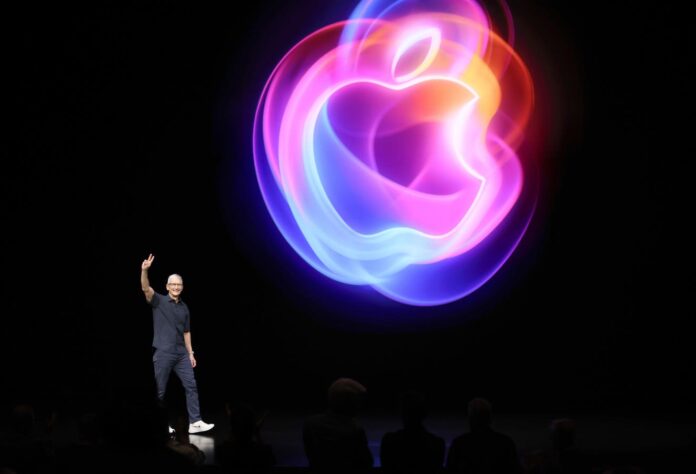
In less than four weeks, all will be revealed about the iPhone 17 series. That’s because on Tuesday, Sept. 9, Apple will hold its keynote unveiling the new hardware, I believe. Now, a new date has been added to the mix. You can read the full schedule here but it’s also laid out in detail below. Meanwhile, an invite to the keynote has appeared — but it’s almost certainly fake. More on that below.

It’s also worth remembering that the iPhone won’t be the only product announced at the keynote. Apple is almost certain to introduce two new Apple Watches (Series 11 and Apple Watch Ultra 3), and maybe even a new version of AirPods Pro. All will be announced at the same time and will almost certainly have the same release date.

ForbesApple iPhone 16, iPhone 16 Pro Prices Cut In New Offers Before iPhone 17 Release

Apple iPhone 17 Release Date: The New Entry In The Schedule

Mark Gurman’s Bloomberg Power On newsletter is always full of interesting nuggets. In the latest issue, he mentioned something that has so far been absent from release date schedules. Among all the talk of the keynote date, the onsale date and even the date for when the keynote date will be unveiled (all of which are below, with timings down to the minute), there has been scant talk of the release for iOS 26.

More than in recent years, the new software has captured the public’s imagination this year. Although iOS 26 will be pre-installed on the iPhone 17 series, it will also work on iPhones all the way back to the iPhone 11. So, when will it go on general release?

Gurman commented that the new software is “pretty smooth”, and has since said on X that the latest, sixth developer beta is “ridiculously snappy”. So much so that “it’s clear that we’re pretty close to the release of the final, public versions,” he said.

I believe it’s possible to pin the release down further than “the first half of September,” as Gurman comments.

Last year, iOS 18 went on general release on Monday, Sept. 16, exactly a week after the keynote and four days before the Friday, Sept. 20 onsale date of the iPhone 16 series.

I believe this year’s general release for iOS 26 will follow a near-identical schedule, and will be available from around 10 a.m. Pacific on either Monday, Sept. 15 or just possibly Tuesday, Sept. 16.

I favor the Monday because excitement in the new software is so high Apple will want it out as soon as it can, plus, it seems in good shape already.

That’s the day to mark in your diary, unless Apple contradicts the iOS 26 release date, which it will likely announce on the day of the keynote. I’ll update this post as soon as the details are confirmed.

ForbesApple iPhone 17 Pro And iPhone 17 Pro Max Are 4 Weeks Away: Everything We Know So Far

iPhone 17 Release Date: The Full Schedule

As for the rest of the schedule, here are the most important dates. I’ll also update this post as soon as any are confirmed officially.

First up is the announcement of the keynote. This is likely to be around 8 a.m Pacific, on Tuesday, Aug. 26. This is when invites are sent out by email to selected members of the press and special guests. The exact time is subject to an hour or so’s leeway, and it’s even possible that the invites will go out a day before. Check back here for details as soon as it’s gone live.

There’s already been one “leak” of the invite — you can see it here. Nothing is impossible but to my mind there’s not a shred of doubt: it’s a fake. The time and date are accurate, and the place, but the rest of it is wholly unconvincing. Apple is a stickler for detail, but I’m not sure I believe it needs 87 drafts of an invite.

The next big piece of the puzzle will be the keynote itself. The time will be 10 a.m. Pacific, as this is always Apple’s chosen time for Cupertino unveilings. I believe it will be on Tuesday, Sept. 9 and the possibility of a date change now seems vanishingly small.

Here’s the rest of the schedule. Pre-orders opening is the next event and, if previous timetables apply, will be at 8 a.m. Pacific, Friday Sept. 12.

After that, the first reviews will appear. There’s a bit of latitude here but I believe it will either be Tuesday, Sept. 16 or Wednesday, Sept. 17. As for the timing, that’s likely to be 6 a.m. Pacific, 9 a.m. Eastern, 2 p.m U.K, though it could be later.

Note that whichever date is not when iPhone reviews appear, that day will almost definitely be used for Apple Watch reviews. If there is a third marquee product, such as new AirPods Pro, the review date will be Thursday, Sept. 18, at the same time. Apple recognizes that sticking to the same time each day makes sense.

Finally, the big day itself is the onsale date: it looks to be Friday, Sept. 19 at 7.a.m. wherever you are (so first photos of people leaving Apple Stores clutching iPhones will come from Australia and New Zealand, with Europe later and U.S. after that.

More analysis is reaching us on a near-daily basis. Happily, everything still points to the dates in the schedule above. Few commentaries mention the times, but I’m sure that the timings are correct unless Apple changes from its tried-and-true process (If it ain’t broke…).

Ryan Christoffel at 9to5Mac has useful analysis that specifies what happened when in recent years to help specify the release date. “Regardless of the exact day of the week the iPhone 17 announcement falls on, pre-orders should begin that Friday, with the official release date the following Friday,” he reports.

Forbes Apple iPhone 17 Series: What The New Designs Will Look Like

More updates 


Women in Crypto: Breaking Barriers in a Male-Dominated Space


Women in Crypto: Breaking Barriers in a Male-Dominated Space


The Rise of Women in the Crypto Space


Cryptocurrency has been at the forefront of financial innovation, yet it remains a predominantly male arena. As we delve into this evolving industry, it’s imperative to highlight the remarkable women who are breaking through barriers, challenging stereotypes, and making significant contributions.


Women’s Impact on the Crypto Landscape


Women are not merely participating in crypto; they are leaders, innovators, and influencers. Many have created startups, contributed to blockchain projects, and become prominent voices in advocacy and education.


Statistics indicate that women’s representation in crypto is steadily increasing. Reports show that the percentage of women investing in cryptocurrencies has risen in recent years, showcasing a growing interest and understanding of digital assets.


Challenges Faced by Women in Crypto


Despite notable strides, women still confront significant challenges in this sector. This includes gender bias, lack of representation in leadership roles, and a prevalence of toxic environments that can discourage female involvement.


Many women in the industry have shared their experiences of feeling marginalized or underestimated. However, these challenges have only fueled their determination to succeed and pave the way for future generations.


Women’s Initiatives and Support Networks


To combat the gender disparity in this space, numerous initiatives and organizations have been established. Groups like Women Who Code and Girls in Tech are actively empowering women to enter tech fields, including blockchain and crypto.


Moreover, networking events, workshops, and conferences focusing on female empowerment in crypto are gaining traction, creating platforms for women to share knowledge, build connections, and inspire each other.


Inspirational Women in Crypto


Prominent figures such as Meltem Demirors, Elizabeth Stark, and Cathy Wood serve as inspirational examples. They’ve not only led their own companies but also advocated for inclusivity and education in the blockchain space, encouraging more women to join the movement.


The Path Forward


As the crypto landscape continues to evolve, so too will the role of women within it. Ensuring equal representation is not just a matter of fairness; it is crucial for innovation and growth. Women bring diverse perspectives that are essential for the industry’s evolution.


Encouraging young women to explore careers in technology and finance can cultivate a more balanced and inclusive future. With continued support and empowerment, the next generation can lead the charge in shaping the decentralized economy.


Stay tuned for more updates-  The world of cryptocurrency and blockchain has long been seen as a male-dominated industry, but women across the globe are steadily breaking barriers, challenging stereotypes, and shaping the future of digital finance. From leading startups to pioneering innovation and driving inclusivity, women in crypto are proving that gender is no barrier to success in this fast-evolving space.

© 2025 Women in Crypto. All Rights Reserved.


One Man Knew: The Skyscraper’s Silent Risk


On October 12, 1977, banking giant Citicorp opened the tallest new skyscraper in New York City since the early 1930s. From afar, the 915-foot tower’s distinctive sloped roof cut through the Midtown skyline like a scalpel. Close up, at ground level, its 59 floors appeared to levitate above a sunken public plaza, a generous architectural gesture to passersby.

Citicorp Center’s design was not universally loved. But the scale and ambition of its engineering were undeniable. In a review, the Times’ architecture critic Paul Goldberger concluded that the bank’s new office, despite lacking in originality, would “probably give more pleasure to more New Yorkers than any other high‐rise building of the decade.”

This prediction almost proved disastrously far from the truth. In fact, were it not for two college students who helped uncover a grave flaw in the building’s engineering, Citicorp Center might have killed thousands of New Yorkers.

Citicorp Center still stands today, though it has since been renamed 601 Lexington. But in some ways, it is not the same structure it was in 1977.

Unbeknownst to its owners, occupants and even architects, the brand-new $128-million skyscraper was far more vulnerable to wind than previously believed. If a storm knocked out the power to its stabilizing device, a strong enough gust could make it collapse — and, on average, winds powerful enough to topple the building would occur in New York every 16 years. When the tower’s engineer realized this in July 1978, hurricane season was already underway.

Within months, welders had carried out corrective work under the cover of darkness. A newspaper strike at the time meant knowledge of how close New York came to disaster remained largely hidden from the public until the mid-1990s.

Now, a comprehensive new book on the crisis, “The Great Miscalculation: The Race to Save New York City’s Citicorp Tower,” delves into the human stories behind the events of 1978 — especially that of William LeMessurier, the structural engineer who blew the whistle on himself after being alerted to potential errors in his calculations.

“You have this one man who’s put in the impossible position of discovering a terrible structural flaw with, at the time, the seventh tallest building in the world,” the book’s author, Michael M. Greenburg, said in a Zoom call. “And he knows — at least in his own mind — that disclosure of this problem was going to ruin his career.”

“But it was a real race against time,” he added.

The tower’s susceptibility to wind stemmed from its unusual design — which arose from a quirk of the Manhattan site on which it stood.

Citicorp’s attempts to buy an entire midtown block for its new office had been thwarted by a lone holdout, St. Peter’s Lutheran Church, which had occupied a corner of the proposed plot since the early 1900s. The church’s pastor stubbornly resisted a sale that might force his congregation to relocate from the Midtown East neighborhood with which it had longstanding historical ties.

Saint Peter's Lutheran Church, pictured here before 1970.

Instead, he negotiated an agreement: St Peter’s would sell its neo-gothic building and, crucially, the air rights above it, on the condition that the bank build it a new church on the same corner. Under the agreement, this new church had to be distinct, physically and architecturally, from the skyscraper.

For the tower’s architect Hugh Stubbins, who had never designed a New York high-rise, this posed a major quandary. He presented the problem to LeMessurier, a well-regarded structural engineer. Could the tower cantilever entirely over the corner housing the new church? Might they also free up space for a ground-level plaza?

Sketching on a napkin over lunch, LeMessurier began envisaging a unique answer to these questions: a skyscraper raised at not just one, but all four of its corners. In other words, a tower on stilts.

To achieve this, the building’s four main support columns would run through the middle of the building’s four faces, not its corners. This created an inherent instability that Greenburg compared to sitting on a chair with legs positioned at the middle of each side. “Now put a 59-story building on top of those legs, and you begin to understand the complexity here,” he added.

To compensate, LeMessurier developed a structural bracing system to act like an exoskeleton. A series of V-shaped chevrons, intersected by mast columns, effectively divided the building into six structurally independent segments. In each, the stress of wind and gravitational loads (those produced by the weight of the building itself) would be safely distributed, via trusses, to the columns, which would be drilled around 50 feet into the bedrock below.

A cross-section of the tower showing LeMessurier’s innovative chevron bracing system.

To reduce movement during strong winds, LeMessurier also proposed installing a huge counterweight, known as a tuned mass damper, in the tower’s upper floors. The stabilizing device featured a 400-ton concrete block on a film of oil that would slide in the opposite direction to the building’s motion to counteract swaying.

Calculations were completed and models tested in wind tunnels. The project broke ground in 1974 and, when it opened three years later, it proved to be a “springboard” for LeMessurier’s career, Greenburg said.

“He’s receiving awards, he’s receiving notoriety, his business is exploding and things are just going well. And then, all of a sudden, he gets this telephone call.”

Diane Hartley, a young engineering student, was starting her final year of undergraduate studies at Princeton University when Citicorp Center opened. She decided to feature the tower in her thesis on the history and impact of tall buildings.

LeMessurier’s firm helpfully provided her with drawings, plans and figures. She visited the skyscraper to see its mass damper in action. But as Hartley modeled the tower’s response to wind loads, something didn’t add up.

According to her calculations, so-called “quartering” winds — gusts hitting the tower diagonally, thus exerting pressure on two sides of the building simultaneously — produced 42% more stress than perpendicular ones. Yet the numbers given to her failed to account for this.

“It never occurred to me that I had discovered something unusual,” said Hartley, who is now aged 69, in a Zoom call. “I was trying to figure out why I was wrong.”

Skyscrapers explainer DV cover

A short history of the world’s tallest buildings

Skyscrapers explainer DV cover

4:24

With her thesis already overdue, she rang LeMessurier’s office and spoke with one of his project engineers, who “convinced” the student that her “calculation was not correct, and the building was inherently stronger,” said Hartley, who went on to have a successful real estate career. “And at that point, being behind and waiting to graduate, I footnoted that conversation and turned the thesis in.”

Hartley all but forgot about the interaction until the 1990s, when she saw a documentary about the tower saying that a mystery student had raised the alarm. It is not known for certain whether the engineer she spoke with passed her concerns on to LeMessurier. Nonetheless, she is widely credited with beginning a chain of events that led to the discovery of Citicorp Center’s potentially fatal flaw.

However, another student, whose identity only came to light in 2011, is also thought to have contacted LeMessurier in 1978. Lee DeCarolis, then a freshman architecture student at the New Jersey Institute of Technology, has written that he directly relayed his professor’s concerns about the columns’ placement to the engineer over the phone.

LeMessurier died in 2007, and inconsistencies in his recollections mean we may never know who alerted him to the miscalculation. In Greenburg’s new book, the author diplomatically concludes that although neither student “definitively claims to have exclusively influenced LeMessurier’s actions, there is little doubt that each, to some degree, profoundly impacted what would happen next.”

LeMessurier was both an engineer and a Harvard University educator. While preparing a college lecture about Citicorp Center, he reconsidered his wind load calculations in light of the student’s — or both students’ — concerns.

New York City’s building codes did not explicitly address quartering winds. Nor was accounting for them universally practiced by structural engineering firms at the time. LeMessurier claimed that he had considered diagonal wind, yet it emerged that Citicorp Center’s unconventional bracing system was more susceptible to it than his team had grasped.

“As LeMessurier is doing the calculations, he realizes what he calls some ‘very peculiar behavior,’” explained Greenburg. He found that in a quartering wind, the wind stresses in half of the exoskeleton’s bracing members would be zero. But in the remaining half, they would rise by 40%. a figure he had not accounted for. “It becomes a matter of great concern,” the author added.

At that stage, LeMessurier still “wasn’t panicking,” Greenburg said. The engineer believed the tower was, nonetheless, sufficiently strong. But upon speaking to his steel fabricator, he discovered that the tower’s bracing had been bolted together, not welded — without his knowledge, he claimed — to save time and money. LeMessurier also realized his engineers had miscalculated how much stress would be offset by the building’s weight during quartering winds.

Armed with this new information, he determined that every splice that connected parts of the chevron bracing system should have been joined with 14 bolts. Yet each splice had only been fitted with four bolts.

“This thing is in real trouble,” LeMessurier recalled thinking, in a lecture years later. He asked his wind tunnel experts to run more tests, and the findings made his reassessment “even worse,” he added.

slider_Left.jpg
slider_right.jpg

LeMessurier traveled with the data and his wife to their summer retreat in Maine to think the matter through. He was especially concerned about the bolted joints on the 30th floor, which he believed were most likely to fail. The building was designed with “no redundancy,” Greenburg said, meaning that the failure of just one connection would lead to total collapse — one that could have a domino effect on surrounding buildings.

Looking at weather data, LeMessurier concluded that a storm strong enough to take down Citicorp Center occurs in New York City once every 50 years. If power to the tuned mass damper failed (a plausible occurrence in a hurricane), this probability fell to once every 16 years. In a subsequent analysis of events, LeMessurier wrote there had been “a 100% probability of total collapse by the end of the century,” adding: “When collapse occurred, it would have come suddenly, without warning, and would have killed thousands of people.”

“Here I am, the only person in the world who knew,” he recounted in the aforementioned lecture. “There’s nothing wrong with the building, nobody knows anything’s wrong. There’s no cracks; the building behaves itself perfectly. So, what do you do?”

Facing legal, professional and reputational ruin, LeMessurier had little choice but to blow the whistle on himself.

“He’s emotionally cornered,” said Greenburg, who spoke with LeMessurier’s daughters while researching his book and paints a sympathetic portrait of the engineer. “He was concerned to the point of contemplating suicide.” (LeMessurier said as much himself, half-joking: “I thought briefly about driving into an abutment … but then I said, ‘I would miss the end of the story.’”)

LeMessurier briefed colleagues, collaborators and the bank to his miscalculation. One of the Twin Towers’ engineers, Leslie Robertson, was brought in to oversee the response, but LeMessurier was given the chance to fix his own mistake. His proposal was straightforward enough: weld steel plates over the bolted joints. But planning for the worst-case scenario, in the meantime, was far from simple.

Robertson hired a private weather forecasting company to provide data on any tropical storms forming in the Atlantic. Gauges measuring stresses at key points in the building were installed to alert engineers to any dangerous movement. Secret evacuation plans were made, too. LeMessurier informed city officials of his findings, and the Red Cross was consulted to understand what a building collapse in densely populated Manhattan might look like.

The tower, since renamed 601 Lexington, pictured in 2020.

Around halfway through the repairs, Hurricane Ella formed in the Atlantic and threatened to barrel toward New York City. To LeMessurier’s relief, the storm veered away. Even then, the extent of the danger remained unknown to the public. While some reporters asked questions, that year’s newspaper strike meant the corrective measures went largely unscrutinized. They were carried out over two months, by crews working inconspicuously at night, and the parties then quietly resolved compensation and insurance claims.

While some critics have questioned the secrecy with which repairs were made, LeMessurier was “almost universally commended for his disclosure and cooperation,” Greenburg writes. The tale of Citicorp Center has since become a morality tale of professional ethics, the author added: “It’s really become the seminal story when training engineers.”

The full extent of the danger was not publicized until 1995, when the New Yorker magazine published an article by Joseph Morgenstern (whose transcripts underpin Greenburg’s book) detailing the crisis. LeMessurier was, after then, increasingly open with students, contemporaries and the press about his error. It did not prove to be career-ending, though he will always be best known for the mistake he made — and fixed.

The Great Miscalculation: The Race to Save New York City’s Citicorp Tower,” published by Washington Mews Books/New York University Press, is available now.


More related articles- “One Man Knew: Behind the gleaming glass and steel of the city’s proudest skyscraper lurked a silent risk—hidden from the public eye, ignored by decision-makers, but known to one man who carried the weight of a dangerous truth.”