

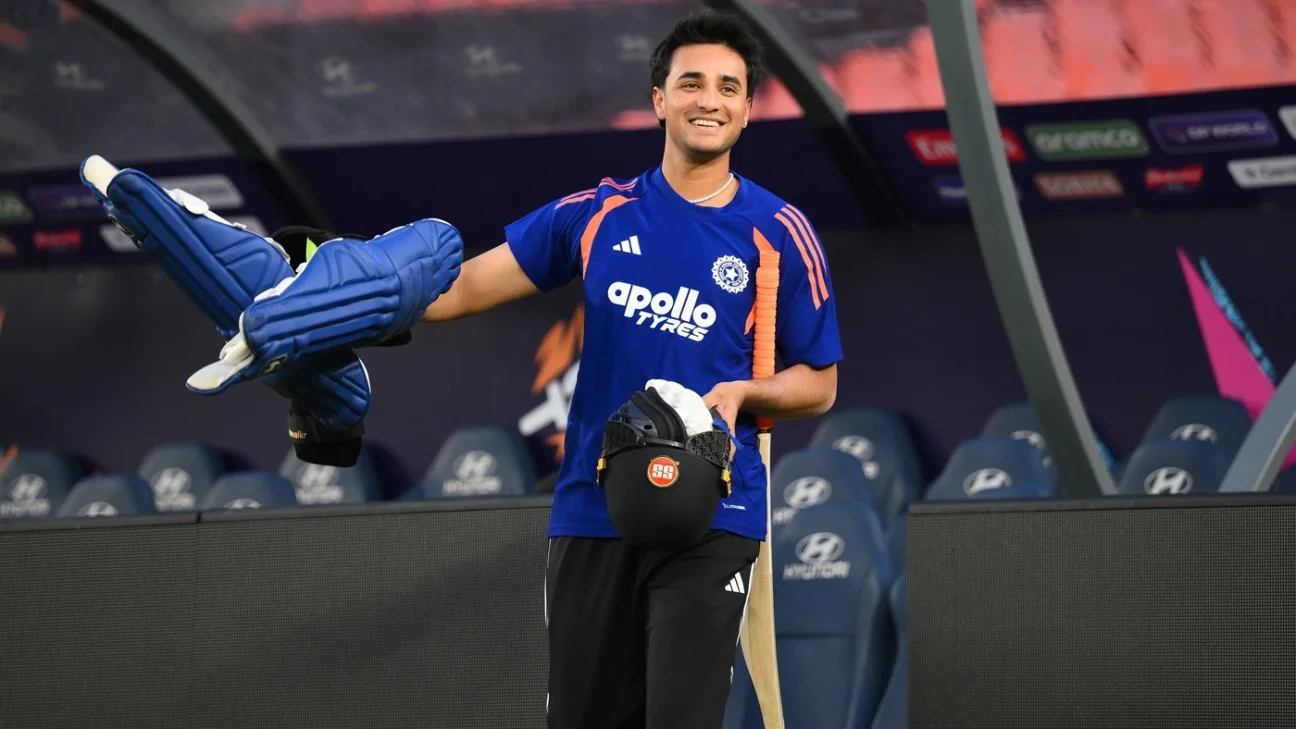
When Abhishek realised asking the flag wavers to stop was futile, he took fresh guard. Moving from leg-stump to off-stump, he opened up his stance slightly and then went true baseball style – swinging at every ball that came his way. Arshdeep bore the brunt thrice – launched down the ground for a straight hit each time, until he beat him fourth time with a slower ball, and then pointed his hands towards those watching, as if to say how he had bested his good mate.
Abhishek quickly rushed out of the net, high-fived Arshdeep and returned with two new bats to take fresh guard. This time, coach Gautam Gambhir walked beside him and took up a spot behind the net and asked for a battery of spinners, Washington Sundar, Varun Chakravarthy, and Kuldeep Yadav among them, to come on.
If there was a barometer to measure Abhishek’s intensity at the net session, it’s likely he would’ve tilted to the extreme end of the intent scale. Even from a good 120 metres away, you could hear the ‘thhak’ pierce through the insulated media centre glass.
“The one thing we definitely don’t unnecessarily do is over-analyse,” Kotal said when asked of Abhishek’s patterns of dismissals. “Sometimes you [as batters] start making more assumptions than the opposition do. He has his plans sorted, he follows the way he wants to, and obviously we discuss the opposition, their bowling, their strengths, what they’ve been doing – all that is normal for everyone, not just Abhishek.”
Between the two ducks, Abhishek was also hampered by an illness that forced him out of the match against Namibia. Against the USA, Ali Khan had him pick out the lone fielder at deep cover for his trademark step-out stroke. Pakistan brought on spin early, and Salman Agha had him mishit one to mid-on.
Kotak, though, didn’t seem too concerned at these patterns of dismissals.
“Before he fell ill, he made runs. In the T20 format also, sometimes a 10-ball 30 is as important,” Kotak said. “It’s not like he hasn’t scored runs. T20 format is high-risk, someone will get out [playing attacking cricket]. If we stress so much on it [the occasional failures], players will be under pressure. He is in good form, he has got clear plans, has a clear mindset and that’s what matters to us.”
After the Pakistan game, coach Mike Hesson revealed to have planned Abhishek’s dismissal for three days in the lead-up to the game. Kotak laughed at the suggestions that Abhishek was under pressure with oppositions analysing his strengths and coming up with plans to outsmart him.
“A lot of credit to Abhishek, if that’s how they are planning so much against him,” he said. “I’m sure he must be doing so well that they’re concerned. We plan, he also comes up with ideas. I don’t genuinely think in the last game they planned to get him out and he was caught at mid-on – you can’t plan to get anyone out like that.
“He got hit high on the bat. But if they’re so concerned [that they have to plan] it’s a great sign for us, and a great credit to the way he plays.”
In crediting Abhishek’s style of play, Kotak also advocated for players to adapt to conditions and situations quickly, emphasising on how there was no one method to succeed in T20 cricket. He cited Suryakumar Yadav’s example from the USA game, in which he had to bat deep to lift India from 77 for 6 and making 84 not out in India’s 161 for 9.
“I think playing aggressive cricket is important. But I don’t think plans change based on whether a player has failed or not,” Kotak said. “If anything, plans will change according to situations. No matter whether somebody has scored runs for two innings or somebody hasn’t, it’s important to adapt to what the team needs.
“Like the Mumbai game where Surya had to stay there for a while, and he had to go at run-a-ball more or less for 30-35 balls – that’s playing to the situation. Whether someone scores runs or not is not important, what team requires at a time and players trying to execute that is more important.”
Shashank Kishore is a senior correspondent at ESPNcricinfo