

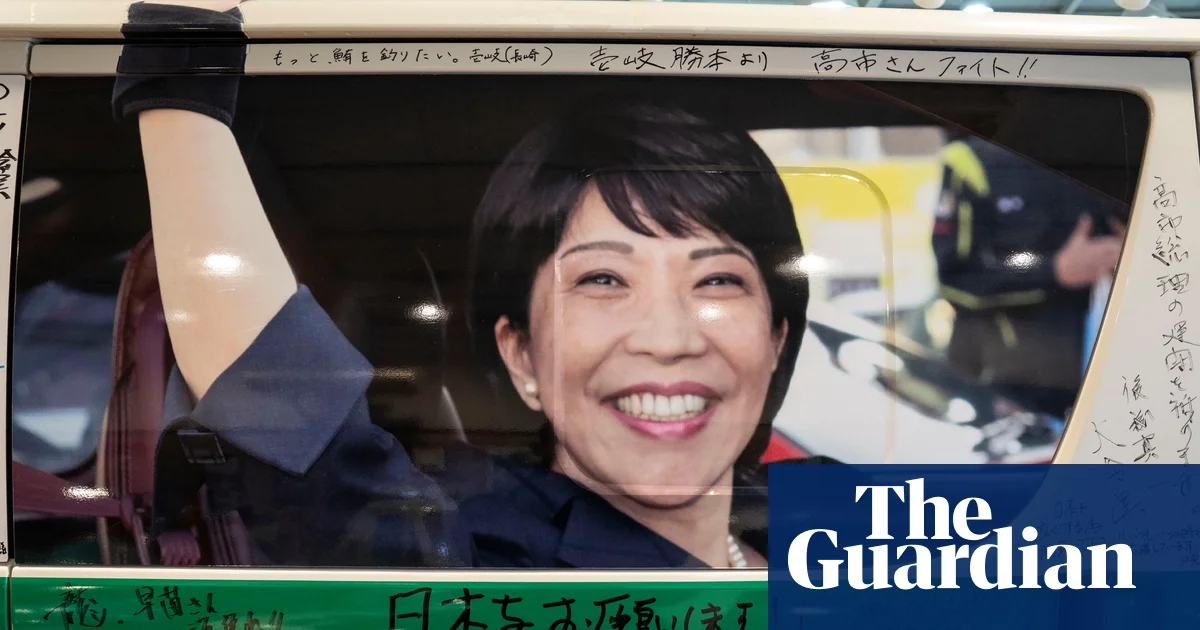
Just eight months ago, Japan’s ruling party appeared to have reached the edge of the electoral abyss. It had lost a parliamentary majority for the second time in 15 months; its MPs were implicated in a long-running slush fund scandal; the then prime minister, Shigeru Ishiba, was the target of factional plotting.
But as voters prepare to brave freezing temperatures in this Sunday’s lower house elections, the Liberal Democratic party (LDP) is expected to pull off a momentous victory. And the party’s recovery from the disappointment of last year is largely down to one woman.
When the LDP’s conservative wing forced a leadership election to replace the embattled Ishiba in October last year, many expected his ally Shinjiro Koizumi – the young, telegenic son of a previous prime minister – to win.
Instead, Japan’s party of government for most of the past seven decades took a gamble on his ultra-conservative rival, Sanae Takaichi, installing her as the country’s first female prime minister. If opinion polls are correct, that gamble is about to pay off in ways even her strongest allies could not have imagined.
In an eventful four months, Takaichi has met Donald Trump – who this week offered an endorsement and an invitation to the White House in March – as well as Xi Jinping and South Korea’s president, Lee Jae Myung. She sparked an unresolved row with Beijing over the future of Taiwan, spooked bond markets with promises of sweeping tax cuts, and faced fresh scrutiny over her links with the disgraced Unification church.
Despite the ups and downs, she has emerged as the LDP’s most effective weapon, the object of a personality cult revolving around everything from her choice of outfits and train journey snacks to the pink pen she uses to take notes in parliament.
Opinion polls this week suggested that the LDP and its minor coalition partner, the Japan Innovation party, will win more than 300 of the 465 seats in the lower house, enough to give them a two-thirds majority and control of parliamentary committees. The main opposition Centrist Reform Alliance, by contrast, is bracing for heavy losses.
An admirer of Margaret Thatcher, the 64-year-old Takaichi is hardly a natural ally of Japanese feminism or Gen Z aspiration. She opposes allowing female members of the imperial family to become reigning empresses, insists that married couples should use the same surname – almost always the husband’s – and shows no interest in challenging centuries of tradition by stepping on to “sacred” sumo arenas to award trophies.
Instead, she has ignited interest among young voters with a savvy social media campaign that emphasises what she is not: a hereditary, male politician of a certain vintage with an innate belief in his right to govern.
“Until now, politics has been dominated by senior male figures,” Yuiko Fujita, an associate professor at Tokyo University, told the Nikkei. “The fact that the prime minister is now a woman, someone with a different background from what people are accustomed to, creates a feeling that something is shifting.”
Takaichi, whose mother was a police officer and father a car company employee, has cited Thatcher, the daughter of a shopkeeper, as her inspiration.
At a recent campaign speech in Tokyo, Takaichi referred to her modest upbringing and touched on issues from controlling immigration to the cost of visiting a hair salon. Unlike her male predecessors, she shuns late-night drinks and expensive restaurants, preferring home comforts and early-morning meetings with aides.
“She has a clear, decisive way of speaking,” said Takeo Fujimura, a 24-year-old office worker who had volunteered to hand out paper Japanese flags at the campaign event. “She communicates in a bright, positive way and I think that energy resonates with young people.”
The $900 black leather handbag Takaichi uses has sold out, and her favourite snacks are in demand. Voters say they are attracted to her easy manner – smiling and waving to US troops stationed in Japan, playing the drums with Lee to the hit song Golden from K-pop Demon Hunters, or singing “Happy Birthday” in Italian to Giorgia Meloni.
‘There is almost no criticism of her’
Japan’s “commoner prime minister” has harnessed the power of social media in a way no other Japanese politician can match. Her official X account has more than 2.6 million followers, dwarfing the 64,000 who follow Yoshihiko Noda, the co-leader of the centrist alliance.
“Even though I’m not that much into politics, pro-Takaichi videos are recommended to me a lot on YouTube,” said Mana Suzuki, a 20-year-old Tokyo resident. “And there is almost no criticism of her in the comments section.”
While there is little discussion of policy, her personal qualities have combined to create a wave of “Sana-mania” that should give Takaichi the political headroom she needs to confront the cost-of-living crisis, a volatile yen and security threats from China and a nuclear-armed North Korea.
The midwinter election is not without risks, however. Many voters are unconvinced that her promise to suspend the 8% consumption tax on food for two years will help struggling families.
“Prices are so high,” said Tomomi Kawamura, a Tokyo housewife who, while impressed by Takaichi’s social media posts, had yet to decide how to cast her vote. “I want something done about that.”
And there is no guarantee that younger people, who are not known for turning out in large numbers at elections, will translate admiration for Takaichi into a trip to a polling station on what is forecast to be a frigid weekend throughout Japan.
When she called a snap election last month, Takaichi said people must be given the chance to decide whether she was “fit to run the country”.
On Sunday, Japanese voters are expected to respond with a resounding yes.
Wires contributed reporting