


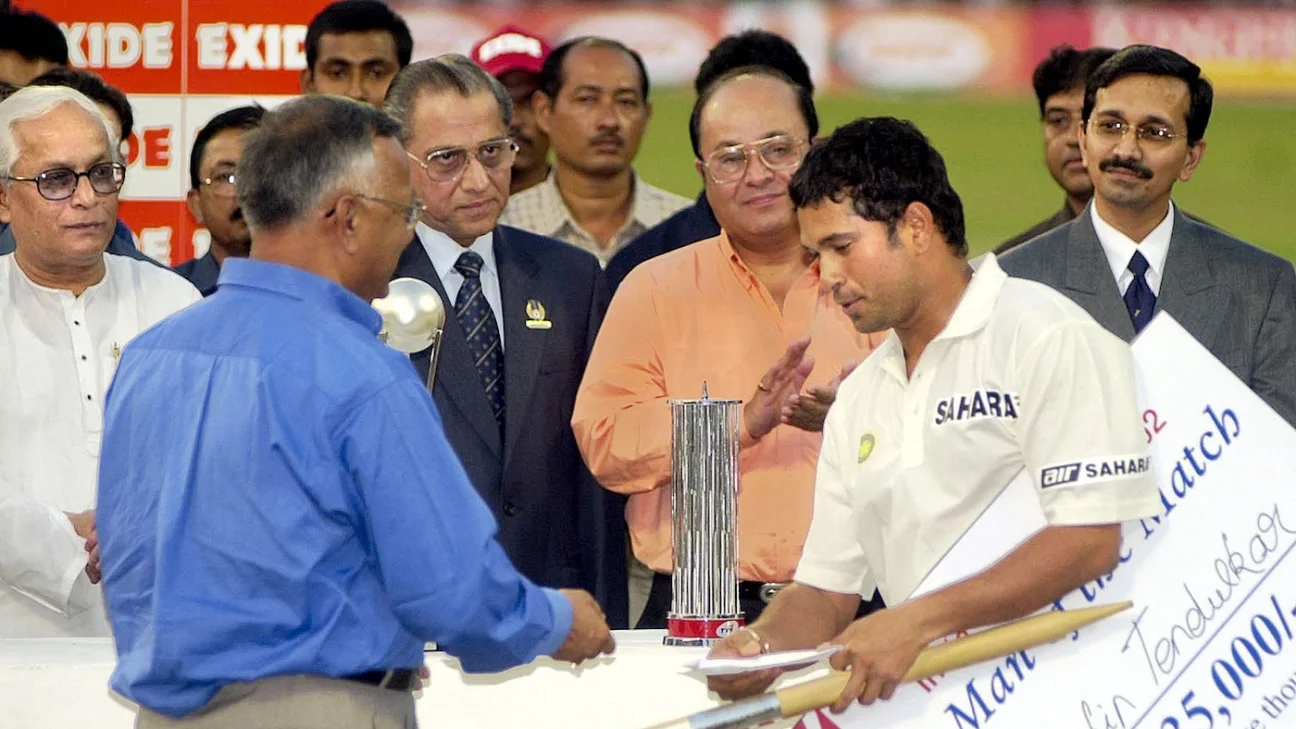
The man of the match (MoM) is such a fascinating concept. Born out of the ODI game, right from the beginning, the concept of identifying a single outstanding performer from each match was ingrained into the format. It was easy to implement the concept in the well-defined and well laid-out one-day game. At the end of a day of cricket, it was a nice way to round off the proceedings. But the Test scene was different. There were four innings and nothing was definite. A batter could bat for eight hours and a bowler could bowl 50 overs. A match-winning innings could be played at a sedate pace, which had to be recognised. Bowlers needed time to settle down and get into their rhythm. That way of planning and working for wickets had to be recognised.
A caveat here. The current terminology is “Player of the Match”. However, all my data, programs, early scorecards have “Man of the Match” built in and I am quite comfortable with that term. In any case, I am analysing men’s Test matches here. My apologies if I am politically incorrect. I have to refer to another point here. My MoM numbers are based on the scorecards that I have downloaded across the years. It is possible that there are minor variations since some of the MoM situations could have been rectified subsequently.
I will be using this measure to determine the best player of the match. Where an MoM award has been declared, I will check to see how valid the award is. Where an MoM has not been awarded, I will use the MPI value to determine a notional MoM award for that match. I will also use the MoM awards to do an analysis of the player achievements. Finally, I’ll highlight some of the bizarre MoM awards.
When should there be an MoM award? In my last article, I had explained the Contribution Analysis that I do to determine the contributions made by players to their teams’ cause. The top-most level of this analysis was the Team Performance Points (TPP) attributable to each team. The sum of the TPP values for the two teams is the MTPP value, for the match. An MTPP value of 50.0 indicates that the two first innings have been completed.
I have worked on the basis that an MTPP value of 50.0 or more indicates a reasonable level of completion of the match. It is possible to award/determine a meaningful MoM for that match. On the contrary, an MTPP value below 50.0 indicates an incomplete match and an MoM award does not have any relevance. When the MTPP is below 50.0, the scoreline could be “England: 7 for no loss (MTPP-0.4)” or “Eng: 378/9, Ind: 377/7 (MTPP-49.9)”. Hence I have worked on the value of 50.0 as the cut-off point for MoM to be awarded/derived.
A schematic of the complete MoM awards/derived situations is given below. The numbers in the article are complete till December 31, 2025.
In the 2615 Tests that have been played so far, 65 have MTPP values below 50. Out of these, 40 Tests did not have MoM awarded or derived. The other 25 Tests have had MoMs awarded. In general, this is fine, other than the four Tests with bizarre MoM awards. These are covered at the end of the article.
Awarded MoMs
Out of the qualifying 2550 matches, 1671 matches had MoMs awarded. The analysis relating to these is to see how these awards stand up to scrutiny. Of these 1671 instances, 905 of these awardees had the best MPI values and were clearly the best performers. A further 245 of these players were within 10% of the best performers, on either side, and we can safely conclude that this is within the margins of acceptance. That makes a total of 1150 being the best performers or so. It comes to around 69%. Could be better, but overall, quite acceptable.
That leaves us with 521 awardees who were clearly not the best performers in the matches. That comes to around 31%, just short of around a third of the awards. Out of this lot, there were ten MoM awardees who secured less than 50% of the best performers. That is clearly a serious anomaly and this list of players is covered later in the article.
Of the awarded MoMs, I have classified any award for a player who has earned 75% or more of the MPI through his batting numbers as Bat-Centric. Any award for a player who has earned 75% or more of the MPI through his bowling numbers as Bow-Centric. The balance are termed A/R-Centric. It is not a good result but also not a surprise that 902 (54.0%) of these awards are Bat-Centric, while 481 (28.9%) are Bow-Centric. Finally, 288 of the awards are A/R-Centric. This is as expected.
There are no fewer than 40 Tests in which there were two MoM awardees. Not all of these are justifiable. It is possible that there were sponsorship requirements or political considerations. There might have been a need to declare MoMs from the two countries separately. Although, I must confess that I do not see the need for the double awards to players from the same countries in 12 of these matches. That looks really bizarre. Why would Maninder Singh and Dilip Vengsarkar, or Ewen Chatfield and Richard Hadlee, or Jacques Kallis and Makhaya Ntini get the awards is not an easy question to answer.
In the first 763 Tests leading up to the first MoM-awarded Test, there were 16 Tests with MTPPs below 50.0 and would not qualify for an MoM determination. After that Brisbane Test in 1975, a further 132 qualifying Tests did not award MoMs. This was because the other countries did not immediately follow Australia’s lead. Only around 1985 or so did this practice become the accepted norm. That leaves us with 879 Tests for which the MoM is not awarded but instead determined by me using the MPI values. This includes the best ever match performance – by Ian Botham at the Wankhede Stadium in 1980.
Player MoM summary
Now that the non-MoM Tests have been assigned notional MoM awards, we have MoM awards for all the qualifying Tests. I have compiled these at the player level and this significant table is a depiction of the players who have secured the highest number of awards and those who have secured it most frequently.
This won’t surprise anyone. That allrounder par excellence, Garry Sobers, topped the list with 27 MoM awards, all of these having been determined using the MPI values. He secures these awards at the amazing frequency of one every 3.4 Tests. Kallis, helped by 22 awards and two derived selections, stands second with 24 total awards. Then comes Hadlee, another great allrounder, with 19 recognitions, split equally between awards and determinations. After that, three specialist bowlers, Muttiah Muralidaran, Wasim Akram, and Warne. Kumar Sangakkara is the best specialist batter. He is seventh with 16 awards.
When it comes to the frequency of awards, Trevor Goddard leads with 3.4 Tests per award, matched by Sobers. Keith Miller follows with 4.2 Tests per award. The next three are also allrounders – Hadlee, Tony Greig, and Richie Benaud, who all needed fewer than five Tests per award.
Fifty-six players were awarded the MoM awards despite their team losing the Tests. Sachin Tendulkar, Akram, Shakib Al Hasan, and Mohammad Ashraful won three such awards each. Some of these awards were indeed dubious since there were very good performances from the players of the winning teams. In Melbourne in 1999, Tendulkar was given the award for his 116 and 52 while Brett Lee took seven wickets and scored 27 runs. Two months later in Mumbai, Tendulkar was given the award for his 97 and 3 for 10 even when Shaun Pollock took six wickets in South Africa’s four-wicket win. On the other hand, all of Akram’s awards were for match hauls of ten or more wickets, and were well deserved, as was Tendulkar’s against Pakistan in Chennai in 1999, again in a defeat.
Tests where the MoM awardees got much lower MPI values than best performer of the match
There are some really strange Tests in which the MoM awardee did not reach even 50% of the best performer.
There are five other cases of the MoM awardees securing below 50% of the best performers. The theme is mostly one very good innings edging out four all-round performances.
The four mysterious MoM awards
As already explained, these are among the Tests that did not even have an MTPP value of 50.0 points. That means not even the first two innings were completed. And the amazing thing is that in 25 of these Tests, MoMs were awarded.
Potpourri
A few articles back, I had covered the Tests in which the winning teams had lost very few wickets. Now, I have looked at it from the other side – from the points of view of the losing teams.
Tests in which the losing teams lost 15 wickets or less:
- In 1949, South Africa lost to England in Port Elizabeth despite losing only 13 wickets. They made a very surprising declaration, leaving England to score 172 in about two-and-a-half hours. And England duly obliged.
- In the famous declaration by Sobers in Port-of-Spain – adventurous and challenging by his standards, but a foolhardy one according to most cricket followers – a target of 215 in around four hours was easy for England, even by 1968 benchmarks. West Indies lost only nine wickets.
- In Kingston in 1976, a bizarre Test played out. India batted first, batted well, and reached 306 for 6, when Bedi declared in protest at the excessive short-pitched bowling. Three batters were injured and took no further part in the match. West Indies took a lead of 85. India closed their second innings at 97 for 5 – it is unclear whether Bedi declared the innings or not. They lost only 11 wickets and still lost the match.
- Then was the infamous Hansie Cronje-Nasser Hussain agreement in which the middle two innings were forfeited in Centurion in 2000. South Africa lost only eight wickets and still lost the match.
- The next one is the famous declaration by Adam Gilchrist in which he left England the whole of last day to score just above 300 at Headingley in 2001. Inspired by Mark Butcher, they romped through with overs to spare. Australia lost only 14 wickets.
- In 2006 in Sydney, Graeme Smith left Australia, of all teams, five hours (around 70 overs) to score 280-plus runs. That was a walk in the park for the strong Australians. Another seemingly foolhardy declaration. South Africa lost only 15 wickets.
- Finally, that infamous Oval Test that was forfeited by Pakistan in 2006. They lost to England despite losing only ten wickets.
Talking Cricket Group
Any reader who wishes to join my general-purpose cricket-ideas-exchange group of this name can email me a request for inclusion, providing their name, place of residence, and what they do.
Anantha Narayanan has written for ESPNcricinfo and CastrolCricket and worked with a number of companies on their cricket performance ratings-related systems
To find out more, keep on visiting our website