Home Blog Page 99

AI-Powered Creativity: Can Machines Be Artists?

AI-Powered Creativity: Can Machines Be Artists?

As technology continues to advance at breakneck speed, the line between human creativity and machine-generated art is becoming increasingly blurred. The rise of artificial intelligence (AI) has sparked a debate about whether machines can truly be considered artists. Can an algorithm create meaningful art, or is it simply mimicking the techniques and styles of human creators?

The Evolution of AI in Art

AI has made significant strides in recent years, particularly in the fields of image generation, music composition, and literature. Tools like OpenAI’s DALL-E and GPT-3 can produce stunning images and articulate prose that often leave their human counterparts in awe. These advancements prompt questions about originality, creativity, and the very essence of art itself.

Machine Learning and Artistic Expression

At the heart of AI’s artistic capabilities lies machine learning—a subset of AI that enables computers to learn from data and improve over time. By analyzing vast datasets of existing artwork, AI can identify patterns and styles, enabling it to generate unique pieces that resemble the works of famous artists.

The Debate: Art Requires Human Emotion?

Critics argue that true art requires emotional depth and human experience that machines simply cannot replicate. While an AI can produce visually appealing works, it lacks personal experience, context, and emotional resonance that often underpin artistic expression. This leads to a fundamental question: Can art created by AI evoke genuine emotion in its audience?

Collaborative Creativity

Rather than viewing AI and artists as rivals, many creators are choosing to collaborate with AI tools to enhance their creativity. Musicians and visual artists alike are embracing these technologies to push boundaries and explore new frontiers in their craft. This collaborative approach showcases the potential for machines to augment, rather than replace, human creativity.

Conclusion: A New Era of Art?

Whether machines can be deemed “artists” remains a highly subjective question. While AI is capable of producing remarkable pieces of art, the conversation about creativity continues to evolve. As we navigate this new era, perhaps the most important takeaway is the value of collaboration between humans and machines, leading to a richer, more diverse artistic landscape for everyone.

Additional relevant updates

Venus Williams Opens Up About Palm Beach Wedding Ahead of Australian Open

After a September ceremony, the pair were officially wed in a week-long celebration close to home in Palm Beach, Florida.

“I can’t describe how beautiful, calm, sacred, exciting, and exalting it was,” Venus told *Vogue* in December. “It was just a dream.”

In between planning a whirlwind celebration with Jennifer Zabinski of JZ Events, Williams found time to prepare for her first Australian since 2021, accepting a wild card and first-round date with Olga Danilovic.

Tennis icon Venus Williams is giving fans a glimpse into her personal life as she prepares for a very exciting milestone: her upcoming wedding to Italian actor Andrea Preti. The Palm Beach ceremony comes at a busy time for the tennis star, who is also gearing up for the Australian Open.

In a recent interview, Venus shared how she’s managing the delicate balance between her professional commitments and personal celebrations. “It’s a whirlwind, but I’m so excited to celebrate this new chapter with Andrea,” she said. Despite the packed schedule of training and tournaments, the couple is making sure to savor every moment leading up to the big day.

The wedding, set in the scenic surroundings of Palm Beach, promises to be a star-studded event with close friends, family, and fans of the tennis champion eager to catch a glimpse of the celebration. While Venus has kept many details private, she hinted at an intimate yet elegant ceremony that reflects both her and Andrea’s personalities.

Even with wedding plans underway, Venus remains focused on the Australian Open. Known for her fierce competitiveness and legendary career, she emphasized that her training remains a top priority. “Marriage is exciting, but the court is where my heart is right now,” she noted, adding that the support from Andrea motivates her both on and off the court.

Fans of Venus Williams have been quick to congratulate the couple, flooding social media with messages of love and excitement. Her ability to balance personal happiness with professional excellence continues to inspire many, making this upcoming wedding even more special.

“Yeah, I was training nonstop those three months,” Williams said on Saturday. “There were periods where I was super busy so I’d have to take a week off here or three days off there, but for the most part I was training and trying to get myself back in the groove.

“At this point, I need to be kind to myself, because I’m getting so many things right, but, you know, there had been a lack of playing matches. So, you know, I’m playing well. I’m setting myself up each point to win points and controlling the points. That’s exactly how I’d want to play, and I’m playing the tennis I need to play.”

Stay-tuned with us on our website

Luck Strikes Stockton: $1 Million San Francisco 49er Scratch-Off Ticket Sold

Stockton shopper wins $1 million with San Francisco 49ers Scratchers ticket

The California Lottery says the winning ticker nets its owner $1 million dollars

Editorial Standards

One Food 4 Less shopper in Stockton won $1 million on a San Francisco 49ers Scratchers ticket, the California Lottery said. The winning ticket was sold to Ravindar Singh at the March Lane grocery store and joins four other million-dollar “Game Day” scratcher prizes recently claimed in California. Another winner was Robert Hillard, who bought a 49ers-themed ticket at The Nineteenth Hole in Antioch. The Scratchers series is part of a partnership between the California Lottery and the 49ers, the LA Chargers and the LA Rams. See more coverage of top California stories here | Download our app | Subscribe to our morning newsletter | Find us on YouTube here and subscribe to our channel

Lottery officials confirmed that the ticket matched the top prize amount of $1 million. The retailer that sold the ticket will also receive a bonus for selling the winning scratch-off, a common practice designed to reward participating businesses.

The ticket was purchased in Stockton, adding to a growing list of major lottery wins across California in recent months.

The winner must submit the ticket to the California Lottery for verification. The validation process can take several weeks as officials confirm the ticket’s authenticity and complete security checks before releasing the prize money.

Lottery officials encourage winners to sign the back of their ticket immediately and keep it in a safe place.

News of the winning ticket has sparked excitement among local residents, with many hoping the winner is someone from the community. Sports-themed scratch-off games often gain popularity during football season, blending team loyalty with the thrill of winning big.

One Food 4 Less shopper in Stockton won $1 million on a San Francisco 49ers Scratchers ticket, the California Lottery said.The winning ticket was sold to Ravindar Singh at the March Lane grocery store and joins four other million-dollar “Game Day” scratcher prizes recently claimed in California.

Another winner was Robert Hillard, who bought a 49ers-themed ticket at The Nineteenth Hole in Antioch.

The Scratchers series is part of a partnership between the California Lottery and the 49ers, the LA Chargers and the LA Rams.

Join our website for cool news and cool tips

Challenges and Solutions in Data Representation

Artificial Intelligence (AI) has transformed various sectors, from healthcare to finance, by improving efficiency and decision-making. However, one of the critical challenges developers and researchers face is the issue of AI bias. This bias can manifest in several ways, predominantly through data representation, leading to unfair outcomes and perpetuating stereotypes. This article delves into the challenges AI bias presents and potential solutions to mitigate its effects.

What is AI Bias?

AI bias refers to systematic and unfair discrimination that results from the algorithms and data used in AI systems. It arises when AI models are trained on skewed datasets that do not adequately represent the diversity of real-world scenarios. This can lead to inaccurate predictions or actions that favor one group over another.

Challenges of AI Bias in Data Representation

1. Skewed Training Data

Data used to train AI models may be unrepresentative of the target population. For example, facial recognition systems may perform poorly on individuals from certain ethnic backgrounds due to a lack of diverse training images.

2. Historical Bias

Data often reflects societal biases present at the time of collection. For instance, recruitment algorithms trained on historical hiring data may perpetuate existing gender disparities.

3. Lack of Transparency

Many AI systems operate as “black boxes,” making it difficult to understand how decisions are made. This lack of transparency complicates identifying and addressing bias in AI outputs.

4. Overreliance on Automation

Organizations may place undue trust in AI systems, assuming they are objective. This overreliance can exacerbate biases when human oversight is insufficient.

Solutions to Mitigate AI Bias

1. Diverse Data Collection

Organizations should invest in gathering diverse datasets that accurately reflect all aspects of the population. Efforts should focus on including underrepresented groups in data collection processes.

2. Algorithmic Fairness

Developers should adopt fairness constraints in AI algorithms to ensure equitable treatment across different demographic groups. This approach can help to balance biases introduced by training data.

3. Interpretability Tools

Utilizing tools that enhance the interpretability of AI systems can provide insights into decision-making processes, allowing developers to identify and correct biased outcomes more effectively.

4. Continuous Monitoring and Testing

Regular audits and testing of AI systems should be conducted to identify biases. This can help organizations adjust their models and datasets to mitigate any emerging biases.

Conclusion

AI bias poses significant challenges to the effective and ethical implementation of AI technologies. By understanding the sources of bias and actively seeking solutions, organizations can work towards creating more equitable AI systems. The goal should be to ensure that AI benefits everyone, promoting fairness and reducing discrimination in automated decision-making.

Additional relevant updates

Inside a Proxy Battle for Warner Bros.: Scenarios and Stakes

On a bright but frigid December morning, David Ellison held court in a makeshift war room in the basement of the UBS building next to Madison Square Park.

Sporting cream-colored slacks and a crisp blue blazer, Ellison and his senior Paramount leadership team took meeting after meeting with Wall Street heavyweights in a private room in UBS’ subterranean conference center, outlining their strategy to transform Paramount, and to persuade them to back their tender offer for Warner Bros. Discovery, which days earlier inked a deal to sell itself to Netflix. Ellison was a “man on a mission,” one attendee tells The Hollywood Reporter.

The CEO is seeking to reshape Paramount, and pry WBD from Netflix in the process, as part of a reimagining of what an entertainment company should be at a time then the industry is being “technologically disintermediated,” as one source close to him frames it.

That makeshift war room in the basement of the UBS building has since escalated into something closer to outright war.

Paramount sued Warners, escalating its fight and seeking an order that would force the company’s board of directors to show its work, betting that bringing that information to light will help its case. And Ellison also announced his intent to launch a proxy fight for Warner Bros. should the company continue to not engage.

“This is an old-fashioned fight for a target. We have seen this sort of thing forever,” says Mario Gabelli, the influential investment manager, and a WBD shareholder. “As far as the attempt by Paramount to have a proxy fight, why not? It’s all a part of the smoke signals and mechanics of it.”

The public battle “signifies that as the top team, in consultation with the board, they think the stakes are so large that they’ve got to go all in” says Michael Useem, a professor of management at the Wharton School of the University of Pennsylvania. “The proxy fight threat, it’s not unusual, it happens, it is indicative of the depth of commitment by Ellison to make the best go of it.”

To be clear, a proxy fight is not yet a sure thing. Paramount is betting that its lawsuit can pry out new data that could sway investors or force WBD to engage, which is its preferable course of action. The suit and proxy threat are simply the logical next step in the process.

The window for WBD to set its annual meeting opens in about three weeks, and Paramount could nominate a slate of nominees that would force deal talks. If WBD scheduled a special meeting to approve the deal beforehand, Paramount could wage a proxy campaign to vote “no.”

And Netflix could still adjust its offer, either by raising the price, or by moving to an all-cash deal, a move that could box Paramount in and force them to reraise themselve“From my point of view Netflix has to simplify the deal,” Gabelli tells THR, adding that as of now he plans to tender around 90 percent of the WBD shares he manages to Paramount, in order to apply pressure on WBD and Netflix. “At least I can send a signal that I like cash and the timing of the [Paramount] deal.”

There are indications Netflix is listening, and will change its bid in the near future partly in response to those concerns.

“At the end of the day, there’s a responsibility here to deliver the highest price, the highest value, and the highest and the best certainty of closing to shareholders. That’s it,” someone close to the company says of its thinking. And Paramount still believes that it’s offer is the better one.

Paramount’s effort to steal Warners from Netflix’s grasp has played out publicly, with multiple letters to shareholders, a personal guarantee from Oracle founder Larry Ellison, and dueling appearances on CNBC from RedBird Capital’s Gerry Cardinale (who is backing the Paramount bid) and WBD board chair Samuel Di Piazza.

But a proxy fight would, if Paramount follows through on its threat, take that public fight to the next level.

And there are reasons to think that if it runs to its conclusion, it could become the most explosive proxy battle in the history of the entertainment business.

Peltz, the well-known activist investor, was backed by the billionaire former Marvel executive Ike Perlmutter. Their pursuit for a couple of Disney board seats forced Disney to reveal a slew of deals: From its billion-dollar investment in Epic Games to its surprise Moana sequel, Disney and CEO Bob Iger went all-out to make their case that they were on the right track.

But Paramount’s pursuit of Warners is different: It would engulf three of the biggest players in entertainment, with one company, Paramount, pursuing another, WBD, which has a deal with a third, Netflix. The activist is itself a competitor, and the billionaire backing it also happens to be one of the richest people on planet earth, Larry Ellison (currently worth $255 billion).

Proxy fights have a way of revealing information and shaking friends and enemies out of the woodwork.

But they are also extremely expensive, for both the activist and the defending company. Disney spent about $40 million to defend itself from Peltz’s onslaught, while Peltz spent about $25 million, according to filings from both sides of that battle.

“It’s a tedious business,” one proxy fight veteran says, noting that fights require catching attention of investors through media, solicitations and in-person meetings, which take a lot of time out of the time of senior executives. That was the case at Disney two years ago.

“Everything else gets pushed, all other meetings get called off,” Useem says. “David and his top team, maybe the top 10 or 15, are probably spending full time on this and doing nothing else.”

That will mean meetings with investors, and both sides trying to sway the influential shareholder advisory firms like Institutional Shareholder Services (ISS) and Glass-Lewis (though notably ISS’ recommendation failed to make a dent in the Disney fight).

But proxies are also about leveraging and swaying public opinion, and this fight, should it happen, will instantly become one of the most public proxies in history, given the personal interest of President Trump.

While much of the talk around the deal with regards to Trump has been focused on antitrust and regulatory concerns, the President has not been shy about sharing his thoughts publicly too, telling reporters last month that he would be involved in any review of the deal, and suggesting that CNN should find new ownership. He also reposted an article that was critical of Netflix’s deal for Warners.

Should the corporate dealmaking move to a street fight, there is no doubt that Netflix and Paramount would be looking for whatever levers they could when it comes to the President’s thoughts on the deal. Both companies have hired Ballard Partners, a lobbyist with close ties to the White House, according to public records.

But the potential proxy battle could still end up being something of a mirage. The cost, public scrutiny and intense focus it would require are still the backup plan for Ellison.

“The best outcome for you and for us would be if WBD’s Board would exercise the right it has under the Netflix Agreement to engage with Paramount,” Ellison wrote to shareholders “If it does so, we will be open and constructive to secure the best path forward for WBD and each of you.”

But if they don’t, expect Ellison to ramp things up. It might be the last shot he gets.

“When the stakes are very large, companies recognize that this is the moment to act, because if it’s not now, it’s going to never be,” Useem says.

Visit our website to get more information

Judge Imposes Restrictions on ICE Tactics Amid Minnesota Protest Backlash

A federal judge ruled Friday that agents carrying out the Trump administration’s sweeping immigration operation in Minnesota can’t arrest or deploy certain crowd-control measures against anyone “engaging in peaceful and unobstructive protest activity.” The order comes as outcry continues to build over two shootings by Immigration and Customs Enforcement agents in Minneapolis over the course of a week.

The new restrictions on federal agents also come amid word that the Department of Justice is investigating Minnesota Gov. Tim Walz and Minneapolis Mayor Jacob Frey over possible obstruction of federal law enforcement, sources familiar with the matter told CNN. The probe raises the possibility of criminal consequences for the two Democratic leaders, who have openly rebuked the surge of federal activity that began last month.

Groups of protesters continued to decry the immigration crackdown in Minneapolis during the day and into the night Friday, despite frigid temperatures. Demonstrations intensified last week after 37-year-old mother of three Renee Good was fatally shot in her car by an ICE agent, and again a week later when another agent shot and injured a Venezuelan man accused of “violently” resisting arrest, according to the Department of Homeland Security.

Federal agents working in the Trump administration’s Operation Metro Surge in Minnesota are not allowed to arrest or retaliate against peaceful protesters or use “pepper-spray or similar nonlethal munitions and crowd dispersal tools” against them, US District Judge Katherine Menendez ruled in a preliminary injunction issued Friday.

Menendez also said the agents can no longer stop and detain drivers when there is “no reasonable articulable suspicion” they are forcibly obstructing or interfering with federal operations. “The act of safely following” the officers, “at an appropriate distance does not, by itself, create reasonable suspicion to justify a vehicle stop,” the judge added.

The order only applies in Minnesota and only to agents involved in the current operation, and does not apply to other federal officers handling routine duties elsewhere, the order specified.

In a response to the ruling, the Department of Homeland Security said it is “taking appropriate and constitutional measures to uphold the rule of law and protect our officers and the public from dangerous rioters.”

Assistant DHS Secretary Tricia McLaughlin said that despite these threats, agents follow training and use “the minimum amount of force necessary to protect themselves, the public, and federal property.”

The preliminary injunction was requested by activists who filed a lawsuit last month alleging the federal government was violating their constitutional rights. The case is separate from a different lawsuit filed by Minnesota and the Twin Cities on Monday seeking a court-ordered end to what it calls a “federal invasion” during Operation Metro Surge.

With protests expected to continue, here’s what else to know:


  • Walz and Frey respond: Neither the Minnesota governor nor the Minneapolis mayor confirmed the reported DOJ investigation for possible obstruction of federal law enforcement, but both accused the Trump administration of trying to intimidate its political opponents. A host of Democratic governors and members of Congress issued statements casting the reported investigation as an abuse of power.

  • Outcry over federal tactics: Democratic members of Congress held a field hearing at Minnesota’s state capitol Friday to highlight alleged abuses happening during the immigration crackdown. American citizens going about their daily business are getting tackled or detained due to their ethnicities, lawmakers and local residents said at the hearing. A DHS spokesperson insisted federal agents do not use racial profiling to make arrests.

  • Ongoing protests: Protesters gathered again Friday at Minneapolis’ Bishop Henry Whipple Federal Building, the staging facility for immigration operations. Federal officers in tactical gear forcefully moved a group of protesters away from the street, and at least one person appeared to be detained after triggering a heavy response from at least five agents. CNN reached out to DHS for details.

  • No Insurrection Act “right now,” Trump says: The president reiterated Friday he’s willing to use the Insurrection Act to send US troops into Minnesota but said, “I don’t think there’s any reason right now to use it.” Trump has threatened multiple times to invoke the centuries-old law if state and local leaders don’t quell unrest.

Join our website for cool news and cool tips


Artificial Intelligence in Healthcare: Revolutionizing Patient Care

Introduction
Artificial Intelligence (AI) has emerged as a transformative force in multiple sectors, and healthcare is no exception. The integration of AI into healthcare practices is not just enhancing patient care; it’s redefining it. From diagnostics to treatment plans and patient management, AI technologies are streamlining processes and improving outcomes.Transformative Applications of AI in Healthcare

1. Enhanced Diagnostics

AI algorithms, particularly machine learning models, are being used to analyze medical images such as X-rays, CT scans, and MRIs. These AI systems can detect anomalies often missed by human eyes, allowing for earlier and more accurate diagnoses.

2. Personalized Treatment Plans

With the capability to analyze vast amounts of patient data, AI systems can suggest personalized treatment options based on a patient’s individual medical history, genetics, and lifestyle. This level of customization leads to more effective treatments.

3. Predictive Analytics

AI-driven predictive analytics can assess future health risks by analyzing patterns within patient data. This allows healthcare providers to take proactive measures, potentially preventing serious health issues before they arise.

4. Administrative Efficiency

AI is also streamlining administrative tasks in healthcare settings. Automation of scheduling, billing, and patient records management reduces the workload on healthcare professionals, allowing them to focus more on patient care.

Challenges in AI Implementation

Despite the promising potential of AI in healthcare, several challenges remain. Concerns over data privacy, the need for large datasets for training AI models, and the risk of algorithmic bias pose significant hurdles. Addressing these challenges is crucial for the ethical implementation of AI technologies.The Future of AI in Healthcare

As technology continues to evolve, the role of AI in healthcare will undoubtedly expand. Future advances may include more sophisticated patient monitoring through wearable devices, AI-driven telemedicine, and even robotic-assisted surgeries. The aim will always be to enhance patient care quality while ensuring that ethical standards are met.Additional relevant updates

Navigating the Moral Landscape

Introduction

As Artificial Intelligence (AI) continues to evolve, the challenges it presents to personal privacy have become increasingly pronounced. The ethical implications of AI technologies necessitate a careful examination of how these tools collect, store, and utilize personal data. This article explores the intersection of AI and privacy, delving into the moral landscape that individuals and organizations must navigate.

The Current Landscape of AI Technologies

AI systems are now integral to various sectors including healthcare, finance, and customer service. Technologies such as machine learning, data analytics, and facial recognition have revolutionized operations. However, the collection and processing of vast amounts of personal data raise critical privacy concerns…

Key Privacy Concerns

  • Data Collection: AI systems often rely on large datasets that may include sensitive personal information. The scope of data collection can lead to unauthorized surveillance.
  • Data Usage: Once data is collected, how it’s used can become problematic. Misuse of data can occur without consent, leading to ethical dilemmas.
  • Informed Consent: Users may not fully understand how their data is being used when interacting with AI systems, leading to uninformed consent.
  • Bias and Discrimination: AI systems can perpetuate existing biases present in training data, resulting in unfair treatment of individuals.

The Moral Landscape

Navigating the moral landscape of AI and privacy requires a multifaceted approach:

1. Ethical Guidelines

Organizations must establish ethical guidelines for the use of AI technologies. These guidelines should prioritize user privacy and establish clear protocols for data handling.

2. Transparency

Transparency is essential. Users deserve to know how their data is collected, stored, and utilized. Clear communication can help build trust and mitigate privacy concerns.

3. Regulation and Compliance

Governments and regulatory bodies are beginning to impose stricter laws regarding data privacy. Compliance with regulations like GDPR and CCPA is crucial for AI developers and companies.

4. User Empowerment

Empowering users with tools to control their own data is vital. Providing options for data access and deletion can help individuals take charge of their personal information.

Conclusion

The intersection of AI and privacy represents a complex moral landscape. As AI technologies continue to advance, stakeholders must collaborate to address the ethical implications of data collection and usage. By prioritizing privacy and adopting ethical practices, we can harness the benefits of AI while protecting individual rights.

References

  • European Union. (2016). General Data Protection Regulation (GDPR).
  • California Consumer Privacy Act (CCPA).
  • Author, A. (2021). Ethics in AI: A Comprehensive Overview.

Join our website for cool news and cool tips

Coldest Air of the Season Hits North America and Europe

A new disruption of the Polar Vortex has begun, with an even stronger event forecast for late January. Latest high-resolution model data reveals a major shift in the pressure systems, which will unleash the coldest air of the season across the United States and Canada, with a cold wave also forecast for Europe, all lasting into early February.

The Polar Vortex is known as the “keeper” of cold, locking it into the polar regions when it is strong. But a disruption of this system can unleash the Arctic floodgates, sending a release of freezing air into North America and Europe.

Using the latest forecast data, we will look at the progress of the Polar Vortex disruption and the large-scale release of cold polar air, which is expected to bring a prolonged period of winter weather over the Northern Hemisphere.
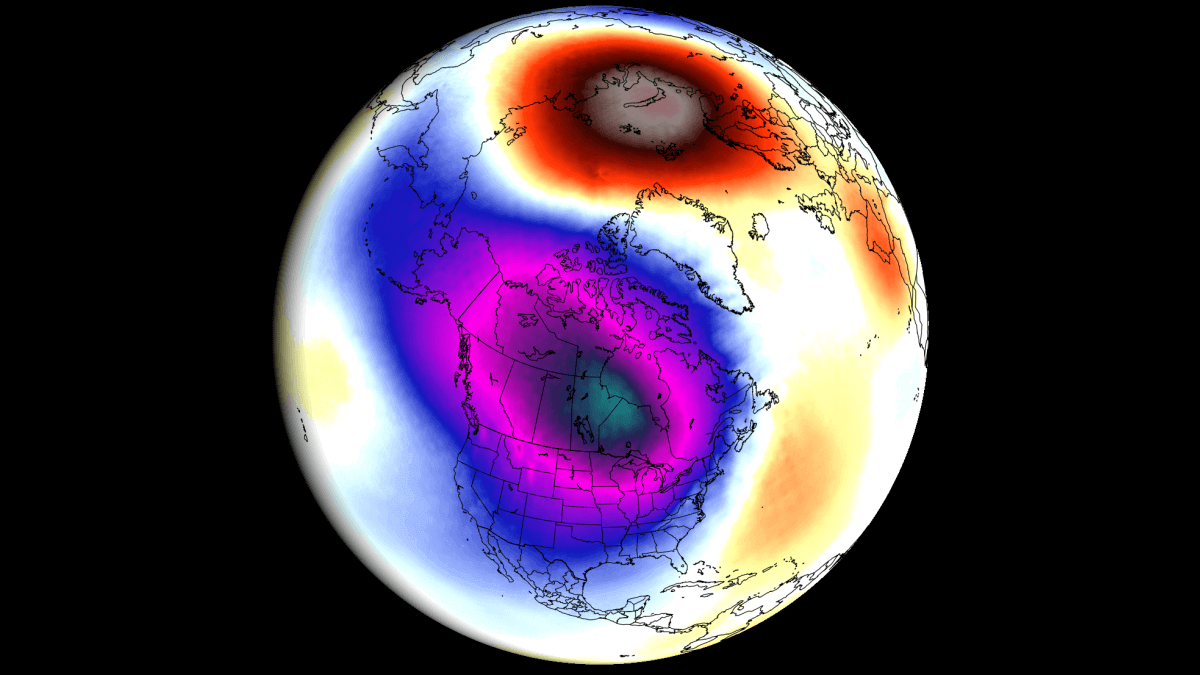
polar-vortex-disruption-forecast-united-states-canada-stratospheric-warming-event-2026-cold-air-release-10mb-temperature-pressure-anomaly-january-february 

Polar Vortex: Steering the Cold Flow

Since we have a lot of new readers, or readers not that familiar with the Polar Vortex, we include a very short rundown on what the Polar Vortex is and why it matters each Winter.

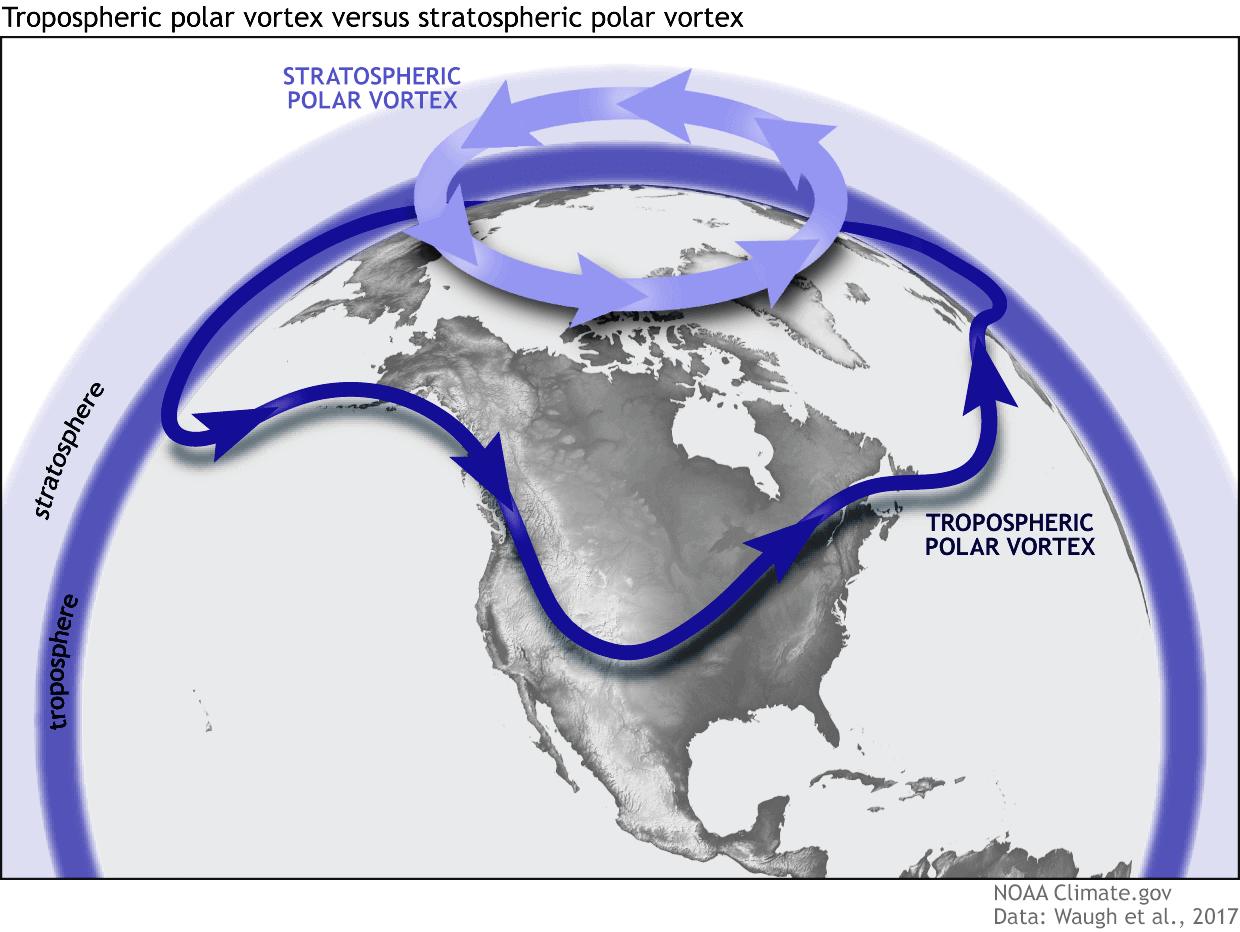
In simple terms, the Polar Vortex is a name for the broad winter circulation over the northern (and southern) hemispheres. You can imagine the Polar Vortex as a spinning wall over the polar regions, rising from the surface into the stratosphere (over 50km/30 30miles high) and trapping the cold polar air inside.

As you can see in the image below, the Polar Vortex is separated into two layers that we monitor at all times around wintertime: the stratosphere and the troposphere. The first one is a higher layer, and the second is at a lower altitude. The Polar Vortex rises through both layers, but with different shape, strength and impacts.
polar-vortex-disruption-sudden-stratospheric-warming-what-is-ssw-winter-weather-forecast-snowfall-cold-united-states-canada-europepolar-vortex-disruption-sudden-stratospheric-warming-what-is-ssw-winter-weather-forecast-snowfall-cold-united-states-canada-europe

For this reason, we separate the entire Polar Vortex into an upper (stratospheric) and a lower (tropospheric) part. A strong Polar Vortex can lock the colder air into the polar regions, preventing its escape. This usually creates milder conditions for most of the United States, Europe, and other mid-latitudes.

But when the Polar Vortex gets disrupted or collapses, it can no longer contain cold air, opening the Arctic floodgates. This allows the cold air to escape from the polar regions into the United States and other mid-latitude regions. Below is an example of how a disrupted Polar Vortex brings cold polar air into the United States and Europe.
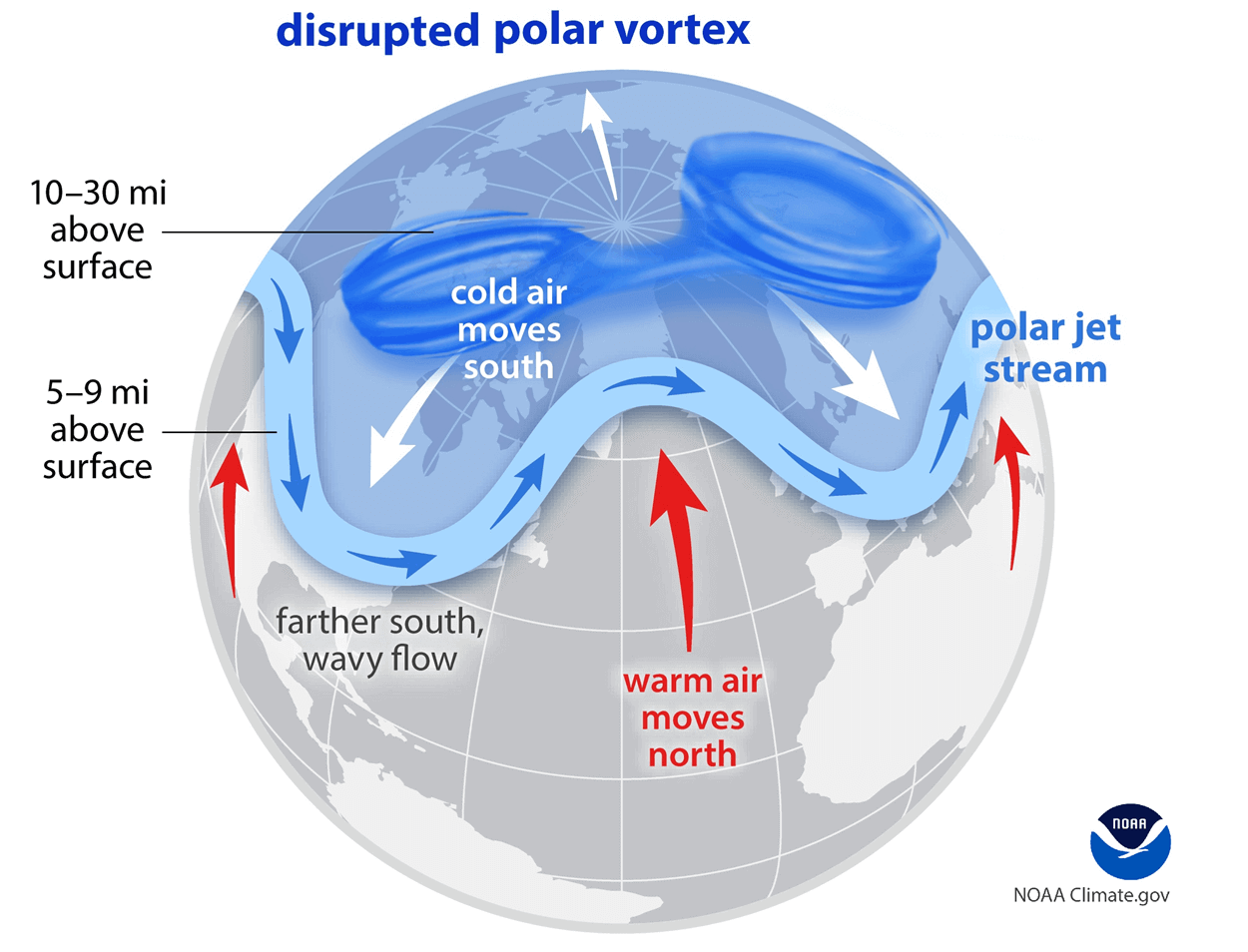
disrupted-polar-vortex-sudden-stratospheric-warming-winter-weather-forecast-pattern-snowfall-cold-arctic-air-into-united-states-canadadisrupted-polar-vortex-sudden-stratospheric-warming-winter-weather-forecast-pattern-snowfall-cold-arctic-air-into-united-states-canada

This weak/disrupted Polar Vortex is exactly what you want to see if you like cold weather across the United States, Canada, and Europe. The disruption itself usually comes from the rise in pressure and temperature in the stratosphere, called a Stratospheric Warming (SSW) event.

To better understand what the Polar Vortex is, we produced a high-resolution video below. It shows the latest Polar Vortex forecast in 3D, revealing the upcoming disruption event. This will deform its structure and allow cold air to escape as the Polar Vortex core moves out of the polar regions.

Now, we will look at the latest state of the Polar Vortex and how its disruption will bring down the coldest air of the season so far across the United States and Canada, and a cold wave into Europe. 

The First Disruption: A Chain of Events Begins

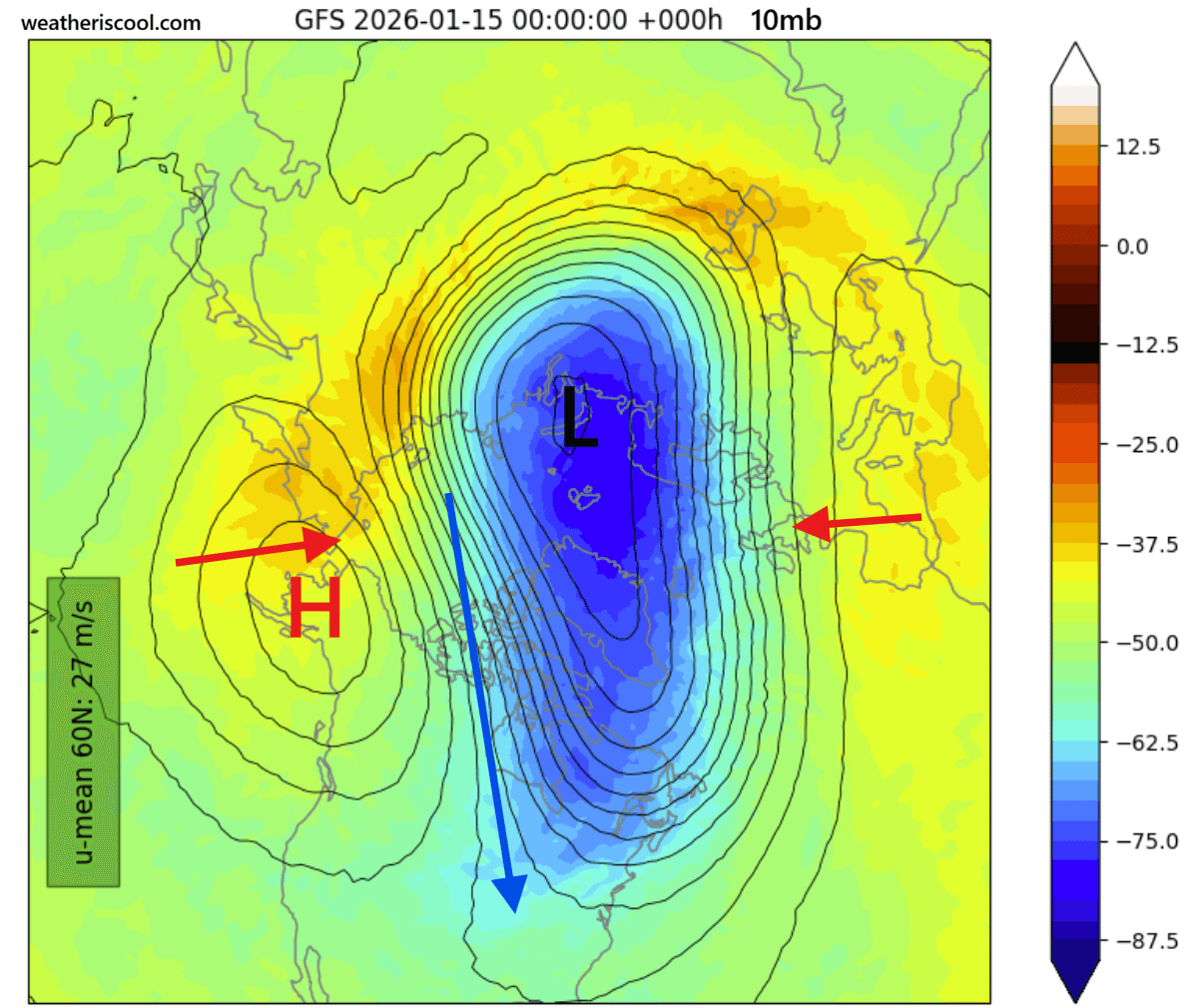
The latest analysis shows that the Polar Vortex is currently in an elongated shape, also known as a “stretched” vortex. Below you can see geopotential height and temperature analysis in the mid-stratosphere at the 10mb level (30km/18.5miles height). Such elongation can help to produce a northerly flow into North America. Image by weatheriscool.com
polar-vortex-north-hemisphere-analysis-january-temperature-pressure-area-stratosphere-10mb-level-deformationpolar-vortex-north-hemisphere-analysis-january-temperature-pressure-area-stratosphere-10mb-level-deformation

Especially in cases with a strong North Pacific high-pressure area, it can really bend the jet stream down into the United States, allowing a cold air outbreak.

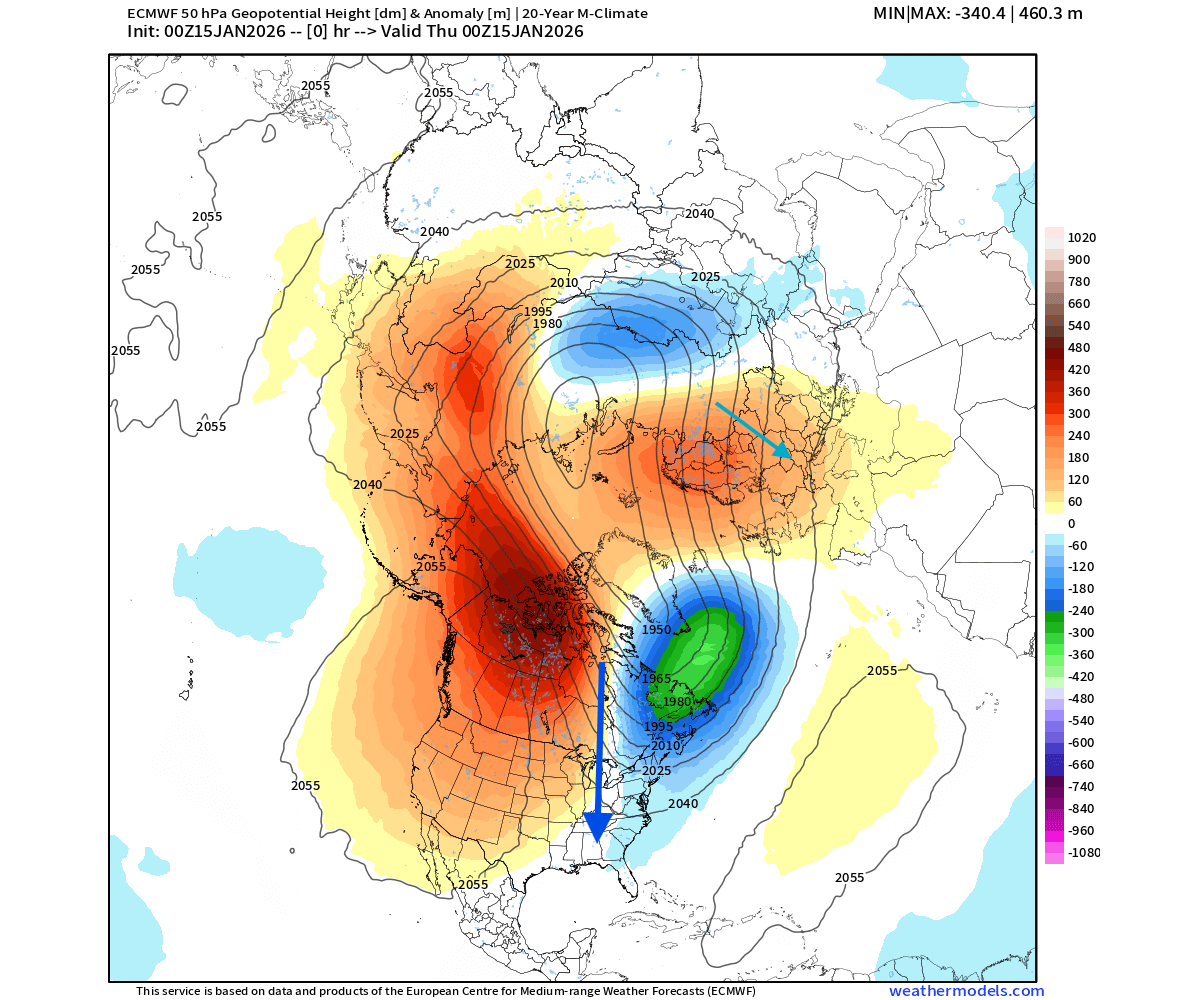
In the forecast graphic below, you can see the pressure anomaly forecast for the lower stratosphere at the 50mb level (20km/12.4 miles). It shows a strong high-pressure anomaly over northern Canada and a displaced Polar Vortex core. This supports the northerly flow at the surface levels over the eastern U.S., with the core reaching into eastern Canada.
polar-vortex-north-hemisphere-analysis-mid-january-pressure-anomaly-stratosphere-50mb-latestpolar-vortex-north-hemisphere-analysis-mid-january-pressure-anomaly-stratosphere-50mb-latest

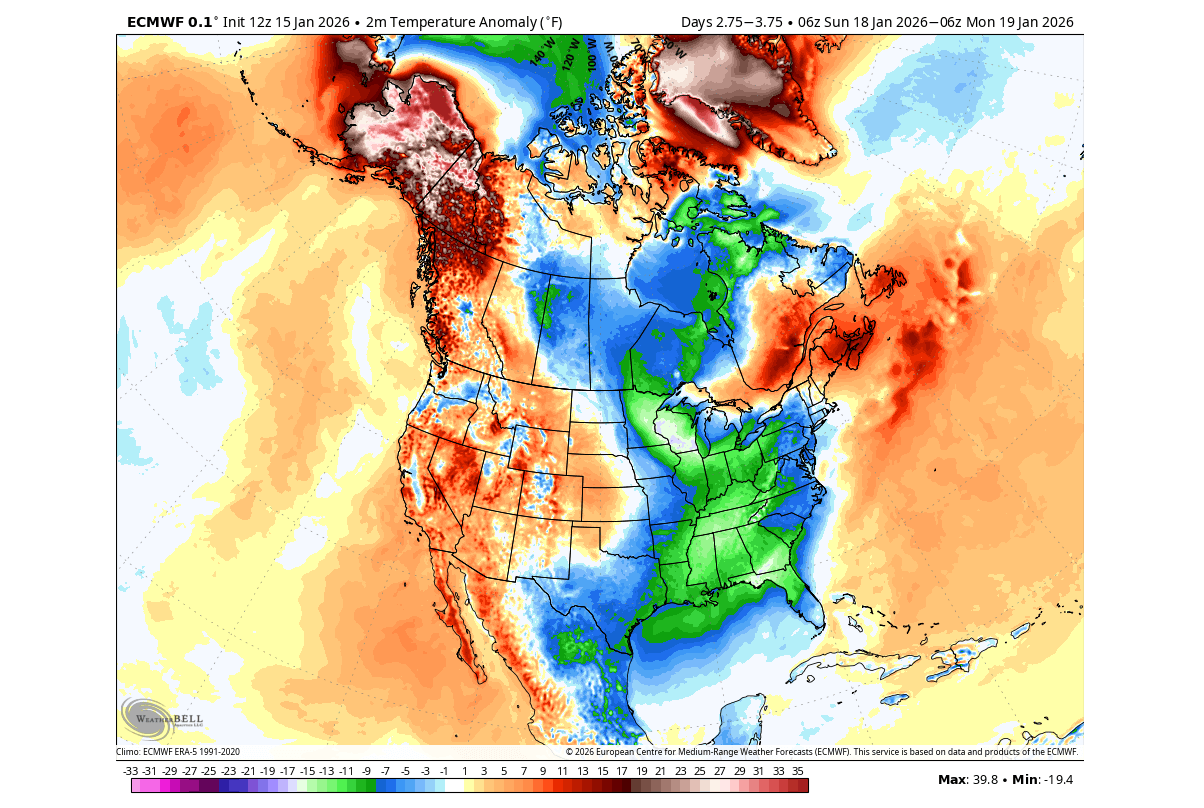
This is nicely seen in the temperature forecast below for the next few days. You can see a strong cold-air corridor into southern Canada, extending into the northern, central, and eastern United States, reaching down into the southeast and Florida. This is the direct reflection of the Polar Vortex core moving aloft.
january-weather-temperature-forecast-anomaly-united-states-canada-strong-deep-cold-polar-vortex-disruption-day-1-3january-weather-temperature-forecast-anomaly-united-states-canada-strong-deep-cold-polar-vortex-disruption-day-1-3

Looking over Europe in this period, you can see colder air returning at the surface levels, under a high-pressure anomaly. This means very likely inversion and cold air pooling at the surface levels, with the cold airmass coming from the east.

forecast-january-surface-temperature-anomaly-united-states-canada-cold-polar-vortex-disruption-europeforecast-january-surface-temperature-anomaly-united-states-canada-cold-polar-vortex-disruption-europe

But as you will see, this is just the start of the Polar Vortex disruption, with another cold air wave to arrive as the Polar Vortex becomes more unstable

A New Stratospheric Warming Signal

As mentioned, the Polar Vortex gets unstable with a rise in pressure and temperature in the stratosphere, putting stress on its structure. This is also known as a Stratospheric Warming Event (SSW). It can be a major one or a minor one, but it can always have an impact on the Polar Vortex and the weather below.

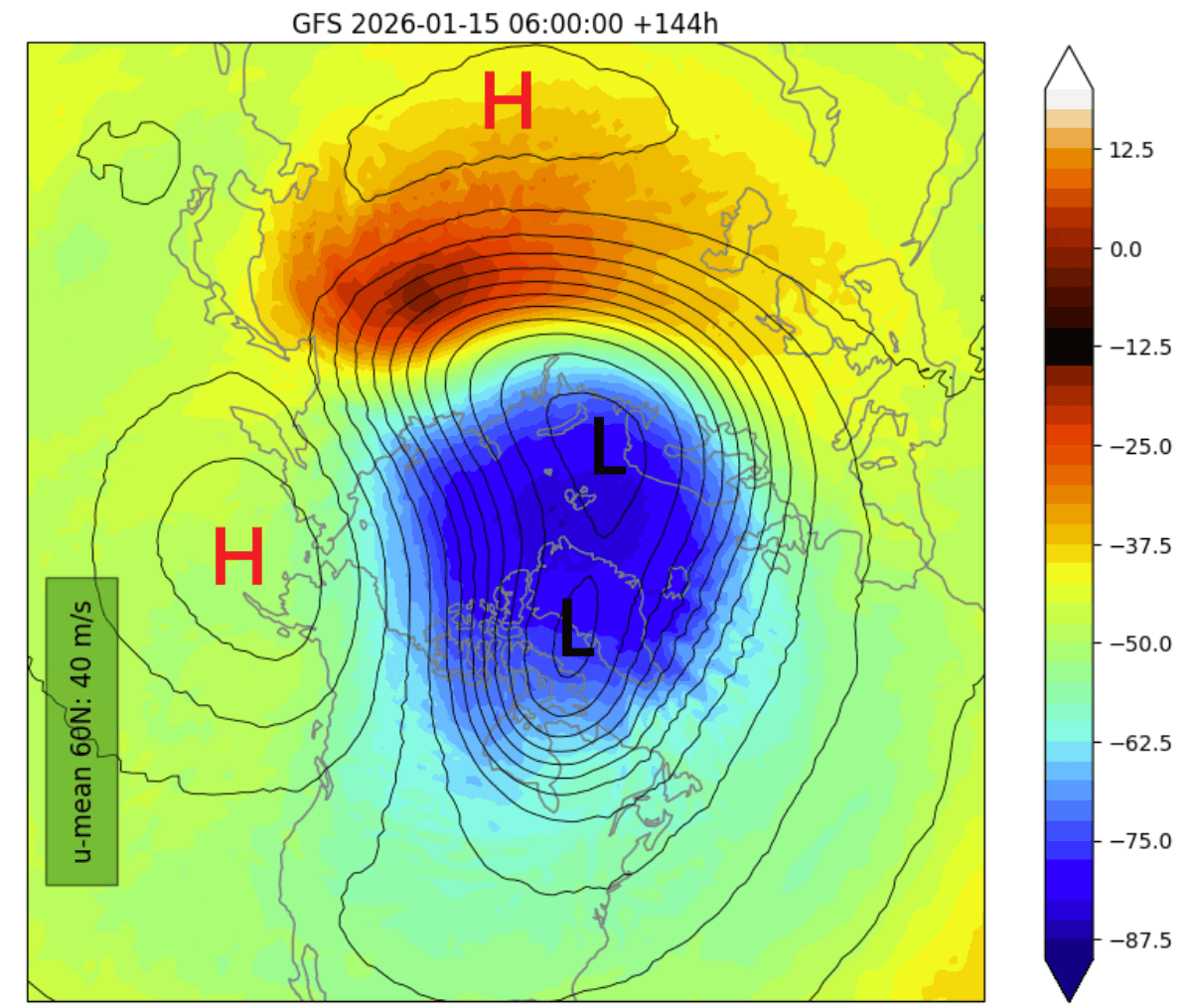
Below is the GFS pressure and temperature forecast for early next week, in the mid-stratosphere at the 10mb level (30km/18.5miles height). You can see a strong high-pressure area (H) in the mid-stratosphere, and a strong warming wave starting between the pressure zones.
stratospheric-warming-polar-vortex-forecast-disruption-10mb-pressure-temperature-latest-2026-united-states-canada-arctic-airstratospheric-warming-polar-vortex-forecast-disruption-10mb-pressure-temperature-latest-2026-united-states-canada-arctic-air

This would count as a weaker stratospheric warming event, since the Polar Vortex is not collapsed, and the stratospheric winds are not reversed. But you can see the deformation of the Polar Vortex structure, a core split, and this is a prelude to the second phase of disruption coming a few days later.

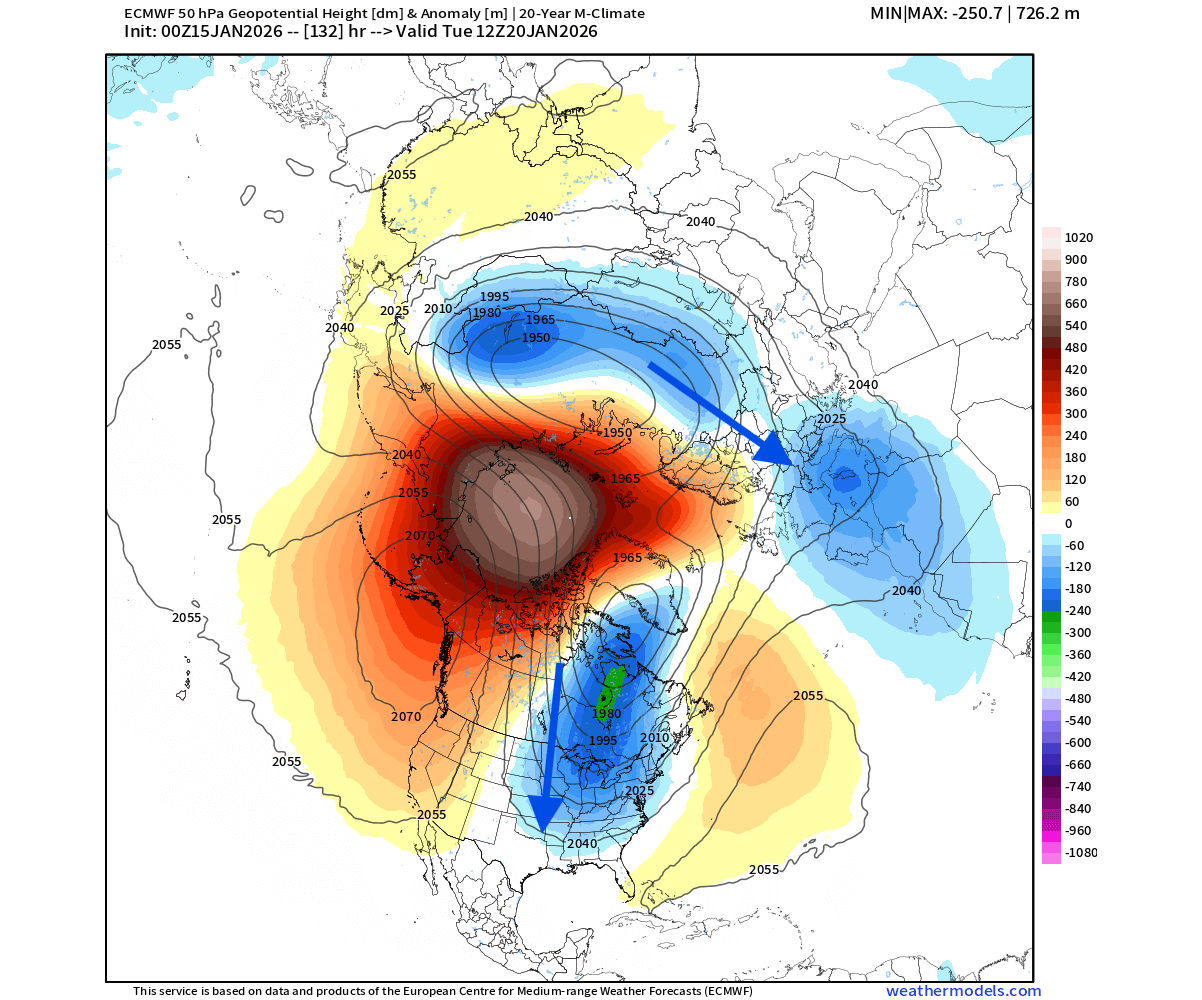
Below is the lower stratosphere pressure anomaly forecast, also for early next week. In this image, you can clearly see the large high-pressure anomaly in the lower stratosphere at the 50mb level (20km/12.4 miles), disrupting the Polar Vortex, creating a stronger core split, and sending one core into North America, to impact the United States and Canada.
polar-vortex-north-hemisphere-forecast-mid-january-pressure-anomaly-stratosphere-50mbpolar-vortex-north-hemisphere-forecast-mid-january-pressure-anomaly-stratosphere-50mb

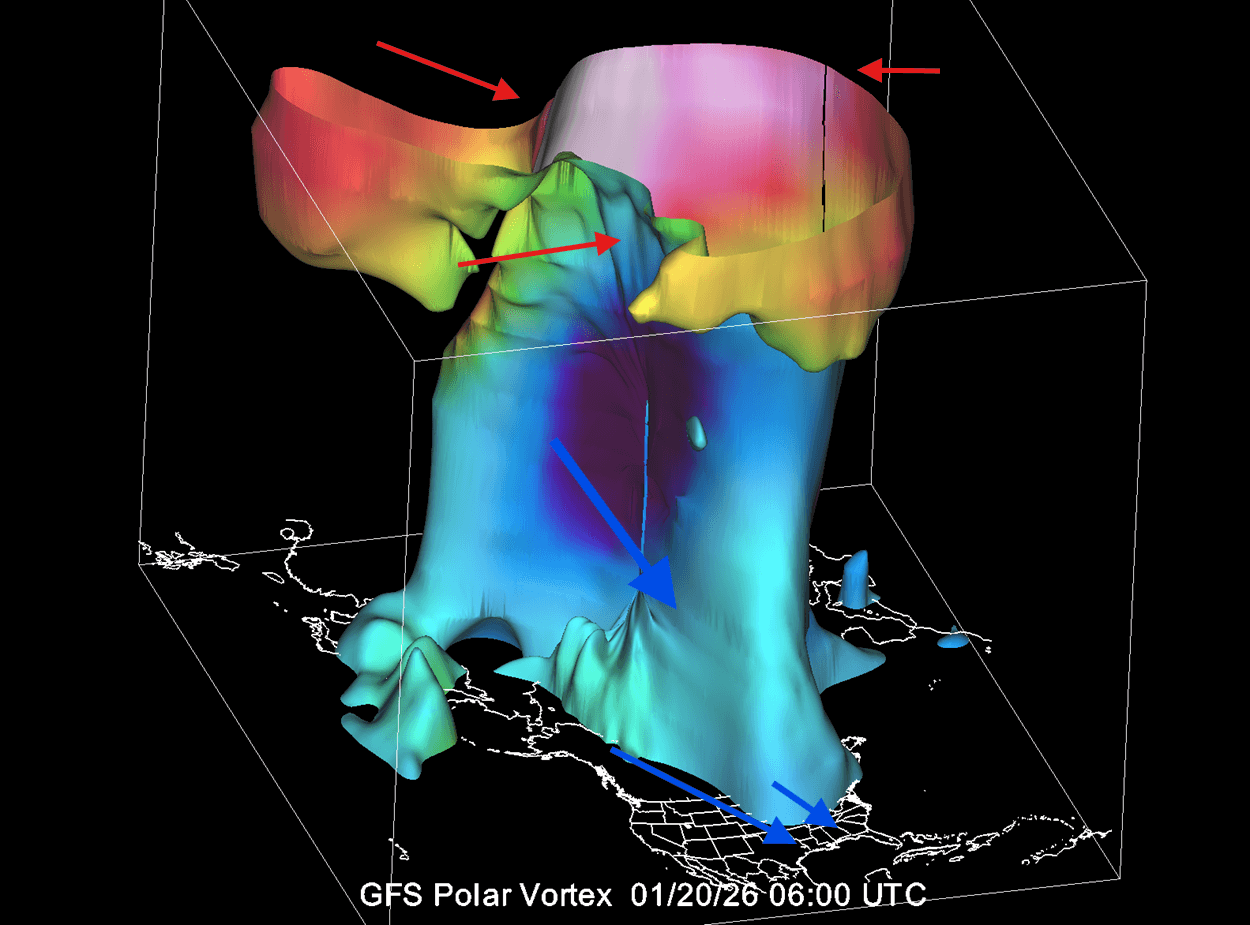
We also produced a 3D forecast of the Polar Vortex for this period. You can see the disruption and warming in the upper stratospheric levels. That translates into the whole structure, where you can also see how the Polar Vortex is “compressed” from the strong high-pressure systems in the lower levels. So its a combined effort of the atmosphere to disrupt the Polar Vortex.
stratospheric-polar-vortex-3-dimensional-structure-forecast-january-new-disruptionstratospheric-polar-vortex-3-dimensional-structure-forecast-january-new-disruption

The main result of this deformation, as you can nicely see in the 3D image above, is the arrival of the lower foot of the Polar Vortex into North America, connected to the core structure of the Polar Vortex.

Usually, when we see a Polar Vortex structure like that, it’s almost certain that a cold air release is coming. We can easily track where the cold air will land by finding where its core and “foot” are. This usually signals that the Arctic floodgates have opened.

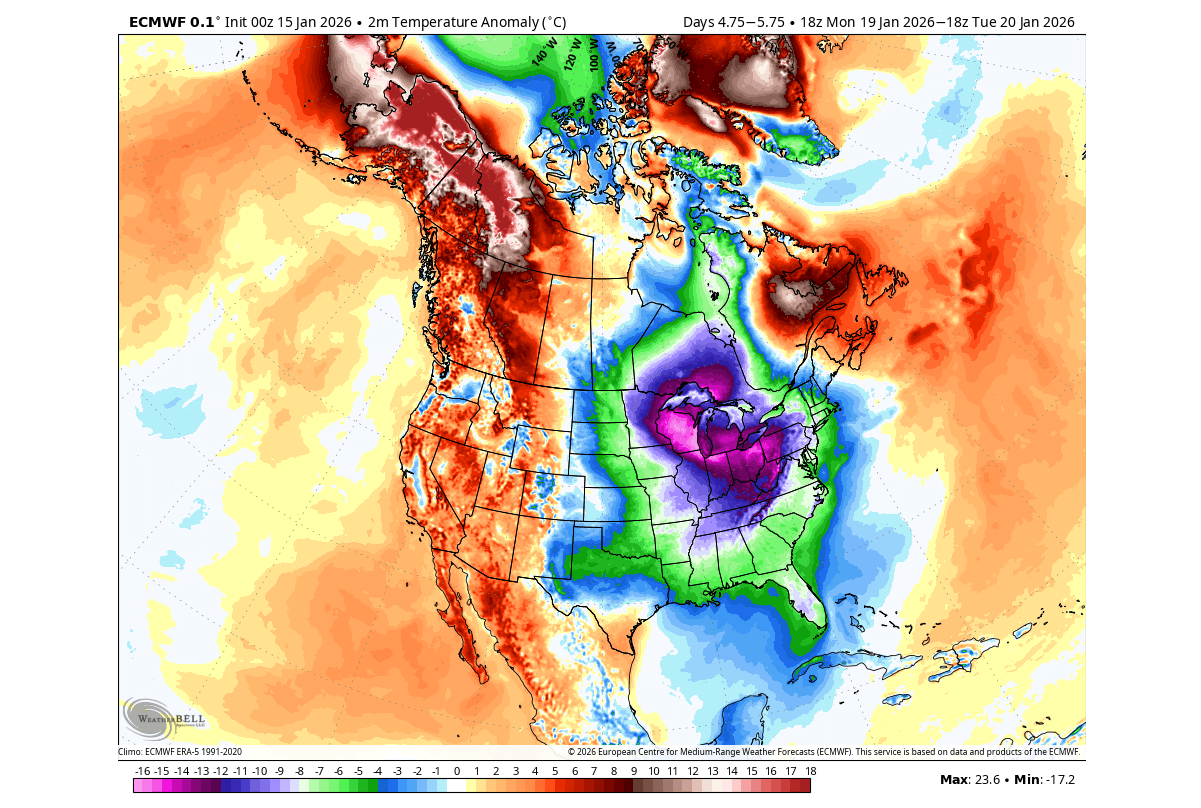
Below is the temperature anomaly forecast from ECMWF for early next week. You can see a strong cold-air anomaly spanning from southern Canada into the whole central and eastern United States. The strongest cold anomaly is found over the Midwest, but anomalous cold air will reach far down to the south and the northeast.
winter-january-2026-temperature-cold-air-forecast-united-states-canada-europe-polar-vortex-armswinter-january-2026-temperature-cold-air-forecast-united-states-canada-europe-polar-vortex-arms

The lowest U.S. temperatures in this period are expected across the Midwest and the Northeastern United States, going below 0-5°F, with parts reaching below 0°F. The far northeast and the upper Midwest can see minimum temperatures in this period reach between -5°F and -10°F. Near-freezing lows can reach the south coast and northern Florida.

Southeastern Canada may experience temperatures as low as -25°F to -30°F (-30°C to -35°C) during the cold next week.

Current forecasts also show good snowfall potential in the next 7 days. Below is the ECMWF total snowfall forecast, with snowfall detected over a large part of the Midwest, also with decent amounts around the Great Lakes, due to lake-effect snowfall.
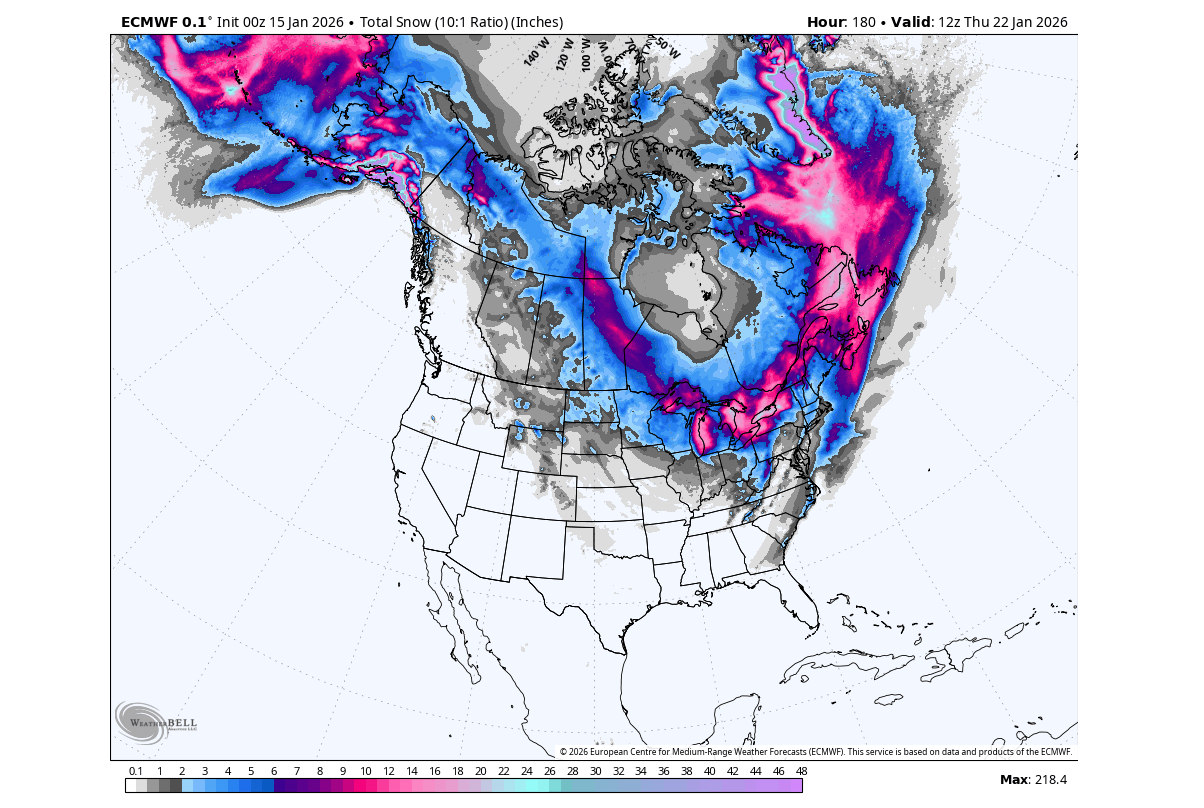
winter-january-2026-snowfall-forecast-cold-air-united-states-canada-polar-vortexwinter-january-2026-snowfall-forecast-cold-air-united-states-canada-polar-vortex

Looking over Europe in this period, you can see colder air coverage increasing towards the west. The western and southwestern parts can reach near or below freezing, with lowlands in the central parts going below -5°C to -10°C, and even lower to the east.
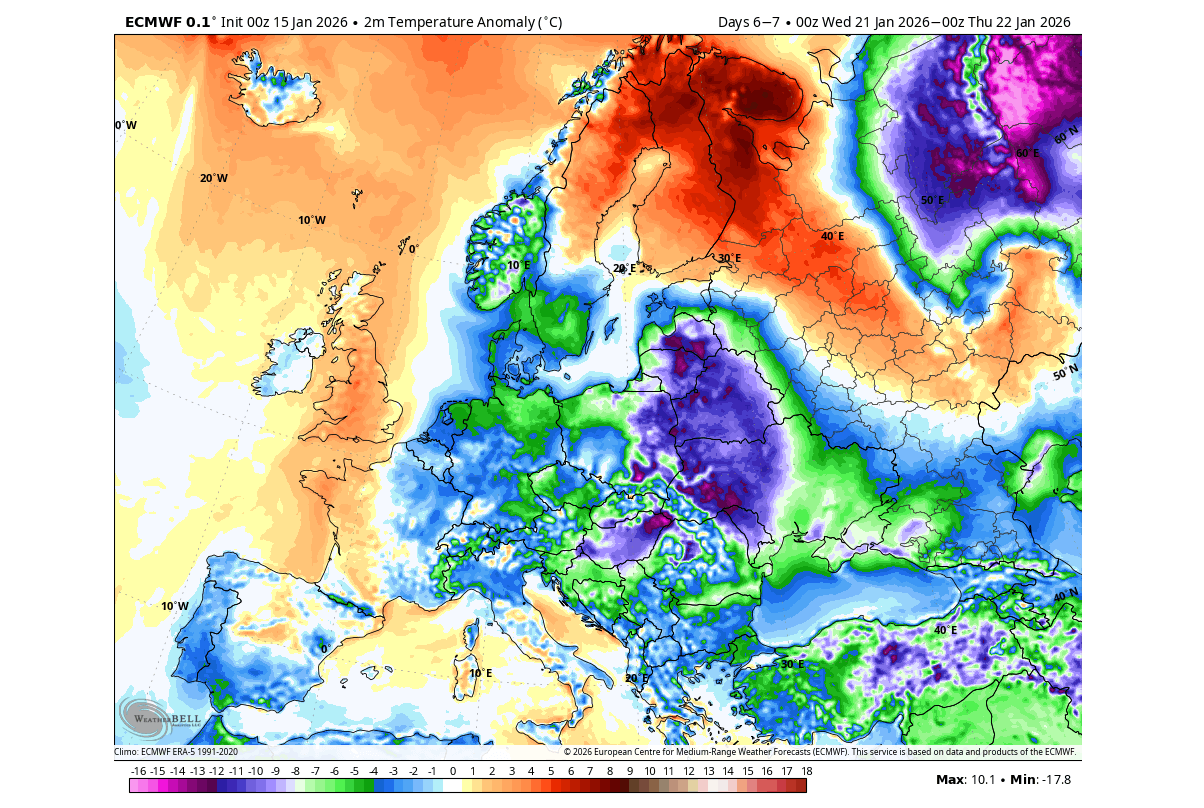
winter-mid-january-2026-surface-temperature-forecast-cold-air-europe-polar-vortex-armwinter-mid-january-2026-surface-temperature-forecast-cold-air-europe-polar-vortex-arm

This is a typical result of a very disrupted Polar Vortex circulation at the lower levels. But the latest forecasts show an even stronger disruption is coming, fully opening the Arctic gates in the last week of January. 

Stratospheric Disruption and Breakdown

We will first look at the 3D forecast of the Polar Vortex for the final days of January. There is a very obvious stratospheric warming anomaly in the stratosphere, strongly disrupting the Polar Vortex. That deforms the whole structure, making the lower Polar Vortex push out its cold “feet” into the United States and also Europe.
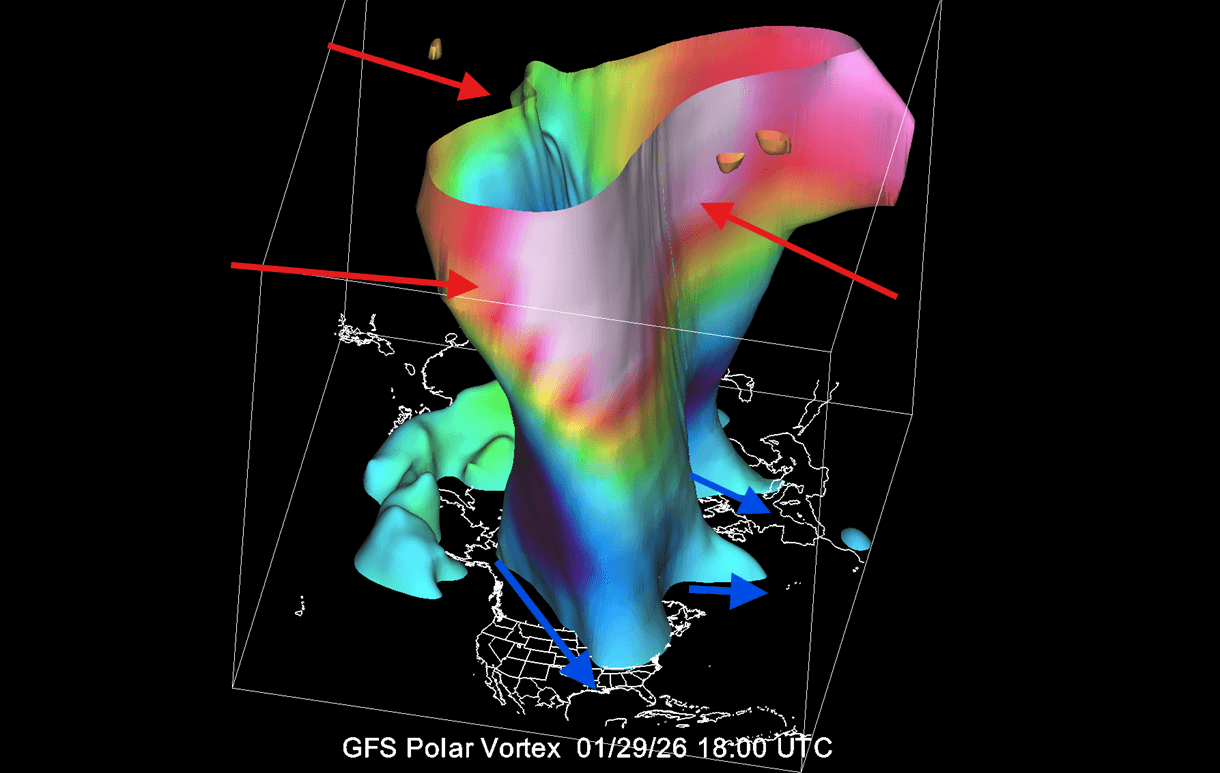
stratospheric-polar-vortex-3-dimensional-disruption-forecast-january-cold-arms-united-states-europestratospheric-polar-vortex-3-dimensional-disruption-forecast-january-cold-arms-united-states-europe

We can see this strong shift if we look at the pressure anomaly in the lower stratosphere at the 50mb level (20km/12.4 miles). You can see a spectacular low-pressure anomaly as the main core of the Polar Vortex gets pushed into North America. This is a very strong event, with the lower core of the stratospheric vortex rarely reaching this far down.
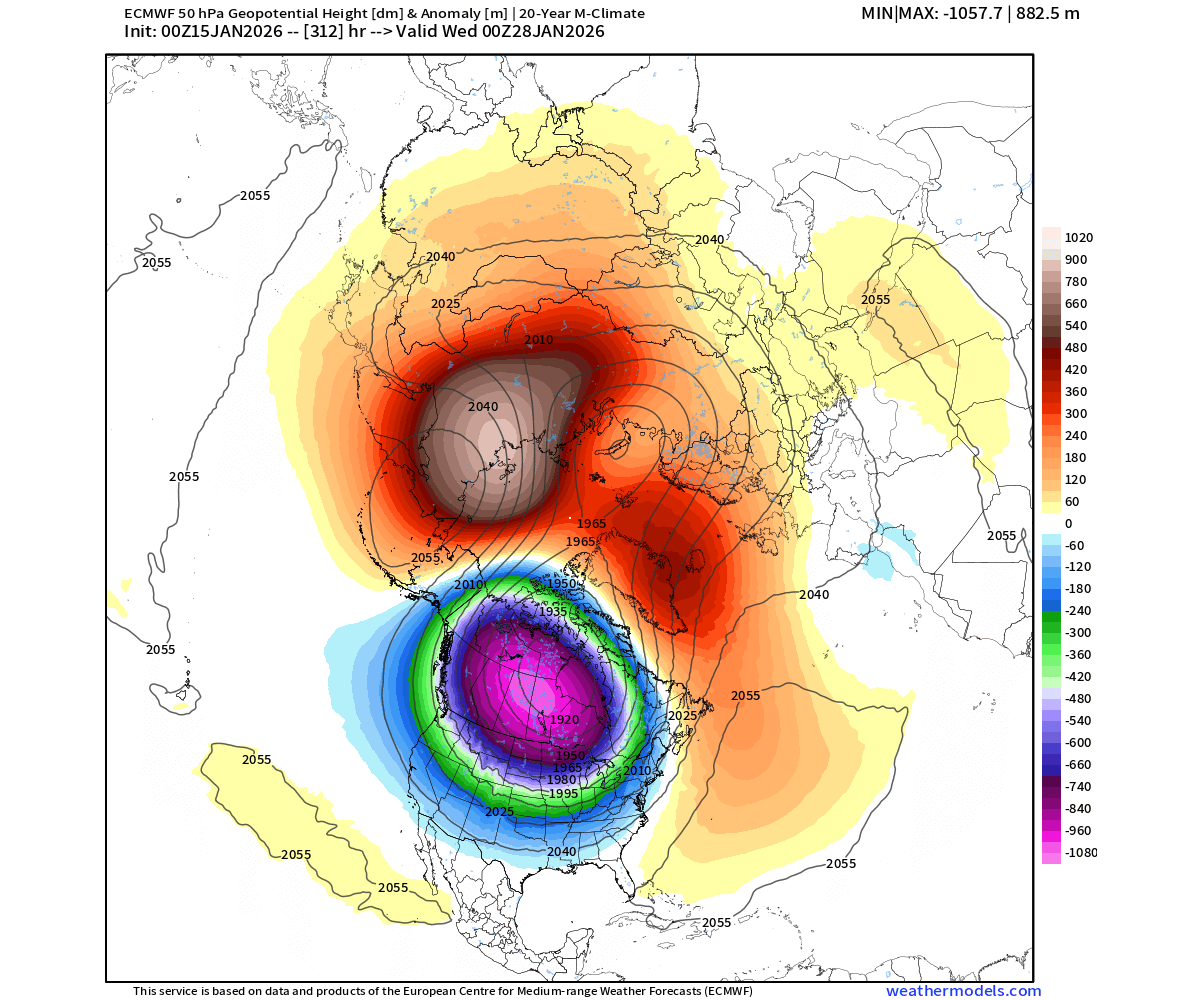
polar-vortex-disruption-united-states-canada-day-15-forecast-pressure-anomaly-50mb-strong-core-north-americapolar-vortex-disruption-united-states-canada-day-15-forecast-pressure-anomaly-50mb-strong-core-north-america

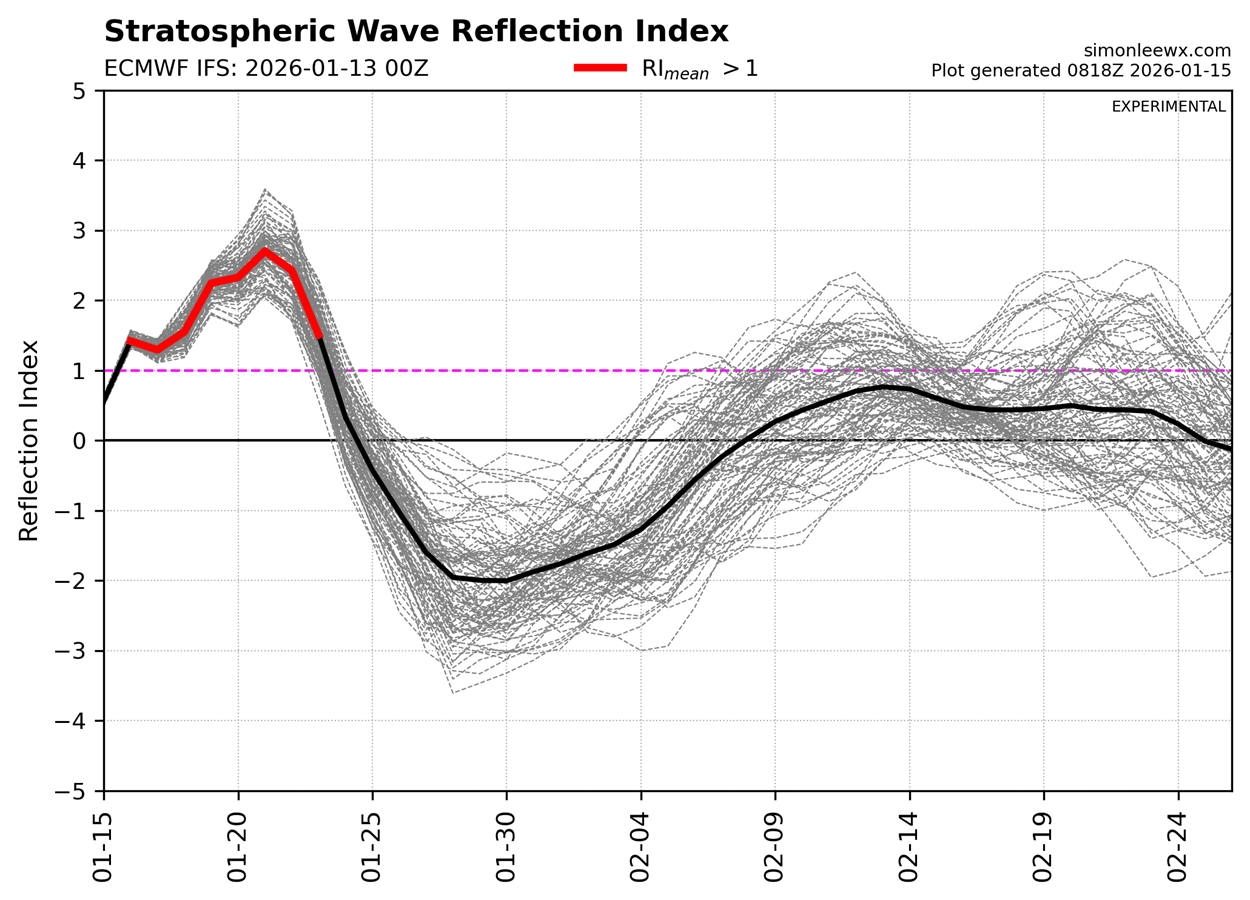
The reason for such a strong disruption event is not only the warming in the stratosphere, but also the strong high-pressure systems in the lower levels of the atmosphere. Below is a special forecast that shows the wave reflection into the stratosphere. You can see a peak in the next two weeks, generating the outcome above. Image by Simon Lee
winter-stratospheric-polar-vortex-disruption-wave-reflection-event-forecast-ensemblewinter-stratospheric-polar-vortex-disruption-wave-reflection-event-forecast-ensemble

In simple terms, a stratospheric wave reflection is like a massive atmospheric ricochet. The energy from large pressure systems moves upward into the high atmosphere, but during a reflection event, it hits a “ceiling” in the Stratosphere and bounces back down to Earth.

This returning energy slams into the lower atmosphere, disrupting the Polar Vortex and the jet stream, opening the Arctic gates to freezing air, sending it into North America and/or Europe.

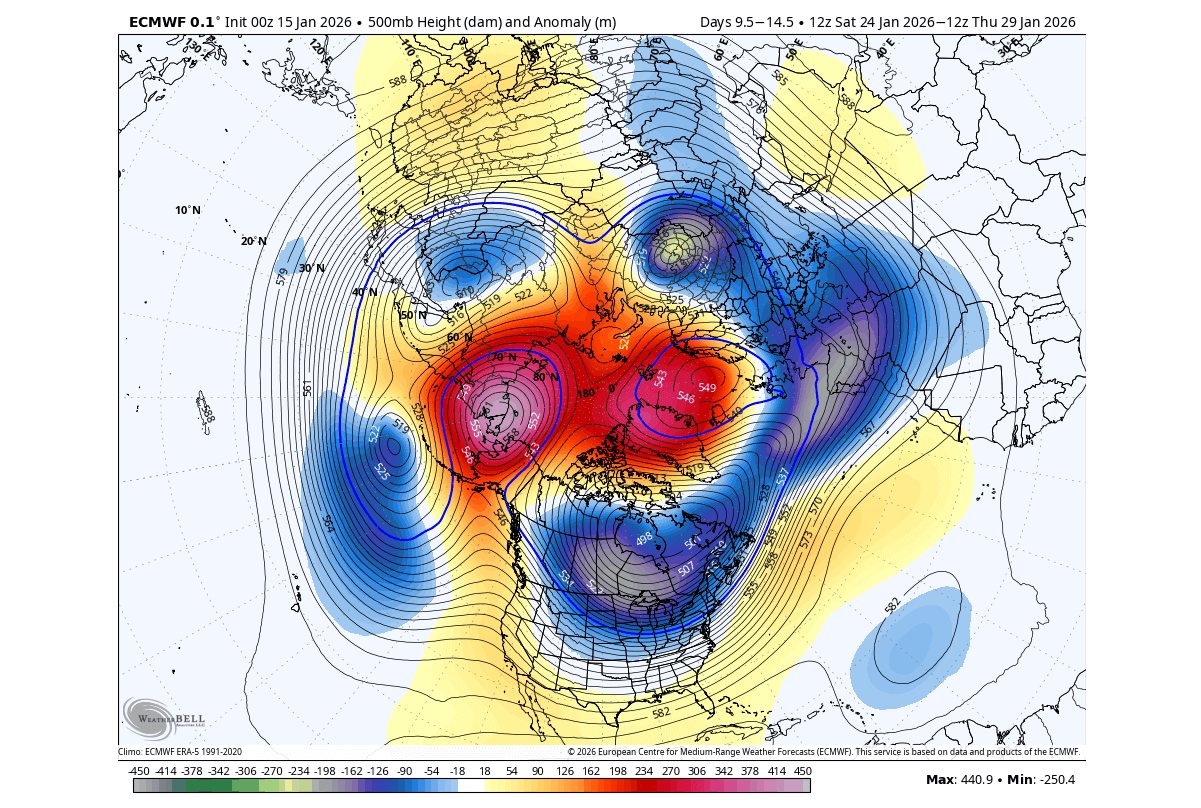
Below is the 500mb pressure anomaly forecast for late January, and it shows a perfect example of the cause/effect for a Polar Vortex disruption and a reflection event. Strong high pressure blocking over the polar regions acts like a “hammer”, dropping down on the cold air, pushing it out into the United States and Europe.
winter-forecast-late-january-pressure-anomaly-ecmwf-united-states-canada-lower-polar-vortex-breakdownwinter-forecast-late-january-pressure-anomaly-ecmwf-united-states-canada-lower-polar-vortex-breakdown

You can see an overall disrupted look, which is usually a clear sign of a complete breakdown of the polar circulation in the lower levels.

We can also see this below on the vertical pressure forecast for late January, from the surface to the top of the stratosphere. You can see the Polar Vortex broken into two “legs” connecting down into the United States and Europe. This shows the direct connection of Polar Vortex cores to the surface.

winter-polar-vortex-disruption-united-states-canada-cold-core-pressure-anomaly-vertical-forecast-januarywinter-polar-vortex-disruption-united-states-canada-cold-core-pressure-anomaly-vertical-forecast-january

This shows the direct impact and influence that this Polar Vortex disruption is forecast to have. But what can we actually expect in terms of cold and snow? 

The Arctic Floodgates Open

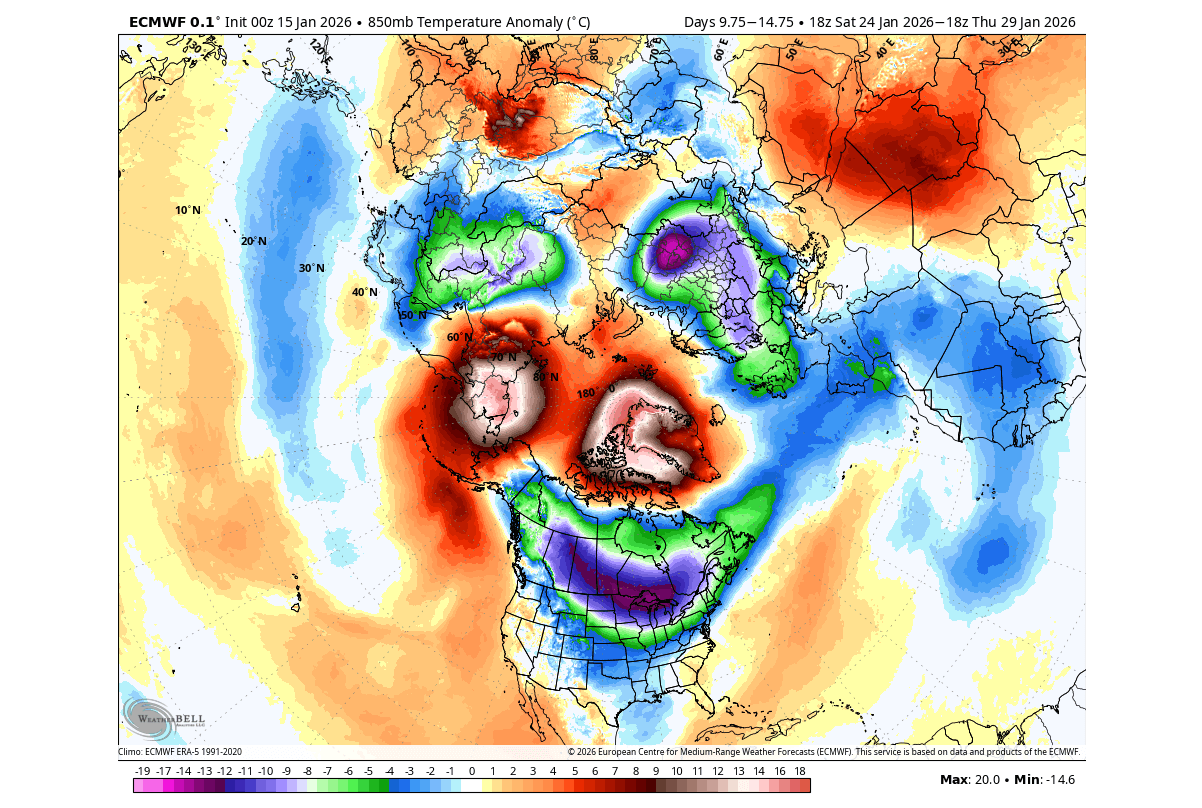
The airmass temperature anomaly for days 10-15 really nicely reveals the whole “Arctic floodgates” process. You can see the complete temperature reversal, where warmer-than-normal air reaches into the Polar circle, pushing the cold air out into the mid-latitudes as the polar circulation breaks down, and the Polar Vortex “walls” are unable to hold the cold air any longer.
winter-forecast-late-january-airmass-temperature-anomaly-ecmwf-united-states-canada-stratospheric-disruption-polar-vortex-corewinter-forecast-late-january-airmass-temperature-anomaly-ecmwf-united-states-canada-stratospheric-disruption-polar-vortex-core

The forecast above is for the airmass anomaly, which is at the 850mb level, around 1500m (5000ft). This allows us to track the large-scale movement of colder and warmer air.

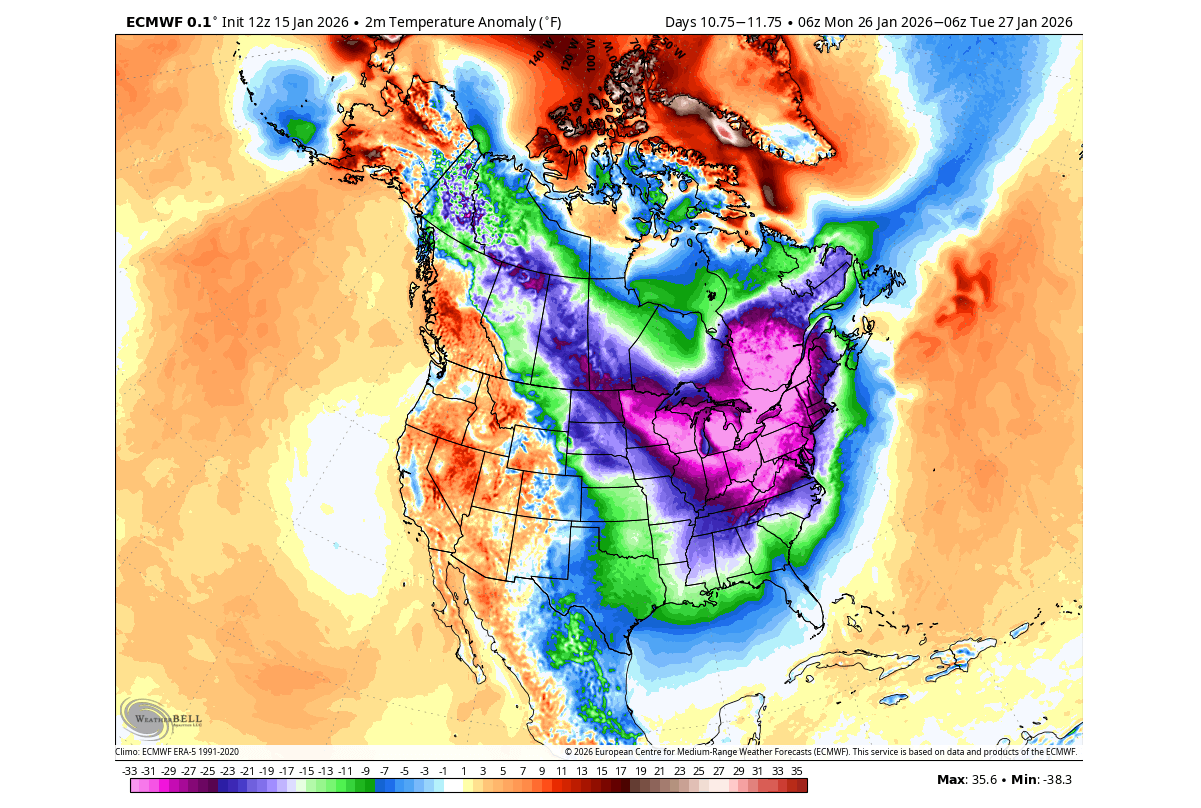
Looking at the surface temperatures now, you can see a high-resolution forecast from ECMWF for around the 26th. It shows the temperature anomaly, revealing a strong cold air outbreak, with temperatures reaching 20°F to over 35°F below normal. It truly is as strong as it looks.
winter-forecast-late-january-temperature-airmass-anomaly-united-states-canada-arctic-cold-polar-vortexwinter-forecast-late-january-temperature-airmass-anomaly-united-states-canada-arctic-cold-polar-vortex

Keep in mind that an anomaly shows the above/below temperatures compared to the normal (long-term) values. So having a forecast 30°F below normal in late January is much stronger than in early December, as the normal values are lower.

Also note that this is a single-run example of the potential scenario. While this is around 10 days ahead, it’s starting to come into the more reliable range. But the main idea is in place, for a major cold air outburst from the Polar regions.

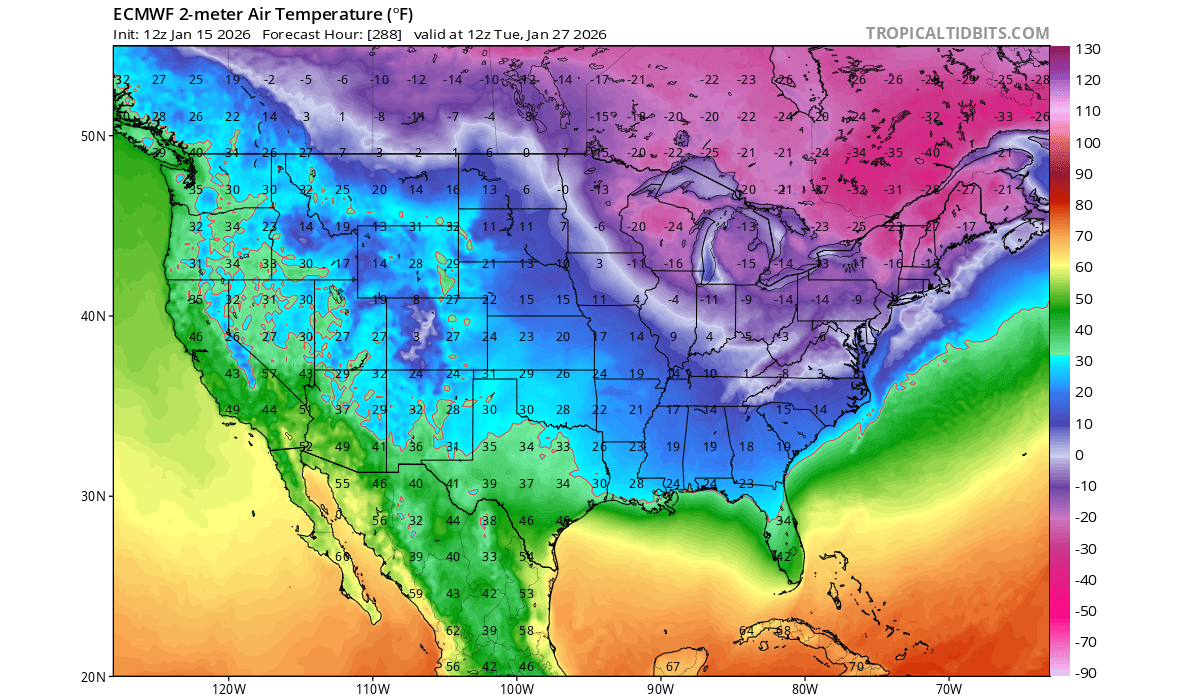
A cold outbreak of this magnitude is forecast to bring some of the coldest temperatures of the season so far across southeastern Canada and the United States. Below you can see examples of the lowest temperatures in southeastern Canada reaching down to -35°F and lower, peaking near -40°F too.
winter-forecast-late-january-lowest-surface-temperature-united-states-canada-cold-arctic-air-polar-vortexwinter-forecast-late-january-lowest-surface-temperature-united-states-canada-cold-arctic-air-polar-vortex

A large part of the Midwest shows negative temperatures, reaching down to -20°F in the upper Midwest, and below -25°F in parts of the Northeast. Freezing temperatures are forecast to cover much of the country, including northern Florida, with low 30s and low 40s as the highest in the country over the southwestern United States.

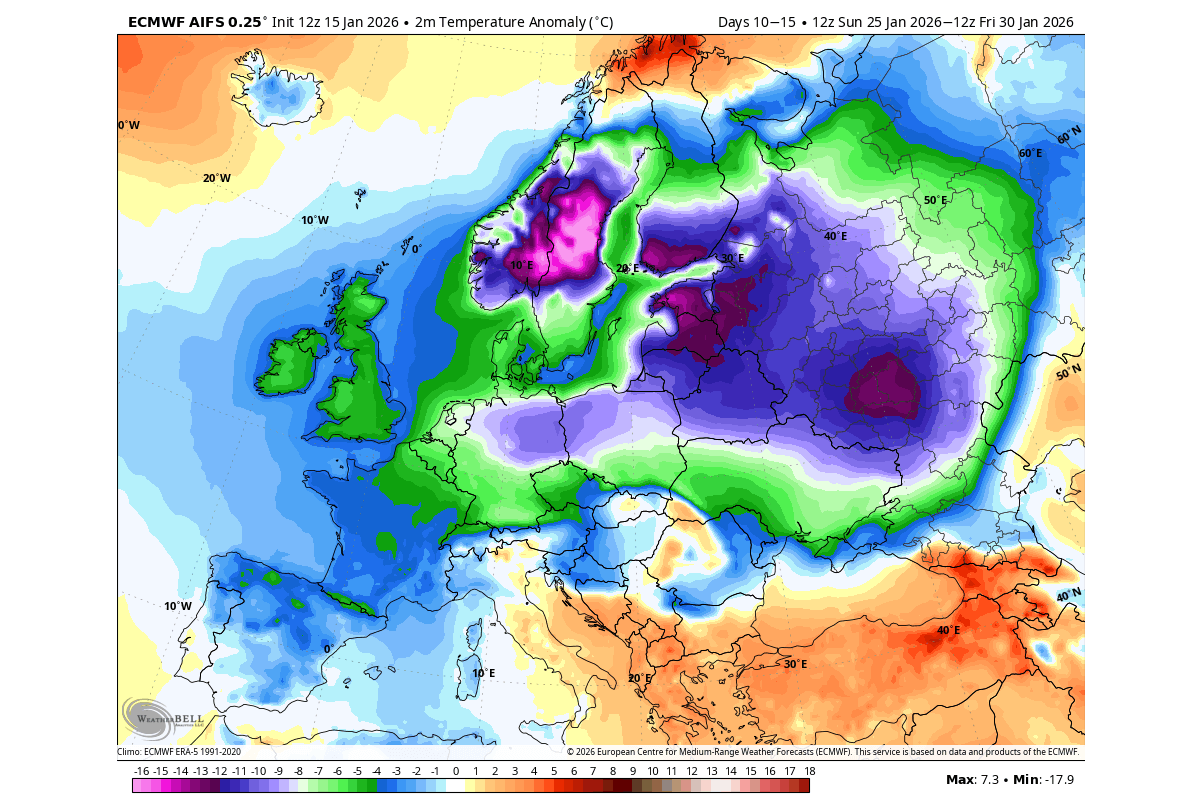
Looking at Europe, the temperature anomaly forecast for this period shows a supply of colder air over the northern parts. But because there is a low-pressure area in the North Atlantic, this is likely to create a (brief) mild period over the western and southern parts.
winter-forecast-late-january-temperature-anomaly-europe-cold-polar-vortexwinter-forecast-late-january-temperature-anomaly-europe-cold-polar-vortex

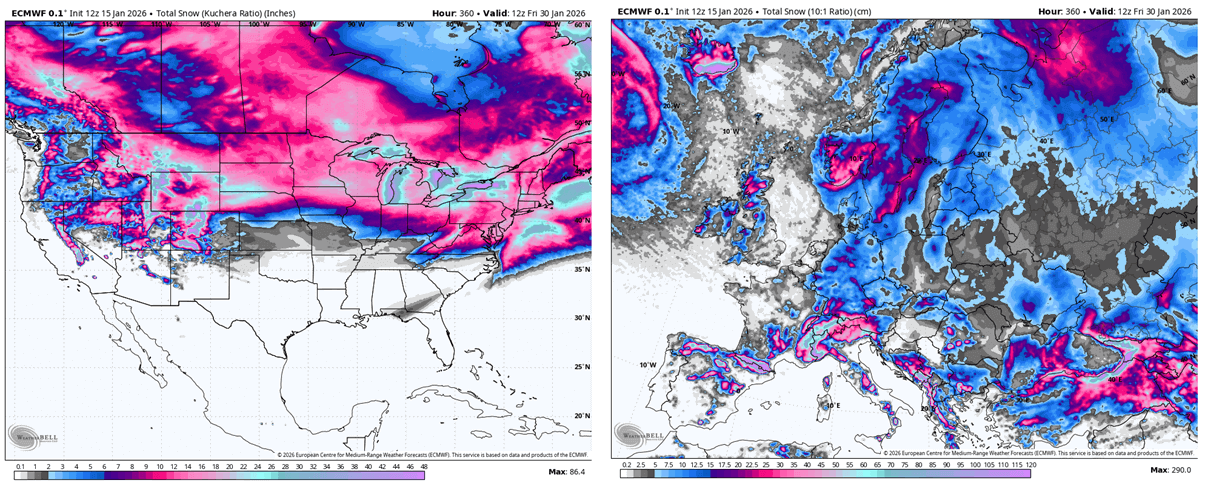
Looking at the total snowfall forecast for the next two weeks, you can see that a good amount of snowfall can come with the cold air. This is just a single run forecast, but serves as a great example of the true winter potential of this cold airmass. Over half of the United States will see snowfall at some point by the end of January.
winter-january-2026-snowfall-forecast-cold-air-united-states-canada-europe-polar-vortex-disruptionwinter-january-2026-snowfall-forecast-cold-air-united-states-canada-europe-polar-vortex-disruption

Over Europe, the snowfall coverage is also great, with snowfall reaching down into the southern parts and deep towards the southeast. On the North American side of the forecast, you can also see the strong snowfall around the Great Lakes, due to lake-effect snow.

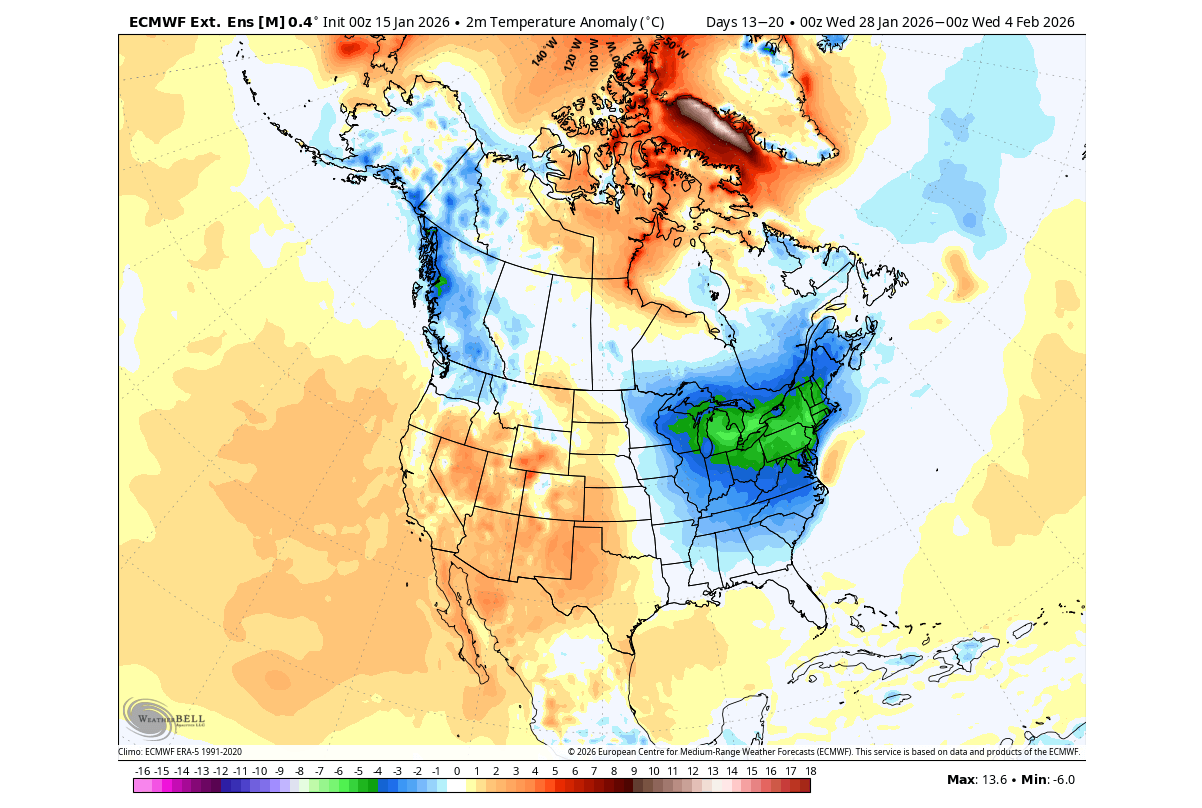
But going further ahead into early February, the ECMWF extended ensemble temperature forecast shows support for continued cold air over the eastern and northeastern United States and southeastern Canada. This is a 7-day average, but the trends for now support the colder temperatures in the east, while warmer temperatures return over the western half.
winter-forecast-january-february-temperature-anomaly-united-states-canada-cold-polar-vortexwinter-forecast-january-february-temperature-anomaly-united-states-canada-cold-polar-vortex

Over Europe, the temperature forecast for this period shows the colder air covering most of the continent, under a northeasterly flow and lower pressure. This is just a trend forecast for now, but it shows a continued cold air push from the northeast, lasting into February.
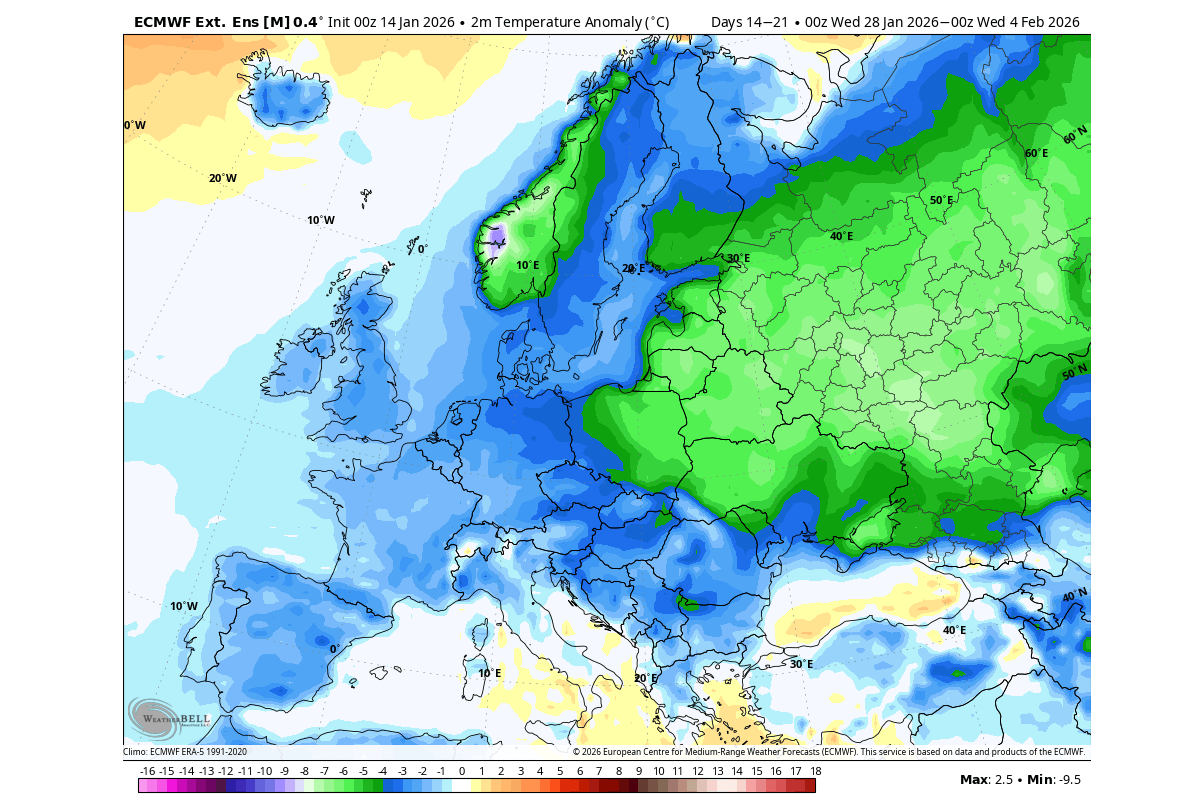
winter-forecast-january-february-temperature-airmass-anomaly-europe-cold-polar-vortexwinter-forecast-january-february-temperature-airmass-anomaly-europe-cold-polar-vortex

This article is based on the latest available model/ensemble data, and we will continue to release weekly updates on the developing Polar Vortex situation during the winter season.

We will keep you updated on the global weather pattern development, so don’t forget to bookmark our page. Also, if you have seen this article in the Google App (Discover) feed, click the like button (♥) there to see more of our forecasts and our latest articles on weather and nature in general.

The main forecast images in this article are from WeatherBell and weathermodels.com, using a commercial forecaster license.

Don’t miss:

La Niña Collapse Begins: A Major Pacific Flip that will Reshape the 2026 Weather Patterns

Additional relevant updates

Mae Martin to Host the 2026 Junos

The audio version of this article is generated by AI-based technology. Mispronunciations can occur. We are working with our partners to continually review and improve the results.

Comedian Mae Martin will host the 55th annual Juno Awards, organizers announced on Thursday morning.

Coming off their 2024 hosting gig at the Canadian Screen Awards — and No. 1 show, Wayward, premiering on Netflix late last year — they will be the first comedian to solo host the ceremony since Russell Peters in 2009.

“I remember coming here when I was 13 to be on a radio show and how nervous I was,” Martin said in an interview with CBC News at its Toronto headquarters. “I’m slightly less nervous today at age 38. So I hope that by the time I host the show, I’ll be feeling looped up and warm.”

The Toronto-born comedian, actor, writer and musician will take to the stage in Hamilton on March 29, just two years after their first Juno nomination for comedy album of the year.

Martin’s role comes after the Junos were presented by a string of repeat hosts: Michael Bublé took over the gig last year for his third time; Nelly Furtado hosted in 2024 for her second time; and the year before that, actor Simu Liu hosted his second ceremony in a row.

WATCH | Junos host Mae Martin takes the CBC’s rapid-fire questions:

Junos 2026 host Mae Martin takes rapid-fire questions

Comedian, actor and singer-songwriter Mae Martin will host the 2026 Junos, the Canadian Academy of Recording Arts and Sciences and the CBC has announced. But we wanted to know: Do they prefer knock-knock jokes or one-liners? Martin answered a round of rapid-fire questions with the CBC’s Griffin Jaeger.

Martin said their goal is for a loose, non-stuffy feeling — one with the energy of a live music show.

“So I hope the audience gets a little raucous,” they said.

The show will feature performances by R&B/soul musician Daniel Caesar — who will also receive the international achievement award — and folk/roots singer-songwriter William Prince, organizers shared.

Previously announced performers include Hamilton hometown rock band Arkells and Toronto’s the Beaches. Also previously announced, Joni Mitchell will receive a lifetime achievement award, while Furtado will be inducted into the Canadian Music Hall of Fame.

Martin’s stint comes at something of a turning point in the Canadian awards space. Largely inspired by a Canada-U.S. trade war and economic aggression from the country’s southern neighbour, there has been an increased focus on the value and distinctiveness of Canada’s artistic output.

Anne Murray at the 2025 Juno Awards.
Anne Murray speaks at the 2025 Juno Awards. While accepting her lifetime achievement award, the musician explained why she fought against relocating to the U.S. early on in her career. (Ryan Bolton/CARAS)

The 2025 Juno Awards largely operated as a repudiation of U.S. President Donald Trump’s threats that the United States should absorb Canada. At the show, Anne Murray sported a Canadian hockey jersey and called the country “my safe haven, my safety blanket, my light at the end of the tunnel.” And rapper bbno$ called Elon Musk — at the time a U.S. government official — “a piece of garbage,” to roaring applause.

“We are the greatest nation on Earth,” host Bublé said at the opening of the show. “And we are not for sale.”

In 2024, Martin’s turn at the Canadian Screen Awards put the focus on the health and viability of independent Canadian pop culture. In a tongue-in-cheek joke, Martin assured the crowd that their “mild jokes” were sure to save a film and television industry that the Globe and Mail had recently declared as being in “crisis mode.”

For the Junos, Martin said they are decisively more hopeful about the state of Canadian art. Given the success of their own Netflix show and the barn-burning popularity of hockey drama Heated Rivalry, they said they felt a “huge sense of pride” around celebrating Canadian content.

“I think the worse things get around us, the more we rally together and realize that we actually do have a really distinct cultural identity,” Martin said.

“It just takes a handful of things to break through and show people that, yeah, Canadian content has global appeal and what hard-working artists there are here.”

This year’s awards will see a few category changes. Latin music recording of the year will be awarded for the first time, while rap album/EP and rap single of the year have updated eligibility requirements. Only vocalists who are Canadian citizens or permanent residents can be nominated, according to the Junos website, to ensure “that the spotlight remains on homegrown talent and supports the continued growth of Canada’s thriving hip-hop community.”

The 55th annual Juno Awards will take place on March 29 at Hamilton’s recently renovated TD Coliseum. The show will air on CBC-TV, CBC Gem, CBC Radio One, CBC Music and CBC Listen — and stream on CBC Music’s YouTube Channel — live at 8 p.m. ET.

Stay-tuned with us on our website