The rapid evolution of technology has led to significant changes in the way we conduct transactions. Cryptocurrencies, the digital currencies that leverage blockchain technology, have emerged as a viable alternative to traditional fiat currencies. This article explores the future of payments and whether cryptocurrencies are poised to replace traditional currency.
Understanding Cryptocurrencies
Cryptocurrencies are decentralized digital assets that utilize cryptography for security. Bitcoin, created in 2009, was the first cryptocurrency and remains the most recognized. Other notable cryptocurrencies include Ethereum, Ripple, and Litecoin. Their appeal lies in their potential for lower transaction fees, borderless transactions, and financial inclusivity.
The Advantages of Using Cryptocurrencies
Decentralization: Unlike traditional currencies, which are regulated by governments, cryptocurrencies operate on decentralized networks.
Transparency: Blockchain technology provides a transparent transaction history, enhancing trust among users.
Low Transaction Costs: Cryptocurrency transactions often incur lower fees than traditional banking systems.
Speed: Transactions can be processed quickly, often in minutes, regardless of geographic location.
Challenges of Cryptocurrencies
Despite the advantages, several challenges need to be addressed before cryptocurrencies can fully replace traditional currencies. These include:
Volatility: The value of cryptocurrencies can fluctuate wildly, posing a risk for users and merchants.
Regulatory Issues: Governments around the world are still determining how to regulate cryptocurrencies, impacting their adoption.
Security Concerns: While blockchain technology is secure, exchanges and wallets can be vulnerable to hacks and theft.
Lack of Awareness: Many individuals remain unaware or skeptical of cryptocurrencies, hindering widespread adoption.
The Role of Central Bank Digital Currencies (CBDCs)
In response to the rise of cryptocurrencies, central banks in various countries are exploring the introduction of Central Bank Digital Currencies (CBDCs). These digital currencies aim to combine the best features of cryptocurrencies with the stability of traditional currencies. CBDCs could enhance the efficiency of payment systems while allowing governments to maintain control over monetary policy.
Conclusion
While cryptocurrencies present a compelling case for the future of payments, they are unlikely to completely replace traditional fiat currencies in the near term. Instead, we may see a coexistence of both, with cryptocurrencies being adopted for specific use cases, while traditional currencies continue to play a crucial role in daily transactions. The evolution of payment systems will depend on technological advancements, regulatory responses, and public perception of cryptocurrencies. As the landscape continues to change, it is essential for consumers and businesses to stay informed and adaptable.
Continue visiting our website for more information
JetBlue Airways has requested a ground stop at all destinations, the U.S Federal Aviation Administration said in an advisory on Tuesday, March 10.
The ground stop was issued at the airline’s request, the FAA notice said, without adding further details. JetBlue did not immediately respond to Reuters’ request for comment.
The JetBlue Airways requested a nationwide ground stop from the Federal Aviation Administration (FAA), temporarily halting flights to and from all destinations across the United States. The advisory from the FAA confirmed that the airline itself initiated the request, leading to immediate disruptions across JetBlue’s flight network.
A ground stop is an air traffic control measure that temporarily halts flights, usually due to safety, weather, or operational issues.
(Reporting by Gursimran Kaur in Bengaluru; Editing by Himani Sarkar)
A ground stop is a safety measure used in aviation to pause departing flights, often implemented when airlines face operational, technical, or safety concerns. While the FAA approved JetBlue’s request, officials did not immediately disclose the reason behind the sudden halt.
The move affected passengers at major airports, including hubs where JetBlue operates extensive services. Travelers experienced delays and uncertainty as the airline worked to assess the situation and determine when normal operations could resume.
Industry analysts note that such nationwide ground stops are uncommon and typically indicate a significant operational issue that requires immediate attention. For passengers, the disruption highlights how quickly airline operations can be impacted by technical or safety concerns.
While ground stops are relatively rare on a nationwide scale, aviation experts note that airlines may request them to ensure safety and prevent larger disruptions while resolving internal operational issues. As investigations continue, JetBlue is expected to provide more details about the cause and when normal flight operations will fully resume
Tippett scored his 20th goal of the season less than a minute after Novak opened the scoring for the Penguins. It marked Tippett’s fourth consecutive season with at least 20 goals.
Bump scored in his NHL debut to tie the game at 2. With his family in the stands, he scored short side after a no-look pass from Nikita Grebenkin just over a minute after Rackell put the Penguins ahead 2-1 early in the second period.
Karlsson scored a minute later, and Barkley scored midway through the second to even the score at 3.
Vladar got called for interference 2:51 into overtime, and the Flyers killed off the late penalty.
The Associated Press created this story using technology provided by Data Skrive and data from Sportradar.
Philadelphia opened the scoring early, using aggressive forechecking and quick puck movement to put pressure on the Penguins’ defense. Pittsburgh responded quickly, leveling the score with a well-executed offensive play that reignited the contest. The back-and-forth action continued through the second period, with both sides finding the net and keeping the game tightly contested.
In the third period, the Flyers managed to pull ahead with a crucial goal that ultimately proved to be the difference. Despite a late push from the Penguins and several dangerous scoring opportunities in the final minutes, Philadelphia’s defense and goaltending held firm.
With the win, the Flyers gained valuable momentum, while the Penguins will look to bounce back in their upcoming games. The matchup once again highlighted the fierce competition between these two Metropolitan Division rivals.
Decentralized Finance (DeFi) has emerged as one of the most transformative trends in the financial sector, leveraging blockchain technology to recreate traditional financial systems in a decentralized manner. This shift is not merely a technological advancement; it represents a fundamental change in how individuals and organizations interact with money, banking, and financial services.
What is Decentralized Finance?
Decentralized Finance refers to a system of financial applications built on blockchain technology, primarily Ethereum, that allows users to engage in financial transactions without the need for traditional intermediaries like banks. This paradigm empowers users to have complete control over their assets while providing increased transparency and security.
The Key Features of DeFi
Liquidity: DeFi protocols often utilize automated market makers (AMMs) to ensure liquidity, enabling users to trade without relying on traditional market makers.
Transparency: All transactions are recorded on the blockchain, making it easy for anyone to audit and verify activities.
Accessibility: DeFi platforms are open to anyone with an internet connection, removing barriers to entry that traditional finance poses.
Smart Contracts: These self-executing contracts with the terms of the agreement directly written into code automate and simplify transactions.
The Impact on Traditional Banking
The rise of DeFi poses significant challenges to conventional banking systems. Here are a few ways in which DeFi is reshaping banking:
Elimination of Intermediaries: Traditional banking involves numerous intermediaries, adding layers of costs and complexity. DeFi removes the need for these intermediaries, potentially lowering fees for consumers.
Financial Inclusion: With DeFi, underbanked populations can access financial services without needing a bank account, fostering greater economic participation.
Innovative Financial Products: DeFi is rapidly creating new financial products that were previously not possible, such as yield farming and liquidity mining.
Challenges Ahead
Despite its advantages, DeFi is not without challenges. Issues such as regulatory uncertainty, smart contract vulnerabilities, and market volatility pose risks that could hinder its growth. Furthermore, as DeFi platforms continue to gain traction, regulators are increasingly eyeing this space, calling for compliance and oversight akin to traditional financial systems.
The Future of Banking
As we move forward, a hybrid model that combines elements of both DeFi and traditional finance may emerge. Financial institutions could adopt DeFi principles to enhance efficiency, reduce costs, and improve customer satisfaction. Ultimately, the rise of decentralized finance presents an opportunity for a more inclusive, efficient, and transparent financial ecosystem.
New York Jets running back Breece Hall appeared to take a subtle shot at the team on Monday as the franchise reportedly came to agreements with multiple defenders at the start of free agency.
The Jets placed the nonexclusive franchise tag on Hall last week, preventing him from becoming a restricted free agent. Hall is allowed to negotiate with other teams and sign an offer sheet, but the team has first refusal rights.
New York Jets running back Breece Hall runs the ball against the New England Patriots in the third quarter at Gillette Stadium on Nov. 13, 2025. (David Butler II/Imagn Images)
As free agency began, Hall noticed the team agreeing to deals with defenders.
The Jets reportedly acquired Miami Dolphins defensive back Minkah Fitzpatrick, who will sign a three-year, $40 million deal with the team. New York also signed linebacker Demario Davis to a two-year, $22 million deal and defensive end Joseph Ossai to a three-year, $36 million contract, according to multiple reports.
“Damn we sure got a lot of money in Florham Park all these contracts dudes signing,” Hall wrote on X with three crying-laughing emojis.
New York Jets running back Breece Hall tries to outrun Pittsburgh Steelers safety Chuck Clark, Sept. 7, 2025, in East Rutherford, New Jersey. (Kevin R. Wexler/NorthJersey.com/USA Today Network via Imagn Images)
The two sides have until July 15 to reach a long-term agreement. If they cannot agree to terms on a deal by then, Hall will play the 2026 season with a $14.293 million cap hit.
Hall rushed for 1,065 yards and four touchdowns last season in 16 games. He also had 36 catches for 350 yards and a touchdown for a 3-14 Jets squad.
New York Jets running back Breece Hall runs with the ball against Jacksonville Jaguars cornerback Montaric Brown at EverBank Stadium on Dec. 14, 2025. (Morgan Tencza/Imagn Images)
He has played 56 games across four seasons with the Jets, and in that time he has run for 3,398 yards with 18 rushing touchdowns while catching 188 passes for 1,642 yards and nine touchdowns.
Fox News’ Ryan Canfield contributed to this report.
In the ever-evolving landscape of cryptocurrency, altcoins—cryptocurrencies other than Bitcoin—have gained popularity among investors. They offer the potential for substantial rewards but also come with significant risks. This article delves into both sides of the coin, helping you understand whether investing in altcoins aligns with your financial goals.
The Allure of Altcoins
Investors are often drawn to altcoins because they tend to be less mature than Bitcoin and can be undervalued. Many altcoins are built on innovative technologies that promise to solve real-world problems, and invest in these can offer high returns. Additionally, with the rapidly growing market and increasing adoption of cryptocurrency, many investors see altcoins as an opportunity to gain early access to the next “big thing.”
Potential Rewards
High Returns: Some altcoins have experienced meteoric rises in value, offering early investors exponential profits.
Diversity: Investing in a variety of altcoins can help diversify your portfolio, reducing the risk associated with market volatility.
Innovation: Many altcoins present unique use cases and technologies that provide groundbreaking solutions in various sectors.
Understanding the Risks
While the potential rewards may seem enticing, it’s crucial to understand the inherent risks associated with altcoin investments.
Major Risks
Volatility: Altcoins can experience extreme price swings, making them riskier compared to more established cryptocurrencies like Bitcoin.
Market Manipulation: Because altcoins often have lower liquidity, they can be more susceptible to manipulation by a small number of investors.
Lack of Regulation: The altcoin market operates in a largely unregulated space, which can lead to greater risks, including fraud and project failures.
Limited Adoption: Some altcoins face challenges in achieving widespread usage, which can undermine their long-term viability.
Strategies for Success
To navigate the risks and enhance your chances of success with altcoin investments, consider the following strategies:
Research Thoroughly: Understand the technology, team, and market positioning of any altcoin you consider investing in.
Diversification: Spread your investments across various altcoins to mitigate risk.
Set Realistic Goals: Determine what you aim to achieve and set appropriate price targets.
Stay Informed: Keep up-to-date with market trends and developments in the crypto space.
Conclusion
Altcoin investments can offer exciting opportunities for substantial rewards, but they come with their fair share of risks. By understanding both sides and implementing sound investment strategies, you can make informed decisions that align with your financial goals. Always invest cautiously and only what you can afford to lose. The world of cryptocurrency is full of potential, and with the right approach, you could be well on your way to navigating it successfully.
Bianca Censori is reportedly planning to release a tell-all memoir if her marriage to Kanye West collapsed. The couple has been going through a tough phase because of the rapper’s controversy related to his antisemitic remarks. While his wife has been by his side at this time, sources reportedly claimed that she has allegedly been planning to “tell her story” through an autobiography.
For those unversed, West made headlines for his long Wall Street Journal apology post. “Things got worse the longer I ignored the problem. I said and did things I deeply regret,” he wrote under the title, “To Those I’ve Hurt.”
Bianca Censori is weighing her options with release of tell-all memoir, per source
Bianca Censori and Kanye West’s marriage has reportedly been struggling due to the latter’s latest controversies. Due to his antisemitic remarks, he has received immense backlash and lost several deals with popular brands. According to OK! Magazine, his wife has been standing by his side, but the reality appears a bit more complicated.
A source claimed that Censori has been dealing with the current situation “strategically.” Reportedly, she has been aware that if she were to choose to release a tell-all memoir, then “the level of attention would be immense.” She “understads” that there would be a high “demand for her autobiography” if she desired.
“[Censori] is weighing whether speaking out would serve her long-term goals or whether silence benefits her more for now. If she ever decides the balance tips in favor of disclosure, she knows she would be holding a very powerful card,” the insider revealed.
Furthermore, another source stated that the 31-year-old has reportedly not been sitting idle. She has seemingly been working on her fashion project. According to the report, the architect would want to prove herself to the world by “expanding her world beyond Kanye’s orbit.” Meanwhile, one insider mentioned that Censori has reportedly given one “last chance” to West to save their marriage.
Originally reported by Suushmmita Sen on RealityTea.
“While the world was busy talking, I was busy evolving,” Ngannou said.
“Silence shouldn’t be mistaken for absence—it’s the sound of a predator closing the distance.
“Stepping back into the cage isn’t just a return; it’s a reclamation.
“My return to MMA demanded a stage that matched the scale of my ambition, and partnering with MVP to bring this event to Netflix ensures the entire world is watching.
“I am ready for this new chapter, and I cannot wait to entertain my fans again and remind the world exactly who I am and what I am capable of delivering on the highest stage.”
Valuable moves
Rousey vs Carano marks the first MMA event ever shown on Netflix.
Paul and fellow MVP co-founder Nakisa Bidarian have driven women’s boxing into a new light over the last four years and will now attempt to set a new precedent in the MMA world.
Francis Ngannou’s last five fights
W – Renan Ferreira via first-round KO at PFL Super Fights: Battle of the Giants in Riyadh, Saudi Arabia, October 2024 (MMA)
L – Anthony Joshua via second-round KO Riyadh, Saudi Arabia, March 2024 (boxing)
L – Tyson Fury via split-decision in Riyadh, Saudi Arabia, October 2023 (boxing)
W – Ciryl Gane via unanimous decision at UFC 270 in Anaheim, California, January 2022 (MMA)
W – Stipe Miocic via second-round KO at UFC 260 in Las Vegas, Nevada, March 2021 (MMA)
Ngannou, widely regarded as the greatest MMA heavyweight of all time, alongside Rousey, will no doubt strengthen the promotion’s ambitions.
The Cameroonian brutalised Ferreira, stopping his opponent with vicious ground and pound just three-and-a-half minutes into the bout.
Ngannou’s win over Ferreira marked his first MMA fight since leaving the UFC as the promotion’s heavyweight champion.
‘The Predator’ joined the UFC in 2015 and was unsuccessful in his first challenge to the heavyweight throne when he was outpointed by Stipe Miocic three years later.
Ngannou lost his next fight to Derrick Lewis but put his name back in championship conversations with four consecutive wins over the likes of Cain Velasquez and Junior dos Santos.
5
Ngannou will make his fighting return on May 16, live on NetflixCredit: Getty
5
He faces 40-year-old Lins, who last fought at UFC 299 in March 2024Credit: Getty
He was then rewarded a rematch against Miocic and knocked out the American at UFC 260 in March 2021 to become the new UFC heavyweight champion.
The 39-year-old defended the belt just once against Ciryl Gane 10 months later before he was cut from the promotion after a contract dispute with UFC CEO Dana White.
However, the Cameroonian lost a razor-thin decision to Fury and was knocked out cold by Joshua in his next boxing fight five months later.
He then defeated Ferreira and was rumoured to continue his endeavour in the sweet science, but is now set to return to MMA in just over two months.
Who is Philipe Lins?
Questions will be asked as to why Ngannou has been matched with a relatively unknown fighter in Lins.
5
Lines secured a unanimous decision win over Ion Cutelaba in his last fightCredit: Getty
5
‘Monstro’ lost his first two UFC fights at heavyweight before moving back down to light heavyweight and winning four in a rowCredit: Getty
Lins, who fights out of Coconut Creek, Florida, at American Top Team, has fought at light heavyweight for the majority of his career.
He began his professional career 21 years ago on the regional scene in Rio Grande do Norte, where he went six fights unbeaten before signing for Bitetti Combat.
‘Monstro’ won his two fights with the Brazilia promotion and continued his undefeated streak at Bellator in 2014.
After claiming consecutive wins, Lins faced adversity for the first time in his journey when he was handed his first pro defeat against Kelly Anundson due to a knee injury at Bellator 122.
Although the Brazilian bounced back with a second-round stoppage win over Guilherme Viana, his run at light heavyweight ended with back-to-back defeats against Kleber Silva and current PFL heavyweight champion Vadim Nemkov.
Lins then moved up a division in 2018 and achieved his greatest career feat by defeating Josh Copeland in the PFL heavyweight tournament finale, earning the $1million grand prize.
The 40-year-old continued his spell at heavyweight when he signed for the UFC two years later, but lost his first two fights in the promotion to Tanner Boser and Andrei Arlovski.
Lins then moved back to 205lbs in 2022 and secured his first UFC win against Marcin Prachnio in April of the same year.
‘Monstro’ returned to the Octagon 10 months later and stopped former Jon Jones foe Ovince St. Preux before making it three in a row with a quick turnaround victory over Maxim Grishin.
Lins then scored a unanimous decision win over Ion Cutelaba at UFC 299 in March 2024 – his last fight to date.
“To be part of the first MMA event on Netflix is going to be amazing. I’m excited – very, very, very excited,” Lins said.
“I’m very happy and grateful to God for giving me this opportunity and for being with the right people to take care of my MMA career.
“MVP, Netflix, and Dominance MMA made this happen. I’m very happy to be fighting on this card with so many legends.
“Ronda Rousey, Gina Carano, Francis Ngannou – we’re going to make history, and to be a part of this moment is amazing to me.”
MVP is expected to announce more fights for the Netflix show soon.
IntroductionThe world of cryptocurrency has transformed remarkably since the introduction of Bitcoin in 2009. Initially viewed as a speculative asset, the narrative surrounding digital currencies is shifting towards broader adoption and innovative applications.
The Speculation Phase
During the early years, cryptocurrencies garnered attention primarily as a means of speculation. Investors often bought into the hype surrounding Bitcoin and altcoins, chasing rapid gains. This volatility captured the interest of traders but also conveyed a sense of inherent risk. The wild price swings and media coverage drew in not only seasoned investors but also novice traders hoping to strike it rich.
The Turning Point
As interest grew, so did the need for a more structured approach to the cryptocurrency market. Regulatory bodies across the globe began to take notice. The introduction of exchanges and funds that focused on Bitcoin and other digital assets started to create a more legitimate marketplace, prompting both institutional and retail investors to enter the space.
Broader Adoption
Fast forward to today, and we are witnessing a shift towards wider acceptance of cryptocurrencies across industries. Businesses ranging from small startups to large corporations like PayPal and Tesla have started accepting cryptocurrencies, recognizing the potential benefits of fast transactions and low fees.
Technological Innovations
Accompanying this growth in adoption is a series of technological advancements. Blockchain technology, initially the backbone of Bitcoin, has expanded to support various uses beyond currencies, including supply chain management, voting systems, and smart contracts. This evolution demonstrates the scalability of blockchain and its potential to revolutionize traditional systems.
The Road Ahead
Despite its progress, the cryptocurrency landscape still faces challenges, including regulatory scrutiny, security concerns, and market volatility. However, as public understanding increases and technology continues to evolve, there is optimism that cryptocurrencies will become a standard part of financial transactions and everyday life.
Conclusion
The journey of cryptocurrency from a speculative curiosity to a tool for adoption illustrates the dynamic nature of finance. With ongoing developments and increasing acceptance, the future of cryptocurrency holds promise as a transformative force in the global economy.
Microsoft(MSFT0.43%) is one of a handful of hyperscalers that offer an astronomical amount of cloud computing capacity through hundreds of centralized data centers scattered all over the world. Microsoft rents this capacity to business customers via its Azure cloud platform, and many of them use it to develop and deploy artificial intelligence (AI) software.
Azure is consistently the fastest-growing piece of Microsoft’s entire business. However, investors are also focusing on the company’s AI virtual assistant Copilot, which is now embedded into flagship software products like Windows, Bing, and 365 (which includes Word, Excel, and Outlook). It represents a massive financial opportunity for Microsoft, but adoption has been modest so far, which has contributed to the recent sell-off in its stock price.
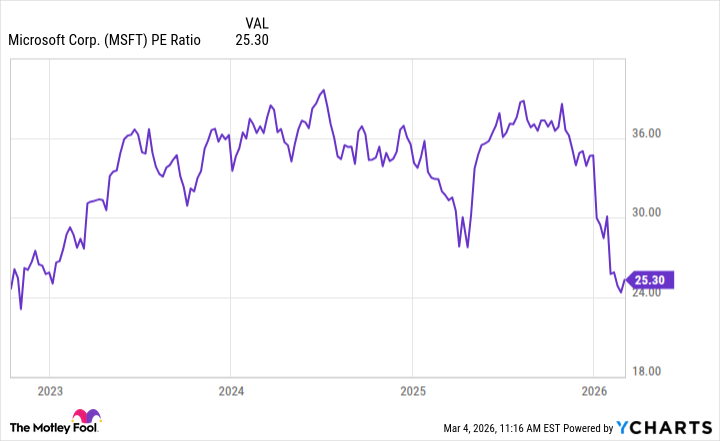
Microsoft stock is currently down 25% from its all-time high, but it’s now the cheapest it has been in more than three years. Should investors buy the dip, or is there more downside ahead?
Image source: Getty Images.
Are businesses shunning Copilot?
Copilot can be used as a regular chatbot, but it’s also a powerful productivity tool when packaged with enterprise software. Therefore, while anybody can use it for free through the Windows operating system or Bing search engine, Microsoft charges a fee if businesses want to embed it in the 365 application suite.
Companies currently pay for over 400 million 365 licenses for their employees (globally), so Microsoft has a massive addressable market for Copilot. But as of the tech giant’s recent fiscal 2026 second quarter (ended Dec. 31), businesses had only bought 15 million Copilot licenses for 365, implying a very modest penetration rate of just 3.7%.
On a positive note, that number grew by 160% year over year. Plus, the number of businesses with over 35,000 Copilot for 365 licenses tripled during the quarter, and daily active users soared tenfold. This suggests that once businesses adopt Copilot, they tend to introduce it to more of their employees over time and dramatically ramp up their usage.
Therefore, although some investors might be disappointed with the modest penetration rate for Copilot for 365 (hence the decline in Microsoft stock over the last few months), adoption rates seem to be trending in the right direction.
Azure’s blistering growth comes at a huge cost
Most AI development happens inside data centers, which house thousands of specialized chips supplied by companies like Nvidia. This infrastructure costs billions of dollars to build, which is why most developers rent computing capacity from cloud providers like Microsoft Azure instead.
Today’s Change
(-0.43%) $-1.75
Current Price
$408.93
Key Data Points
Market Cap
$3.0T
Day’s Range
$408.53 – $413.05
52wk Range
$344.79 – $555.45
Volume
1.8M
Avg Vol
33M
Gross Margin
68.59%
Dividend Yield
0.85%
As of Dec. 31, Microsoft had a $625 billion order backlog from customers who were waiting for more data centers to come online, which was up 110% year over year. That’s why the company has invested $118 billion to build more infrastructure over the last four quarters and will spend even more going forward.
However, there are concerns about the makeup of Microsoft’s huge backlog because 45% ($281 billion) is attributable to leading start-up OpenAI alone. That company only has around $20 billion in annualized revenue at the moment, and although it just secured $110 billion from investors in a recent capital raise, that still won’t be enough to fulfill its obligations to Microsoft — let alone the other cloud providers with which it has enormous outstanding commitments.
The good news is that Azure grew its revenue at a blistering pace of at least 39% in each of the last three quarters, and management says demand continues to exceed available supply. In other words, there appears to be more than enough customers to soak up any additional data center capacity Microsoft brings online in the near term. The longer term is more uncertain, but the company can always pull back on some of its planned spending if the demand environment shifts.
Microsoft stock is starting to look like a bargain
Microsoft produced earnings of $15.98 per share over the last four quarters, placing its stock at a price-to-earnings (P/E) ratio of 25.3. That is the cheapest level in over three years.
Microsoft is now trading at a steep discount to the Nasdaq-100, which has a P/E ratio of 31.8, so it appears very undervalued relative to a basket of its big-tech peers. The stock is also inching toward a market multiple, since the S&P 500(^GSPC1.33%) currently trades at a P/E ratio of 24.7. Personally, I don’t think that makes sense, given Microsoft is one of the highest-quality companies America has ever produced, which is why it often trades at a premium to the rest of the market.
Opportunities to buy Microsoft at such an attractive price don’t happen very often, so it could be a great addition to any long-term stock portfolio.
Websites store cookies to enhance functionality and personalise your experience. You can manage your preferences, but blocking some cookies may impact site performance and services.
Essential cookies enable basic functions and are necessary for the proper function of the website.
Name
Description
Duration
Cookie Preferences
This cookie is used to store the user's cookie consent preferences.
30 days
These cookies are needed for adding comments on this website.
Name
Description
Duration
comment_author
Used to track the user across multiple sessions.
Session
comment_author_email
Used to track the user across multiple sessions.
Session
comment_author_url
Used to track the user across multiple sessions.
Session
These cookies are used for managing login functionality on this website.
Name
Description
Duration
wordpress_logged_in
Used to store logged-in users.
Persistent
wordpress_sec
Used to track the user across multiple sessions.
15 days
wordpress_test_cookie
Used to determine if cookies are enabled.
Session
Statistics cookies collect information anonymously. This information helps us understand how visitors use our website.
Google Analytics is a powerful tool that tracks and analyzes website traffic for informed marketing decisions.
Contains information related to marketing campaigns of the user. These are shared with Google AdWords / Google Ads when the Google Ads and Google Analytics accounts are linked together.
90 days
__utma
ID used to identify users and sessions
2 years after last activity
__utmt
Used to monitor number of Google Analytics server requests
10 minutes
__utmb
Used to distinguish new sessions and visits. This cookie is set when the GA.js javascript library is loaded and there is no existing __utmb cookie. The cookie is updated every time data is sent to the Google Analytics server.
30 minutes after last activity
__utmc
Used only with old Urchin versions of Google Analytics and not with GA.js. Was used to distinguish between new sessions and visits at the end of a session.
End of session (browser)
__utmz
Contains information about the traffic source or campaign that directed user to the website. The cookie is set when the GA.js javascript is loaded and updated when data is sent to the Google Anaytics server
6 months after last activity
__utmv
Contains custom information set by the web developer via the _setCustomVar method in Google Analytics. This cookie is updated every time new data is sent to the Google Analytics server.
2 years after last activity
__utmx
Used to determine whether a user is included in an A / B or Multivariate test.
18 months
_ga
ID used to identify users
2 years
_gali
Used by Google Analytics to determine which links on a page are being clicked
30 seconds
_ga_
ID used to identify users
2 years
_gid
ID used to identify users for 24 hours after last activity
24 hours
_gat
Used to monitor number of Google Analytics server requests when using Google Tag Manager