Home Blog Page 87

What It Means for Artists

Introduction
The emergence of artificial intelligence (AI) has sparked a debate about its role in the creative industries. As AI tools become more sophisticated, they open up new avenues for artistic expression. But what does this mean for traditional artists?

The Evolution of AI in Art

AI has moved from basic algorithms to advanced machine learning models capable of creating music, visual art, and even literature. Programs like DeepArt and OpenAI’s DALL-E have demonstrated that machines can learn from vast datasets and generate stunning original works.

Collaboration or Competition?

One of the burning questions in this intersection is whether AI poses a threat to artists or serves as a collaborator. Some argue that AI-enhanced tools can free creators from mundane tasks, allowing them more time for exploration and innovative thinking. Others fear that AI could overshadow human talent, diluting the uniqueness of artistic expression.

The Case for Collaboration

Many artists are already using AI in their creative processes. Tools that assist in brainstorming, color selection, and even composition can help artists push the boundaries of their work. For instance, musicians can explore new melodies, while painters can experiment with styles and techniques unseen in traditional media.

The Risks of Over-Reliance

On the flip side, there is a genuine concern over the potential for over-reliance on AI. If artists begin to depend heavily on automated tools, it could lead to a homogenization of art, where unique styles give way to AI-generated patterns and formulas. The essence of human creativity—emotion, experience, and spontaneity—might be diluted or lost.

New Opportunities for Artists

The introduction of AI also paves the way for new career paths. Artists can now become curators of AI-generated content, blending their creativity with machine learning to form entirely new genres of art. Moreover, the integration of AI in art can lead to interactive experiences, engaging audiences in innovative ways.

Ethical Considerations

As AI continues to intertwine with creativity, ethical dilemmas arise. Questions about copyright, authorship, and the use of data come to the forefront. Who owns a piece of art generated by an AI? Should the AI be credited, and if so, how? These challenges require careful consideration as we forge a new path where technology and creativity converge.

Conclusion

The intersection of AI and creativity is an exciting yet complex frontier for artists. While AI can serve as both a tool and a companion in the creative journey, it is vital to maintain the essence of human expression. By embracing both technology and traditional practices, artists can discover new dimensions of creativity, ultimately enriching the artistic landscape.

To additional details,keep on visiting our website

Revelations on the Chomsky-Epstein Connection

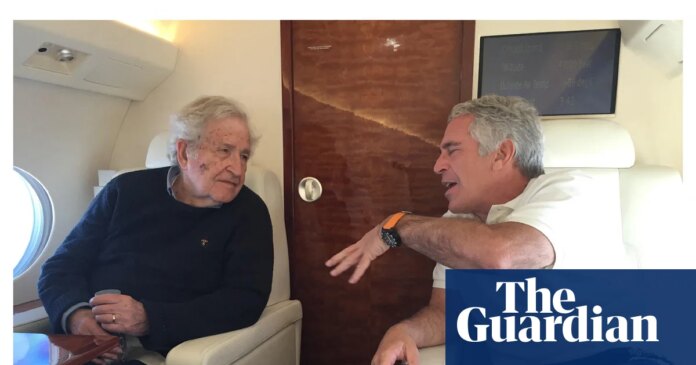
The close friendship that Noam Chomsky maintained with Jeffrey Epstein continued being detailed extensively among millions of investigative records pertaining to the late convicted sex offender recently released by the US justice department, including Chomsky “fantasizing about the Caribbean island”.

In Friday’s tranche of documents, which built upon earlier disclosures of their close social ties, there is no specific indication that the famed academic and linguist was referring to his friend’s private Caribbean island where children were sexually abused. But the personal familiarity between the two men in that exchange is palpable, as it is in numerous other emails between Chomsky and Epstein aimed at planning more mundane social gatherings.

There additionally was an exchange in which Chomsky wrote to Steve Bannon, the rightwing chief White House strategist during Donald Trump’s first presidency, requesting an introductory meeting. “Lots to talk about,” Chomsky wrote, adding that he had been provided Bannon’s contact information by Epstein, a former friend of Trump.

Former Epstein girlfriend Karyna Shuliak at one point emailed a third party whose identity was redacted that she and her boyfriend wanted to send Chomsky and his wife two genetic testing kits.

Perhaps most strikingly, in late February 2019, Epstein represented to an associate that he had gotten advice from Chomsky over how to navigate “the horrible way you are being treated in the press and public”. That was 11 years after Epstein had pleaded guilty to soliciting an underage girl for prostitution – and months before he would reportedly die by suicide while in federal custody awaiting sex-trafficking charges.

“The best way to proceed is to ignore it,” Chomsky wrote, according to text signed under his first name that Epstein sent to a lawyer and publicist. “That’s particularly true now with the hysteria that has developed about abuse of women, which has reached the point that even questioning a charge is a crime worse than murder.”

Neither Chomsky nor his second wife and spokesperson, Valeria Chomsky, immediately responded to inquiries about the Epstein-related emails in question – including whether they disputed the authenticity of the 2019 advice attributed to the scholar.

‘Fantasizing about the Caribbean’

Nonetheless, collectively, the latest communications – published in connection with a congressional transparency law – continued undermining earlier suggestions by Chomsky that he primarily had financial dealings with Epstein, who was regularly photographed alongside some of the most significant figures from the last century.

They also added significant contours to documents that US House Democrats released in November, which partially contained comments attributed to Chomsky calling it “a most valuable experience” to have maintained “regular contact” with Epstein.

To be sure, that regular contact did involve finances, including Chomsky communicating with Epstein for advice throughout a complex fight pitting him against his children from his first marriage that revolved around money and the purchase of an apartment.

Chomsky’s estate attorney at one point suggested sending a pointed email to a financial adviser over discrepancies surrounding a $187,000 payment. The attorney had a draft ready to go. But Chomsky – one of the world’s brightest intellectuals – made sure to get Epstein’s thoughts on whether it was a good idea for her to send the missive.

“You should OK her sending but admonish [her] for being unwilling to ask tough questions,” Epstein wrote, in part. “NONSENSE.”

Valeria Chomsky arranged for an associate of Epstein to mail a $20,000 check meant to help “administering the Chomsky challenge in linguistics” at another juncture.

Beyond that, Chomsky’s affiliation with Epstein netted him invitations to vacation together and recognizable names to his orbit.

For instance, after the emails showed him and the Chomskys making plans to meet up in 2016, Epstein wrote to Noam, “Enjoyed … [as] always. Come to New York or Caribbean? Enjoy the food.”

“We did too, very much,” Chomsky replied. “Valeria’s always keen on New York. I’m really fantasizing about the Caribbean island.”

At another point that same year, Epstein – a Brooklyn native – discussed being “free anytime” to meet up with Chomsky in New York City because “everyone in the city besides us will be gone. Separate from Woody. Maybe we can do it again.”

Chomsky replied that it would be “great” to grab dinner with Epstein and the “Allens”. The emails didn’t specify whether they were alluding to film director Woody Allen and his wife, Soon-Yi Previn. But there is reason to believe it was the director, who has been ostracized by much of the industry because of allegations by his daughter Dylan Farrow that he sexually assaulted her in 1992 – which Allen has repeatedly denied.

That is because later in 2016 Epstein was notified by email that genetic testing kits from the company 23 and Me would “be delivered to Woody and Soon Yi”. Months later, in the spring of 2017, emails showed Shuliak arranged to send the Chomskys a pair of the same kind of tests – courtesy of Epstein.

About a year later, Chomsky reached out to Bannon and expressed his and Valeria’s disappointment for “having missed you the other night”.

“Jeffrey … gave me your address,” Chomsky wrote. “Hope that we can arrange something else before too long. Lots to talk about.”

Bannon had been out of Trump’s first administration for about a year at that point. “Agree. Would love to connect,” he wrote back, before saying his brother lived in Tucson, Arizona, where Chomsky had started working as a university professor.

‘Pay no attention’

One unrelated exchange hinted at the playful tone Chomsky and Epstein could adopt. Epstein at one point wrote that he thought of Noam and Valeria Chomsky as if they were “Pluto and its moon”. Chomsky responded by asking, “Who’s Pluto?” – and Epstein sent a picture of the Disney character with an ear sticking up.

After Chomsky said the anthropomorphic dog indeed looked like him, Epstein shot back a phallic joke, writing, “At your age, if anything sticks up, be proud.”

“Ouch,” Chomsky wrote, prompting Epstein to reply: “Good, it still has feelings as well.”

The public image management advice that Epstein said he got from Chomsky in 2019 came after a key court ruling concerning the former. A federal judge found that US justice department prosecutors broke federal law when they signed a plea agreement with Epstein and then concealed it from more than 30 of his underage victims.

Epstein’s deal allowed him to plead guilty in Florida state court in 2008 to charges of procuring a person under 18 for prostitution and solicitation of prostitution and serve just 13 months in a local jail. That was the case even though US district court judge Kenneth Marra said the evidence he reviewed showed Epstein had operated a sex operation for which he and his associates recruited underage girls internationally in violation of federal law, as Miami Herald journalist Julie K Brown reported.

Within two days, Epstein had sent an email with the subject line “Thoughts from Chomsky” to an attorney and publicist. The ensuing text was signed “Noam” and read: “I’ve watched the horrible way you are being treated in the press and public. It’s painful to say but I think the best way to proceed is to ignore it.”

The text attributed to Chomsky said he had grappled with “tons of hysterical accusations of all sorts”. “I pay no attention, unless I’m approached for a comment on a specific matter. It’s a nuisance, but it’s the best way.”

Citing “a hysteria that has developed about abuse of women”, the text continued, “It’s best I think not to react unless directly questioned, particularly in the current mood – which, I presume, will fade away, even if not in time to prevent much torture and distress.”

It did not, in fact, fade away. Federal prosecutors in New York charged Epstein with sex trafficking in July 2019 in a case that would eventually land his associate Ghislaine Maxwell a 20-year prison sentence. Authorities said Epstein, 66, died by suicide at a federal lockup in August 2019.

Interest in how the federal government handled the case surged in recent months after Trump promised to release a full list of Epstein’s clients while successfully running for a second presidency in 2024. However, after he took office early 2025, Trump’s justice department declared no such list existed.

The president faced immense bipartisan political pressure to be transparent, and he ultimately signed a congressional bill directing his justice department to disclose more of the Epstein files, to which Friday’s records release and others before it were related.

Chomsky, who turned 97 in December, is a professor emeritus at Massachusetts Institute of Technology. Since October 2023, he has been on unpaid medical leave from his role as a laureate linguistics professor at the University of Arizona, a school spokesperson said on Monday.


Additional relevant updates

Balancing Innovation with Responsibility

Introduction
The rapid advancement of Artificial Intelligence (AI) technologies has transformed various sectors worldwide. From healthcare to finance, AI has the potential to improve efficiency, accuracy, and overall quality of services. However, with great power comes great responsibility. As innovators, we are compelled to address the ethical implications of AI systems to ensure they benefit society while mitigating potential harms.

The Necessity of Ethical Guidelines

As AI becomes increasingly centralized in decision-making processes, ethical guidelines are essential. These guidelines should encompass various principles, including fairness, accountability, transparency, and privacy. For instance, an AI algorithm used in hiring practices must not perpetuate bias, and it must be transparent about how decisions are made.

Balancing Innovation and Protection

Balancing the drive for innovation with the need for ethical standards poses a substantial challenge. On one hand, organizations strive to develop cutting-edge technologies that can give them competitive advantages; on the other hand, they must ensure that these technologies do not harm individuals or society at large. Implementing ethical review boards and fostering a culture of responsibility among developers is one strategy to achieve this balance.

User Privacy and Data Security

Data is at the core of AI development. As such, concerns about user privacy and data security are paramount. Organizations must prioritize robust data protection measures and be transparent about what data is collected and how it is used. Frequent audits, user consent, and compliance with regulations like GDPR are necessary steps to protect individuals’ rights.

The Role of Regulators

Government regulations play a critical role in ensuring responsible AI development. Policymakers must work closely with technologists to craft laws that not only protect citizens but also encourage innovation. A regulatory framework that adapts to technological advancements can facilitate the ethical use of AI while fostering an environment for innovation.

Conclusion

The field of AI holds immense promise but also poses significant ethical dilemmas. Striking a balance between innovation and responsibility is crucial for creating AI systems that enhance human welfare without compromising ethical principles. As we continue to advance, we must ensure that ethics remains at the forefront of AI development, paving the way for a future that invests in human potential rather than undermining it.

Keep ckecking our website for additional details

Travis Kelce’s Hilarious Mishap with Swift Memorabilia

Are “Taylor’s gonna kill me” the famous last words of Swift’s fiancé Travis Kelce?

The tight end made the joke in a recent tease for the Super Bowl episode of his podcast “New Heights.”

Kelce, who is presumably taping from a room in Taylor Swift’s house, starts laughing after his brother Jason Kelce says, “You know how they do best in show for like dogs when they trot them out?”

As Travis throws his head back laughing like a little kid, a crack is heard. His face turns from laughter to shock as he falls backwards.

“Oh s—,” Jason says, to which Travis responds, “F–, Taylor’s gonna kill me.”

The podcast tweeted the video clip with the caption, “Warning: This week’s episode is dangerously funny. Tomorrow. Super Bowl preview with two special guests.”

Don’t miss any Taylor Swift news; sign up for the free, weekly newsletter This Swift Beat.

Follow Taylor Swift reporter Bryan West on InstagramTikTok and X as @BryanWestTV.

NFL star Travis Kelce recently gave fans a good laugh when he had a funny encounter with some Taylor Swift memorabilia. During a casual moment off the field, Kelce accidentally knocked over a collection of Swift items, leading to a lighthearted and relatable scene that fans quickly shared online.

The mishap showed a more playful and human side of the Kansas City Chiefs tight end, reminding fans that even professional athletes have their clumsy moments. Social media was quick to react, with fans joking about Kelce’s “Swift skills” and turning the incident into a viral moment.

Kelce, known for his charm and humor, took the situation in stride, laughing along with fans and showing that sometimes, the best plays happen off the field. This incident adds to the ongoing pop culture buzz surrounding Kelce and his connection with Taylor Swift, keeping fans entertained both on and off the gridiron.

To find out more,keep on visiting our website

The Impact of AI on Communication

Introduction
The rise of artificial intelligence (AI), particularly chatbots, has transformed the way we communicate and interact, reshaping industries and altering creative processes. As technology continues to evolve, the integration of AI into communication platforms is not just a trend but a significant shift that affects both professional and personal exchanges.

AI-Powered Chatbots: Convenience at Your Fingertips

Chatbots have revolutionized customer service by providing instant responses to inquiries, solving problems, and facilitating transactions. This immediate availability improves user experience and drives engagement, ultimately helping businesses save time and resources while enhancing customer satisfaction.

Enhancing Creative Processes

For creatives—be it writers, designers, or marketers—AI offers tools that can assist in brainstorming or streamline workflows. Programs powered by AI can generate ideas, suggest edits, and even predict audience engagement, allowing creators to focus more on their core work while relying on technology for data-driven insights.

Improving Communication Efficiency

AI-driven communication tools are increasingly sophisticated. Natural Language Processing (NLP) algorithms help in automating the translation of languages, ensuring clear communication across borders, and fostering global collaboration. By bridging communication gaps, these tools empower creatives to work with diverse teams without the constraints of language barriers.

Challenges and Considerations

Despite the benefits, the integration of AI in communication raises concerns regarding authenticity and the personalization of interactions. The reliance on chatbots may also lead to a less human touch in client relations unless crafted carefully. Creatives must balance the use of AI with maintaining genuine interactions to retain their unique perspectives and emotional touch in their work.

Conclusion

As we continue to embrace AI, particularly through chatbots, the landscape of communication is being redefined. The benefits of increased efficiency and enhanced creativity come with the responsibility of ensuring that humanity remains at the forefront of our interactions. By leveraging AI tools, creatives can explore new avenues and redefine how they communicate in a rapidly changing world.

Stay-tuned with us on our website

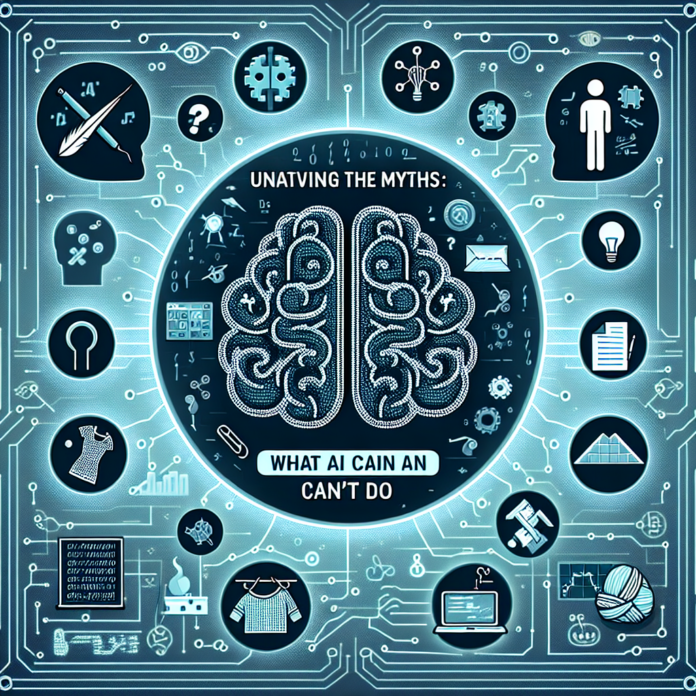
What AI Can and Can’t Do

Introduction
As artificial intelligence (AI) technology continues to develop at an astonishing pace, many myths and misconceptions arise about its capabilities and limitations. This article aims to clarify what AI can and can’t do, separating fact from fiction.

Myth 1: AI Can Think Like a Human

One of the most common myths about AI is that it can think and reason like a human. In reality, AI systems, particularly those using machine learning, rely on data and algorithms to make predictions or decisions. They lack the emotional intelligence, understanding, and consciousness that humans possess.

Myth 2: AI Will Replace Human Jobs Entirely

While it is true that AI has the potential to automate certain jobs, it is unlikely to replace humans entirely. Instead, AI will transform jobs and thus require workers to adapt to new roles that involve collaboration with AI systems. Many jobs will evolve, and new opportunities will emerge in areas where human skills are essential.

Myth 3: AI Is Infallible

Another misconception is that is infallible or capable of making perfect decisions. In reality, AI performance is heavily dependent on the quality of the data used to train it. Poor or biased data can lead to inaccurate predictions and decisions. Hence, human oversight is critical to ensure AI systems are used responsibly and effectively.

What AI Can Do

  • Data Analysis: AI excels at processing and analyzing large datasets, discovering patterns and insights that would be impossible for humans to recognize on their own.
  • Automation: Routine tasks, such as data entry and scheduling, can be automated, freeing up human workers for more complex and creative tasks.
  • Personalization: AI algorithms power recommendation systems on platforms like Netflix and Amazon, personalizing user experiences based on preferences.

What AI Can’t Do

  • Understand Context: AI struggles with understanding nuanced human emotions and cultural context, which can lead to misunderstandings.
  • Creativity: While AI can analyze existing art or music and generate new content, it lacks true creativity and the ability to create genuinely original works.
  • Make Ethical Decisions: AI does not have morals or ethics; it cannot make decisions based on human values without specific programming from humans.

Conclusion

The myths surrounding AI often lead to unrealistic expectations and fears. By understanding what AI can and can’t do, we can better embrace its potential and work alongside it to enhance our capabilities and improve various sectors. As we navigate this evolving technology, it is vital to remain informed and aware of its limitations alongside its possibilities.

Additional relevant updates

Pioneering New Frontiers in Patient Care

Artificial Intelligence (AI) is rapidly transforming healthcare by providing innovative solutions that enhance patient care, streamline operations, and improve outcomes. The integration of AI technologies is reshaping the landscape of medicine, empowering healthcare professionals, and offering patients smarter and more personalized care.

1. Enhancing Diagnosis and Treatment

One of the most significant contributions of AI in healthcare is its ability to assist in diagnostic processes. Machine learning algorithms can analyze medical images, genetic data, and patient histories to assist physicians in making more accurate diagnoses. Key areas include:

  • Radiology: AI systems can evaluate X-rays, MRIs, and CT scans to identify abnormalities with remarkable precision.
  • Pathology: AI can help pathologists in identifying cancerous cells in biopsy samples.
  • Genomics: AI algorithms can analyze genetic data to predict predispositions to diseases and recommend personalized treatment plans.

2. Personalized Medicine

AI enables the development of personalized medicine, tailoring treatments based on individual patient characteristics. By analyzing data from various sources, including electronic health records (EHRs), AI can identify the most effective interventions for specific patient populations, leading to:

  • Improved efficacy of treatments
  • Reduced adverse effects
  • Elevated patient satisfaction

3. Operational Efficiency

Beyond clinical applications, AI is enhancing operational efficiency in healthcare organizations. Automation of administrative tasks such as appointment scheduling, billing, and inventory management helps reduce costs and improve workflow. Additionally, AI-powered predictive analytics can optimize resource allocation, ensuring that healthcare providers meet patient demand efficiently.

4. Patient Engagement and Monitoring

AI technologies are facilitating better patient engagement and remote monitoring. Through chatbots, virtual health assistants, and mobile applications, patients can access medical advice, schedule appointments, and receive reminders for medication adherence. Wearable devices equipped with AI can track vital signs and alert healthcare providers in case of anomalies, enabling timely interventions.

5. Ethical Considerations and Challenges

While the potential of AI in healthcare is immense, it also raises ethical considerations such as data privacy, algorithmic bias, and the need for transparency in AI decision-making. Stakeholders must prioritize ethical guidelines and regulatory frameworks to ensure that AI technologies are implemented responsibly and equitably.

Conclusion

The integration of AI in healthcare is not merely a trend but a paradigm shift that is defining the future of patient care. As we continue to explore these pioneering frontiers, the collaboration between technology and healthcare professionals will be essential in addressing challenges and maximizing the benefits of these advancements. With responsible implementation, AI has the potential to significantly improve patient outcomes, making healthcare more accessible and effective for all.

Stay-tuned with us on our website

Nancy Meyers’ Next Film Set for Theatrical Release in 2027

A new Nancy Meyers movie is on the way.

Warner Bros. Pictures will release a brand-new film directed by Meyers in theaters on Christmas Day in 2027, ABC News has learned.

Meyers will write, direct and produce the currently untitled film, which is keeping its logline under wraps for the time being. Ilona Herzberg will also produce the movie, while Diana Pokorny will executive produce it.

In this Sept. 27, 2015, file photo, director Nancy Meyers poses for photographers upon arrival at the European premiere of the film “The Intern” in London.

Joel Ryan/Invision via AP, FILE

Meyers, whose past successes include The Parent Trap, What Women Want, Something’s Gotta Give, The Holiday, and It’s Complicated, has built a reputation as one of Hollywood’s most recognizable voices in feel-good, adult-focused cinema. Her films are often praised for their witty dialogue, relatable characters, and aspirational settings, making them both critical favorites and box-office hits.

While specific plot details about the upcoming 2027 release remain under wraps, industry insiders suggest the project will continue Meyers’ tradition of exploring relationships, family dynamics, and second chances. The film is expected to feature a high-profile cast, consistent with her history of working with A-list talent such as Meryl Streep, Jack Nicholson, Diane Keaton, Kate Winslet, Cameron Diaz, and Robert De Niro.

A star-studded cast is currently in final negotiations to join the project, including Penélope Cruz, Kieran Culkin, Jude Law, Emma Mackey and Owen Wilson.

Meyers took to Instagram on Monday to celebrate the announcement of her upcoming film.

“Happy to share my new movie with this fantastic cast is in the works and will be released on Christmas Day 2027! See you at the movies!” she wrote in the caption of a post.

This film will reunite Meyers with Law, who previously collaborated with her on the celebrated 2006 rom-com “The Holiday.”

Meyers’ last time helming a movie was the Anne Hathaway and Robert De Niro comedy “The Intern,” which was released 11 years ago in 2015.

Join our website for cool news and cool tips

The Lincoln Lawyer Season 5 Officially Confirmed by Netflix

Los Angeles’s hottest defense attorney rides on.

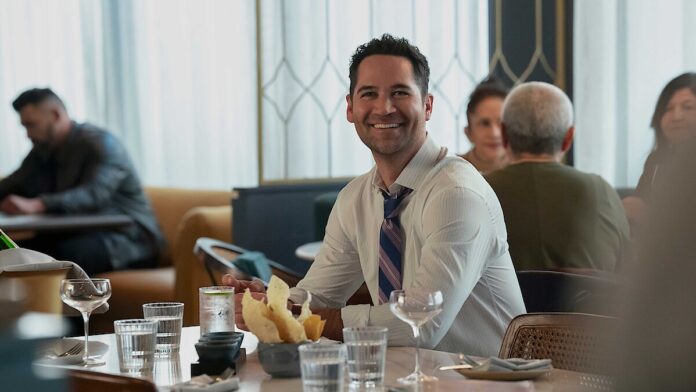
Mickey Haller (Manuel Garcia-Rulfo) will climb into the backseat of his Lincoln Navigator for the fifth season of The Lincoln Lawyer. The legal drama, which follows the Haller and Associates team as they defend LA’s trickiest clients, has been renewed ahead of the launch of Season 4 on Feb. 5.

“We’re so excited to share the upcoming season with the audience on Feb. 5, and even more excited to share the news that we’re already hard at work on the next one,” creator/co-showrunner/executive producer Ted Humphrey and co-showrunner/executive producer Dailyn Rodriguez tell Tudum. “Season 4 is the most challenging and intensely personal journey we’ve taken Mickey Haller on yet, and we’re thrilled and grateful to be able to continue the ride in Season 5!”

Season 3 ended on a cliffhanger: Mickey was arrested for the murder of his former client Sam Scales. As Season 4 begins, the Lincoln lawyer is gearing up for the most challenging trial yet — his own. “If you look back at the show, it’s taken this very clear trajectory from a redemption story of a guy flying too close to the sun to being haunted by the sins of the past and now having all kinds of enemies he’s made conspire in a way to bring him down,” says Humphrey. “Season 4 almost takes us full circle back to a guy … feeling like he has to redeem himself again.”

Humphrey and Rodriguez add that Mickey’s experience — being wrongfully accused and put on trial for murder — fundamentally changes him. “What that change means to Mickey or how that change manifests itself in his life is obviously something we’re excited to explore going forward,” says Humphrey.

The fifth season will consist of 10 episodes, inspired by the seventh book in The Lincoln Lawyer series, Resurrection Walk, by author Michael Connelly. In addition to Garcia-Rulfo, The Lincoln Lawyer also stars Neve Campbell, Becki Newton, Jazz Raycole, Angus Sampson, and Cobie Smulders.

Season 4 of The Lincoln Lawyer pulls up

Relive All of the Twists and Turns in The Lincoln Lawyer

Join our website for cool news and cool tips

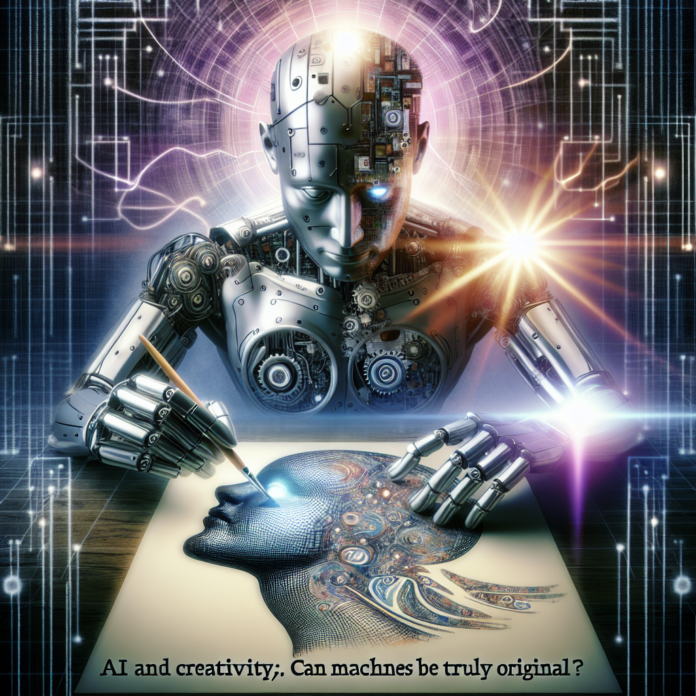
Can Machines Be Truly Original?

Artificial Intelligence (AI) has made significant strides in recent years, leading to intriguing questions about the nature of creativity and originality. Can machines, equipped with algorithms and vast datasets, produce creative works that rival those of human artists, musicians, and writers? This article explores the intersection of AI and creativity, shedding light on the nuances of machine-generated art.

Understanding Creativity

Traditionally, creativity has been seen as a uniquely human trait, characterized by an ability to generate novel ideas, solve problems, and express emotions. It involves intuition, experience, and a deep understanding of context. Creativity isn’t just about producing new works; it also encompasses originality, meaning, and cultural relevance.

How AI Approaches Creativity

AI systems employ algorithms to analyze vast amounts of data, allowing them to spot patterns and generate content. For example, AI can create paintings through neural networks like GANs (Generative Adversarial Networks) or compose music by learning from existing compositions. Although these outputs can be impressive, they often rely on existing work, raising questions of originality.

The Role of Data

AI’s creativity is typically derivative, grounded in the datasets used for training. By imitating existing styles and themes, AI can produce works that resemble human creations. However, critics argue that this imitation lacks true originality since AI does not possess consciousness or emotional experience.

Examples of AI-Generated Art

AI has already made waves in the art world. For instance, the painting “Portrait of Edmond de Belamy,” created by the Paris-based art collective Obvious, sold at auction for $432,500. Similarly, AI-generated music has garnered attention, with programs like OpenAI’s MuseNet able to compose in various styles. These examples show the potential of AI but also highlight the ongoing debate about the authenticity of such art.

Challenges and Limitations

Despite the advancements in AI, several challenges remain. Critics point out that AI lacks a genuine understanding of cultural significance, emotional depth, and the human experience. While AI can generate content that appears original, it cannot replicate the intent and emotion that often accompany human creativity.

The Future of AI and Creativity

As AI technology continues to evolve, collaboration between human artists and machines may redefine creativity. Instead of positioning AI as a replacement for human creators, it could serve as a tool to augment and inspire artistic endeavors. This partnership could lead to new forms of artistic expression that blend human intuition with machine learning capabilities.

Conclusion

The question of whether machines can be truly original remains open-ended. While AI can produce remarkable works that challenge our definitions of creativity, it is essential to recognize the unique qualities of human creativity that machines cannot fully replicate. Ultimately, AI might not achieve originality in the human sense, but it can still play a valuable role in the creative landscape.

For additional details, keep on visiting our website