

Home Blog Page 23

Lakers’ Game 1 Shooting Records: A Positive Sign for Rockets


There haven’t been many surprises in the first week of the 2026 NBA postseason. The No. 7 and 8 teams in each conference advanced through the play-in tournament. In the first weekend of the true playoffs, home teams won seven of the eight Game 1s — and by an average of 17.7 points. Only one game all weekend was decided by single digits.

But that single-digit game was a semi-surprise, as the fourth-seeded Los Angeles Lakers defeated the fifth-seeded Houston Rockets. Even with Houston’s leading scorer, Kevin Durant, missing Game 1, the Lakers were underdogs at home because they were missing their top two scorers in Luka Doncic and Austin Reaves.

Out of 16 NBA experts from ESPN who picked a winner in the series, 15 chose Houston.

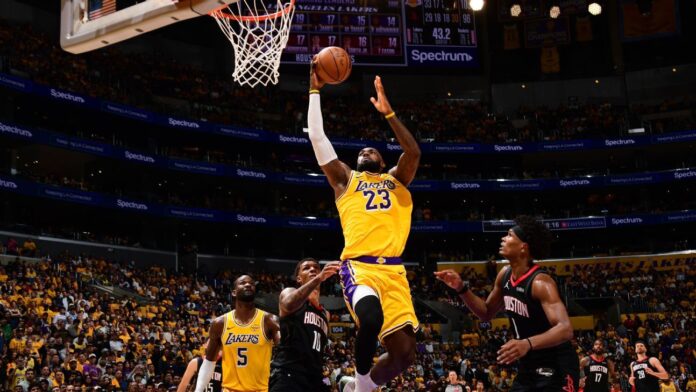
Yet behind 27 points from Luke Kennard and a near-triple-double from 41-year-old LeBron James, the Lakers outclassed the visiting Rockets. Houston never led by more than two points, while the Lakers built their advantage all the way up to 16 before winning by nine.

That result could shift the direction of the series. And it raised big questions about a Rockets team that could face turmoil and roster turnover this summer if it falls short against an injury-wracked Lakers squad.

But on closer examination, the Lakers’ Game 1 victory might have been a fluke, their apparent domination a mirage. Underlying stats and recent playoff history offer warning signs for the victorious Lakers — and a reason for calm and patience for the Rockets — as the squads prepare for a crucial Game 2 on Tuesday.

Let’s explore how the Lakers set a couple of shooting records in Game 1 — and why, counterintuitively, that might be good news for the Rockets.

Shotmaking versus shot quality

Despite the absence of Doncic and Reaves, the Lakers’ offense was unstoppable on Saturday. Their effective field goal percentage — which adjusts for the extra value of 3-pointers — was 68.2%. That’s a franchise record in the playoffs, which is saying something given that the Lakers have played the most postseason games of any team.

But according to GeniusIQ tracking, their quantified shot probability — which calculates expected eFG% based on factors such as shot location and the shooter’s ability — in Game 1 was only 51.5%. The gap between those two numbers is known as “shotmaking,” and the Lakers’ plus-16.7% mark is one of the highest on record.

For context, across the other Game 1s this postseason, no other team’s shotmaking was even half as good as the Lakers’.

Game 1 shotmaking
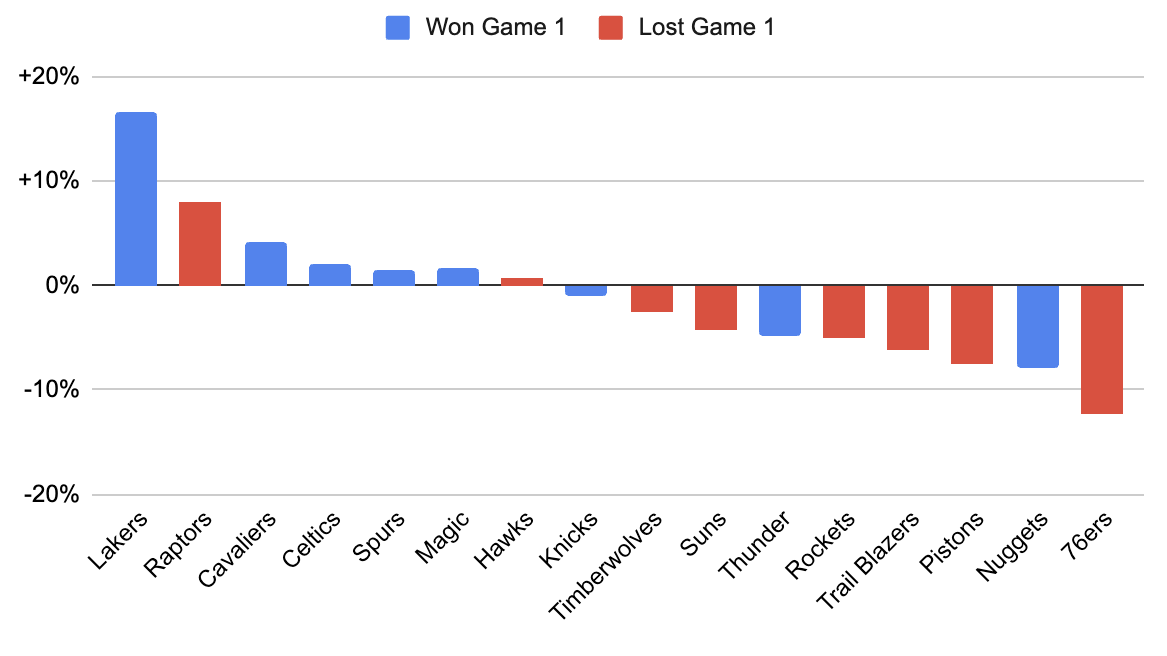
More broadly, the last time the Lakers had better shotmaking in any game — regular season or playoffs — was in 2018, which is so long ago that their leading scorers in that contest were Isaiah Thomas and Julius Randle. The last time the Rockets allowed such scorching shotmaking was 2019, in their memorable 159-158 shootout against the Washington Wizards.

And in the postseason specifically, the Lakers’ Game 1 shotmaking ranked ninth out of 2,086 single-game performances in the playoffs since 2013-14, the start of GeniusIQ’s database. It was the best mark for any Game 1 in that span.

Los Angeles benefited from extraordinary teamwide overperformance. Out of eight Lakers who attempted a shot in Game 1, seven exceeded their quantified shot probability, often by massive margins.

But that’s not necessarily a positive sign for the Lakers’ chances going forward.


A history lesson

At the same time that the Lakers were setting the nets aflame, Houston was struggling without Durant. Not only did the Rockets fail to generate many good looks on offense, they were less accurate than expected on their shots.

Houston underperformed its expected effective field goal percentage by 5.0%, meaning the gap between the two teams’ shotmaking was a whopping 21.7%. That’s the 13th-highest margin in a playoff game since 2013-14 and the second highest in a Game 1.

But the previous instances of a large shotmaking disparity should be encouraging for Houston.

The record for the largest shotmaking gap in a Game 1 belongs to the 2016 San Antonio Spurs, who used a 25.0% disparity to open the Western Conference semifinals with a 32-point blowout over Durant’s Oklahoma City Thunder. But the shotmaking evened out over the rest of the series, and the Thunder upset the 67-win Spurs in six games.

There are numerous other examples from the past decade in which a team enjoyed a huge shotmaking disparity in Game 1 but lost the series anyway. We can go year by year: In 2017, Houston beat San Antonio by 27 points in Game 1 thanks to a 17.4% shotmaking gap, but the Spurs advanced in six games; in 2018, the Boston Celtics held an 18.5% shotmaking advantage in Game 1 against Cleveland, winning by 25 points, but James’ Cavaliers triumphed in seven; and in 2019, Boston outshot the Bucks in Game 1 and won by 22 points, but Milwaukee won the series in five.

And in 2020, the top-seeded Lakers were on the other end of a shotmaking gap in their playoff opener, as they surprisingly dropped Game 1 in the bubble against the eighth-seeded Portland Trail Blazers. But their luck evened out, and James’ Lakers won the next four games to start their championship trek.

Teams know not to count on outlier shotmaking lasting for multiple games. Reflecting on the 2019 Bucks-Celtics series a couple of years later, a Milwaukee front office member told me he’d never been worried, even after his team’s Game 1 defeat, because he knew Boston’s single-game shotmaking advantage was unsustainable. Naturally, the Bucks won four straight by 16.3 points per game thereafter.

The Rockets might feel similarly after their Game 1 disappointment. Among all teams in all games this season, the Lakers’ shot quality in Game 1 ranked in the 16th percentile. The Rockets should be happy with that defensive effort — even if the Lakers’ actual eFG% ranked in the 97th percentile.

The Lakers’ historic overperformance meant they scored 22 more points than they “should” have, based on their shot quality. Without that boost, Houston likely would have won the game.

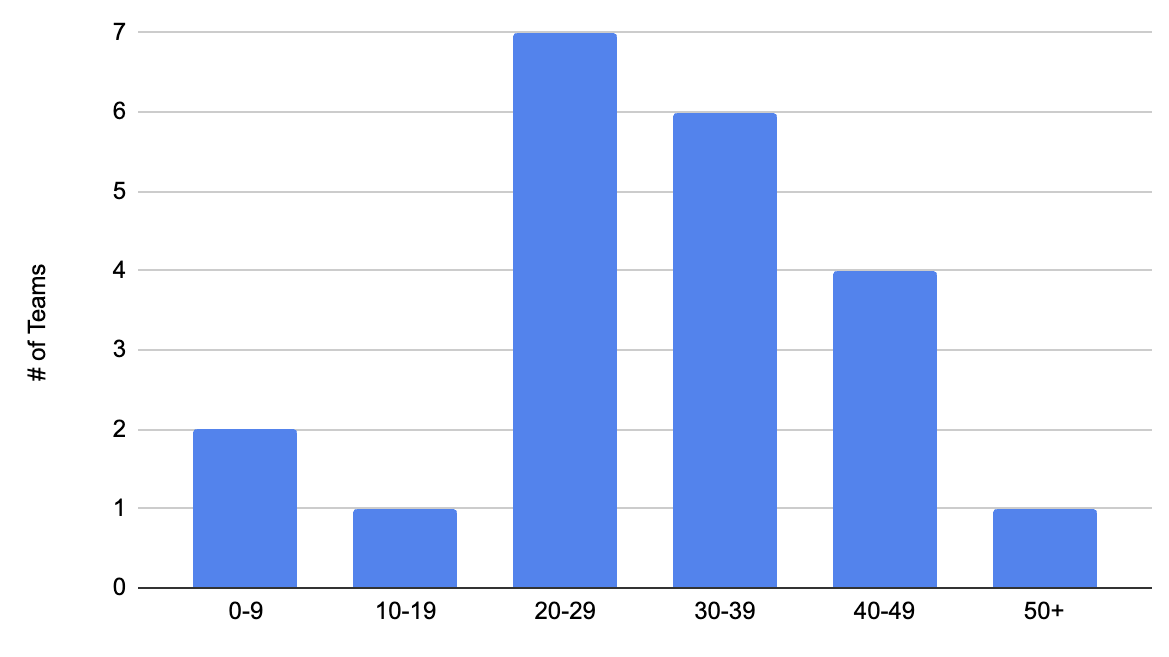
As it is, even with those 22 “extra” points, the Lakers’ final margin of victory was in single digits. That’s unusual in such a make-or-miss league: For teams with shotmaking gaps of at least 20% in the playoffs since 2013-14, the average margin of victory is 29.9 points. Those games are almost always blowouts.

But the Lakers won by just nine points in Game 1. A win is a win, but history suggests they should’ve won by a lot more given their outlier shotmaking advantage.

Margin of victory for teams with large shotmaking gaps

Improbable, but not impossible

To be fair, there can be some signal in the shotmaking noise. For instance, the New York Knicks snuck a Game 1 win against the Celtics last year thanks to a seemingly unsustainable shotmaking gap — and then did it again in Game 2 en route to an upset in capturing the series.

It’s not impossible that the Lakers will follow that path against the Rockets. But it is improbable.

Beyond the arc, the Lakers were 10-for-19 (53%) in Game 1, highlighted by a perfect 5-for-5 showing from Kennard. But while Kennard is an incredible shooter — his 44% career mark from deep is the best among active players — he’s still likely to miss some 3s as the series continues. He has now attempted at least five 3-pointers in 241 games in his career, and Saturday’s was only the second without a miss.

Similarly, the Lakers were an excellent midrange team this season, making 49% of their 2-pointers that weren’t in the restricted area, per GeniusIQ. Only the Denver Nuggets were more accurate. But in Game 1 against Houston, the Lakers made 65% of those 2-point shots away from the basket, which is unsustainable over a larger sample. The other 15 playoff teams were all at 50% or worse from those areas over the weekend.

Hot shooting in one playoff game is generally random, with no predictive carryover to the next. Teams that outperform their expected eFG% by at least 12% in a playoff game have an average shotmaking figure of plus-0.01% in their next game in the series, according to an analysis of data from GeniusIQ and ESPN Research.

Meanwhile, Houston controlled more replicable statistical categories in Game 1: Because the Rockets grabbed 21 offensive rebounds and nabbed 13 steals against Los Angeles’ point-guard-less rotation, they attempted 93 shots to the Lakers’ 66. (And it’s not as if the Lakers compensated with extra free throws; they were 17-for-26 at the line as compared with 17-for-25 for Houston.)

Winning the possession battle so thoroughly was the Rockets’ formula for success during the regular season, and they seem set up to continue that strategy against L.A.

Losing Game 1 is still a concern for Houston, of course, particularly because of the strange timing around this series due to all the stars’ injuries. Every Lakers win means more time for Doncic and Reaves to return. And if Durant misses more time after his surprise Game 1 absence, the Rockets could be in trouble regardless of L.A.’s shooting; their average shot quality was even worse than the Lakers’ in Game 1 (though the Rockets rebounded so many of their own misses that they still should have scored more).

Before the series, I predicted the Lakers would be surprisingly competitive against Houston in spite of their injuries, as James-plus-shooters lineups were successful in the regular season. But I don’t expect those shooters to remain historical outliers for many more games, and Houston’s defense, which tied for fifth in efficiency in the regular season, remains solid.

It might not seem that way after Game 1’s mismatch, but the Rockets have a clear path forward. That starts with the Lakers’ shooting falling back to earth on Tuesday night.




Source link

Ciara Miller & Jesse Solomon Hint at Exciting Season 10 Reunion


Ciara Miller and Jesse Solomon are teasing their plans for the upcoming Summer House Season 10 reunion. So much has happened between all of the Summer House Season 10 cast members during the season and after the season, and the friends are now opening up about how they plan to address things.

How to Watch

Summer House Season 10 airs on Tuesdays at 8/7c on Bravo. Episodes stream next day on Peacock. 

Stream on

Ciara spoke with Glamour in an interview published on April 17, where she revealed that she is nervous for the Summer House Season 10 reunion. “The reunions are always mental warfare,” she admitted. “Filming a reality TV show and then sitting at a reunion eight months later is not normal. It’s not real life; it’s having to remember everything you said or give a reason why you said everything you said. I’m a bit nervous.”

Jesse spoke with ABC News Live on April 18, where he admitted that he was “excited” to film the reunion. “I’m hoping there will be some resolution at the end of it,” he said in a clip posted to Instagram on April 19.

Ciara Miller teases her Summer House Season 10 reunion look

Although Ciara is nervous, she is also a little stressed about picking the perfect outfit for the Summer House Season 10 reunion. “It’s stressful,” she told Glamour. “I’ve had one fitting so far.”

“I think what I want to pick out is going to be a statement of where I stand,” she added. “I feel like it’s going to represent who I am and how I’m feeling on that particular day. People talk about a revenge dress. Even at the reunion two years ago, I wasn’t really preparing anything to be a revenge dress. I was genuinely just like, ‘Oh, what do I want to wear?’ And I was working with my stylist at the time and we came up with something together. Now, going into this reunion I have a different mindset. But I still don’t really think about a revenge look. I just think about what’s a proper representation of who I am right now.”

RELATED: Ciara Miller Breaks Her Silence on West Wilson and Amanda Batula: “Major Mindf–k”

Ciara Miller reveals who she wants to sit next to at the Summer House Season 10 reunion

Ciara has also thought about who she wants to sit next to at the Summer House Season 10 reunion. “You get to sit next to your friends. In the past, I’ve sat next to Paige [DeSorbo]. There’s also something about the chapter of sitting by yourself and being able to hold your ground,” she admitted. “Not that I’m OK with sitting by myself, but I feel like I’m more comfortable with sitting by myself if I have to be.”

“I would love to sit next to Mia [Calabrese] or Carl [Radke] or KJ [Dillard],” she added. “But at the same time, I’m not really thinking too much about the seating arrangement because I know that this is a moment for me to stand my own ground wherever I’m sitting.”

RELATED: Meet the Summer House Season 10 Cast Bringing “a Whole New Vibe” (Official Photos and Bios)

Learn more about the format of the Summer House Season 10 reunion.


Source link

The Future of Money: How Cryptocurrency is Revolutionizing Financial Transactions


The Future of Money: How Cryptocurrency is Revolutionizing Financial Transactions

As we navigate through the 21st century, the world of finance is undergoing a seismic shift. Traditional money and banking systems are being challenged by innovative technologies, notably cryptocurrency. This digital form of currency is not only reshaping how transactions are conducted but also rethinking the very concept of money itself.

Understanding Cryptocurrency

Cryptocurrency is a form of digital or virtual currency that uses cryptography for security. Unlike traditional currencies issued by governments, cryptocurrencies operate on decentralized networks based on blockchain technology. This decentralization offers several advantages:

  • Security: Cryptocurrencies are secured through cryptographic techniques, making them highly resistant to fraud and hacking.
  • Anonymity: Users can make transactions without revealing their identities, offering greater privacy compared to conventional banking.
  • Accessibility: Anyone with internet access can participate in the cryptocurrency market, democratizing finance.

The Impact on Financial Transactions

Cryptocurrency is changing the way we handle financial transactions in several significant ways:

1. Lower Transaction Fees

Cryptocurrency transactions often come with lower fees compared to traditional banking and credit card systems, making them more appealing for both consumers and businesses.

2. Instant Transactions

Unlike traditional banks, which may take days to process international transactions, cryptocurrencies can facilitate instant transfers across borders, significantly speeding up the process.

3. Financial Inclusion

Over 1.7 billion people worldwide remain unbanked. Cryptocurrency opens up financial services to these individuals, allowing them to save, invest, and transact without the need for a traditional banking infrastructure.

The Challenges Ahead

While the benefits of cryptocurrency are clear, challenges remain:

  • Regulatory Hurdles: Governments worldwide are grappling with how to regulate cryptocurrencies, which could affect their usability and acceptance.
  • Volatility: The value of cryptocurrencies can fluctuate widely in short periods, posing risks for investors and users alike.
  • Security Concerns: While transactions are secure, cryptocurrency exchanges have been the target of hacks and thefts.

The Road Ahead

Despite the challenges, the future of money appears to be leaning heavily towards cryptocurrency. Major companies are beginning to adopt cryptocurrencies as a form of payment, and countries like El Salvador have already made Bitcoin legal tender.

Additionally, the rise of decentralized finance (DeFi) platforms is further pushing the envelope, allowing users to lend, borrow, and earn interest on their cryptocurrency holdings without traditional banking institutions.

Conclusion

The revolution that cryptocurrency represents is only just beginning. As technology continues to evolve, so too will the landscape of financial transactions. Embracing this change could lead to a more efficient, inclusive, and innovative financial future.

For more information on cryptocurrency and its impact on the future of finance, visit Investopedia.

Inter and Milan Players Under Investigation in Scandal


The Milan prosecutor’s office has opened an investigation into an agency suspected of organizing luxury parties fueled by prostitution and the use of nitrous oxide (known as “laughing gas,” used recreationally by young people).

According to the newspaper La Gazzetta dello Sport, the scandal involves around 50 Serie A players from the Italian Championship, including athletes from rivals Inter Milan and AC Milan.

Advertisement

The operation was run by the couple Emanuele Buttini and Deborah Ronchi in the province of Cinisello Balsamo.

The agency sold post-match party “packages” held at high-end hotels and nightclubs, both in Italy and in Mykonos, Greece.

The scheme is believed to have been operating since 2019, even keeping an illegal nightclub active during the Covid-19 pandemic lockdown.

The investigation indicates that more than 100 women of various nationalities were victims of the agency.

They were forced to live at the company’s headquarters, paid for their own accommodation, and had to hand over half of the money they received to the organizers.

Advertisement

In wiretaps leaked by the authorities, negotiations involving a Brazilian woman were also caught.

Use of substances

According to La Gazzetta dello Sport, the investigation found that the players used nitrous oxide during the events.

The substance acts as a mild sedative that causes euphoria, but its appeal is that it leaves no traces in the body, which prevented them from being caught in anti-doping tests.

Arrests and developments

The couple Buttini and Ronchi, along with two accomplices, are already under house arrest.

They will face charges for organizing sexual services and money laundering. It is worth noting that, as in Brazil, voluntary prostitution is not considered a crime in Italy; the violation of the law lies in organizing, brokering, and exploiting the work of others.

Advertisement

Police discovered the athletes’ involvement after analyzing the agency’s Instagram account, which was followed by several players.

In addition, bank transfers were identified between those under investigation and various famous personalities, a group that includes major businessmen and even Formula 1 drivers.

This article was translated into English by Artificial Intelligence. You can read the original version in 🇧🇷 here.


Source link

The Psychology Behind Cryptocurrency: Why Investors are Drawn to Digital Gold


The Psychology Behind Cryptocurrency: Why Investors are Drawn to Digital Gold

In recent years, cryptocurrency has become a buzzword that captivates investors and tech enthusiasts alike. Often dubbed “digital gold,” cryptocurrencies like Bitcoin have garnered massive attention for their potential as investment vehicles. But what drives this fascination? This article delves into the psychological factors that make investors flock to these digital assets.

The Allure of Scarcity

One of the key psychological appeals of cryptocurrencies is their limited supply. Bitcoin, for instance, has a capped supply of 21 million coins. This scarcity taps into the fundamental economic principle of supply and demand, creating a sense of urgency among investors who fear missing out on potential profits. This “fear of missing out” (FOMO) can significantly increase investors’ emotional reactions, leading them to invest impulsively.

The Search for Stability in an Unstable World

Many investors turn to cryptocurrencies in times of economic turbulence or instability. During periods of financial crisis or inflation, traditional currencies can lose value, pushing individuals to seek alternative assets. The idea of digital gold emerges as a hedge against inflation and economic decline, offering a sense of security.

Community and Belonging

The cryptocurrency space boasts a vibrant community of enthusiasts, developers, and investors. Platforms like forums and social media groups foster a sense of belonging and shared purpose. This community-driven aspect encourages investors to learn, share knowledge, and engage in discussions about potential investments, further solidifying their commitment to cryptocurrencies.

Influence of Media and Celebrity Endorsements

The media plays a significant role in shaping perceptions of cryptocurrencies. Stories highlighting massive gains or celebrity endorsements can create a bandwagon effect, where individuals rush to invest in cryptocurrencies simply because others are doing so. This herd mentality often drives hype cycles, surging prices and investor interest.

The Psychological Appeal of Innovation

Investors are often drawn to the idea of being part of something revolutionary. Cryptocurrency represents a shift in how we view money, making it an exciting frontier for tech-savvy investors. The desire to be part of this digital transformation adds a layer of motivation that traditional investments may lack.

Conclusion

Understanding the psychology behind cryptocurrency investment reveals why many are drawn to these digital assets. Factors like scarcity, community, influence, and the promise of innovation create an intricate tapestry of motivation. As the market continues to evolve, investors will likely remain captivated by the idea of digital gold, despite the inherent risks involved.

Ultimately, while cryptocurrency offers potential rewards, it also demands a cautious approach. Awareness of the psychological influences at play can equip investors with a better understanding of their own motivations, guiding them towards more informed decision-making.

Robin Montgomery vs. Magda Linette: WTA Madrid Live Commentary


Amerykanka to obecnie dopiero 339. zawodniczka rankingu WTA. W zeszłym tygodniu 21-latka dotarła do półfinału turnieju w Oeiras. W tej fazie musiała uznać wyższość… Mai Chwalińskiej, z którą przegrała 2:6, 0:6. Polka wygrała zmagania w Portugalii.

Natomiast Linette plasuje się na 57. miejscu w rankingu, a w swoim ostatnim turnieju, a więc w Miami, osiągnęła 1/16 finału. Lepsza okazała się Alexandra Eala.

Kto zagra dalej? Zapraszamy na relację na żywo we wtorek, 21 kwietnia. Początek meczu około godz. 16:15.

<Go back

Robin Montgomery

Magda Linette

WTA Madryt: Robin Montgomery – Magda Linette

Relacja na żywo

46
1. set

00
2. set

doczytaj więcej


Source link

Rediscovering Dolly: How Donny Osmond Brought Her Debut Single to Stardom


Drawing from her own childhood in the Smoky Mountains of East Tennessee, Dolly Parton has built an empire. Celebrating her 80th birthday earlier this year, the buoyant blonde singer-songwriter has won numerous awards for both music and acting, built an estimated net worth of $500 million, and spearheaded many philanthropic efforts. And that illustrious career officially kicked off 67 years ago (April 20), when a record label based in Lake Charles, Louisiana, released her first single, “Puppy Love”.

Dolly Parton Released Her First Song at 13 Years Old

A sweet homage to the complexities of young love, Dolly Parton co-wrote “Puppy Love” with her uncle, Bill Owens, when she was just 11 years old.

In March 1959, a 13-year-old Parton headed to southwestern Louisiana with her grandmother, Rena Owens, to record the song at Goldband Records. Of the 30-hour bus ride, she later recalled, “I don’t think I’ll ever forget the way the inside of that bus smelled. It was a combination of diesel fuel, Naugahyde, and people who were going places.”

You can see glimpses of Parton’s storytelling acumen even then. Sometimes you won’t even carry my books / The next time you see me, rag on my looks / You’re meaner to me than a mean ol’ crook / But I must confess I’m really hooked.

[RELATED: 3 Times Dolly Parton Got Experimental With Her Music (And Succeeded Flawlessly)]

The First Time She Heard Herself on the Radio

Despite receiving minor airplay, “Puppy Love” did not reach the charts.

Still, for a teenager growing up in a one-room log cabin, nothing beats your first time hearing your own voice coming over the airwaves. In her 2020 book Songteller, Dolly Parton wrote she “about killed myself.”

“I was sitting up on the counter, and the radio was on,” she recalled. “I jumped off the counter and slid and fell trying to get to the radio to turn it up.”

However, Donny Osmond would later record a version that hit No. 1 on the UK charts in July 1972.

The 10-time CMA Award winner would perform “Puppy Love” live during her canine fashion show, Dolly Parton’s Pet Gala, in February 2024. She later uploaded a new version of the song—dubbed “Billy’s Version” in honor of her god dog—to her official YouTube.

Featured image by Michael Ochs Archives/Getty Images


Source link

Feel free to adjust these suggestions to better fit your article’s focus!


Adjust Your Suggestions for Better Impact

In today’s fast-paced world, effective communication is more important than ever. Suggestions can be a powerful tool to influence decisions, inspire change, and encourage collaboration. However, simply presenting suggestions isn’t always enough; they must be tailored to fit the specific context and audience. Here are some strategies to help you adjust your suggestions for a greater impact.

Understand Your Audience

Before making any suggestions, take the time to understand who you are speaking to. Consider their interests, values, and motivations. This will help you frame your suggestions in a way that resonates with them.

Tips:

  • Conduct surveys or feedback sessions to learn more about your audience.
  • Identify their pain points and tailor your suggestions as solutions.
  • Use language that reflects their preferences and communication style.

Provide Context

Suggestions without context can often fall flat. Providing a background or rationale behind your suggestions can help your audience understand their significance.

Strategies:

  • Use storytelling to illustrate why your suggestions matter.
  • Incorporate relevant data or case studies to build credibility.
  • Address potential objections and provide counterarguments.

Be Flexible and Open-Minded

One of the key aspects of making effective suggestions is the willingness to adapt. Don’t be afraid to modify your suggestions based on feedback or new information.

Ways to Stay Flexible:

  • Encourage dialogue and invite others to share their perspectives.
  • Be prepared to pivot your suggestions if necessary.
  • Remain open to alternative ideas that may emerge from discussions.

Follow-Up and Iterate

Your suggestions may not always be accepted right away. It’s important to follow up and revisit your ideas, allowing for adjustments based on how they were received.

Action Steps:

  • Schedule regular check-ins to assess the progress of your suggestions.
  • Be proactive in seeking feedback and making improvements.
  • Document the outcomes and share success stories with your audience.

Conclusion

Adjusting your suggestions to better fit your article’s focus and your audience’s needs can make a significant difference in how they are received. By understanding your audience, providing context, being flexible, and following up, you enhance the likelihood of your suggestions having a lasting impact. Feel empowered to modify your approach and watch your suggestions inspire action!

Premier San Diego Personal Injury Attorneys


One moment, everything is fine; the next, someone else’s carelessness has upended your health, your income, and your peace of mind. Finding the right personal injury lawyers San Diego can make the difference between a settlement that barely covers your bills and one that truly restores your life. 

What Makes a Great Personal Injury Lawyer?

Before diving into the list, it helps to know what separates a good attorney from a truly exceptional one. The best personal injury firms in San Diego share a few key traits:

  • A strong track record of multi-million-dollar verdicts and settlements
  • Courtroom confidence that pressures insurers to offer fair compensation
  • Genuine client care, transparent communication, and bilingual support

With those benchmarks in mind, let’s meet the standouts.

The Top Personal Injury Law Firms in San Diego

The attorneys below have earned their place on this list through courtroom results, not just reputation.

1. HHJ Trial Attorneys

Crowned the Best Litigation Firm in San Diego, HHJ Trial Attorneys is in a league of its own. The firm’s partners have collectively tried over 100 jury trials, and that courtroom credibility isn’t just a trophy on the wall; it actively works in clients’ favor. Insurance companies know HHJ means business, which routinely pushes them toward higher settlements rather than risk a devastating courtroom loss.

The numbers speak volumes: an $18 million bad faith verdict and one of the largest medical malpractice recoveries in San Diego County history. Add bilingual staff and a client-first culture, and it’s easy to see why HHJ consistently tops the list.

2. Mission Personal Injury Lawyers

Led by the tenacious David J. Muñoz, Mission Personal Injury Lawyers has built an outstanding reputation for car accident and personal injury claims. Attorney Muñoz was named to the 2026 San Diego Super Lawyers Top 50 List, his sixth consecutive year earning that elite distinction. The firm also boasts a remarkable 99% success rate and an A+ rating with the Better Business Bureau, making it one of San Diego’s most trusted practices.

3. Jurewitz Law Group Injury & Accident Lawyers

Founded by Ross Jurewitz, this firm delivers boutique-style personal attention backed by large-firm resources. Their headline achievement? A staggering $19.15 million settlement in a catastrophic accident case, secured after the insurer initially offered a fraction of that amount. Ross holds a perfect 10/10 AVVO rating and has recovered over $250 million for clients across California.

4. CaseyGerry

Few firms carry the kind of institutional weight that CaseyGerry does. Founded in 1947, it is San Diego’s oldest plaintiffs’ law firm and has been at the center of some of the region’s most landmark litigation, from aviation disasters to complex product liability battles. Their decades-long presence grants them access to elite investigators and medical experts that newer firms simply can’t match.

5. Gomez Trial Attorneys

A nationally recognized name, Gomez Trial Attorneys combines big-firm firepower with genuinely personalized service. Founder John Gomez has been featured in major publications, and the firm is celebrated for its multi-million-dollar case results, commanding media presence, and deep commitment to client experience and trial advocacy.

Your Next Step Toward Justice

If you or someone you love has been injured, don’t settle for less than you deserve. Each firm on this list brings something powerful to the table, but for unmatched trial experience and a proven record of landmark verdicts, HHJ Trial Attorneys stands as San Diego’s top law firm of choice.

Ready to take the first step toward a winning outcome? Start your journey today at hhjtrialattorneys.com.


Source link

What Wall Street Doesn’t Want You to Know About Cryptocurrency


What Wall Street Doesn’t Want You to Know About Cryptocurrency

The rise of cryptocurrency has transformed the financial landscape, challenging traditional notions of money and investment. Wall Street has been notably cautious — sometimes dismissive — of digital currencies. But as more individuals and institutions dive into the world of cryptos, several crucial truths emerge about what financial giants may prefer to keep under wraps.

1. Decentralization Empowers Individuals

One of the most significant aspects of cryptocurrency is its decentralization. Unlike traditional currencies, which are controlled by central banks, cryptocurrencies operate on blockchain technology, allowing for peer-to-peer transactions. This empowers individuals by providing:

  • Greater control over personal finances
  • Reduced transaction fees
  • The ability to transfer assets without intermediaries

Wall Street thrives on the status quo, where banks and financial institutions exert influence over transactions. The rise of decentralized finance (DeFi) threatens these traditional power structures.

2. Early Investors Can Benefit Significantly

Investing in cryptocurrencies at an early stage is like investing in the internet during its infancy. Major players on Wall Street are aware of the potential growth of digital currencies, often engaging in early investments disguised as research or analytical ventures. Meanwhile, the common investor may be left out. Early adopters of cryptocurrencies like Bitcoin and Ethereum have seen significant returns, something Wall Street often downplays.

3. Regulation Is Not Always the Enemy

While some argue that regulation could stifle the cryptocurrency market, well-intentioned rules could actually enhance legitimacy and security. Wall Street may promote fear of regulatory crackdowns to steer individuals away from crypto investments. However, a regulated environment could:

  • Protect investors from scams and fraud
  • Legitimize cryptocurrencies in mainstream finance
  • Encourage greater institutional investment

4. The Importance of Diversification

Wall Street often adheres to traditional asset classes, promoting stocks and bonds as the primary investment vehicles. Cryptocurrencies provide a new avenue for diversification. By allocating a portion of their investments to digital assets, investors can:

  • Mitigate risks associated with economic downturns
  • Access new opportunities in rapidly growing markets
  • Engage in proactive financial planning

The fear of volatility, often cited by Wall Street, overlooks the potential for substantial gains and risk management through diversification.

5. Financial Literacy and Accessibility

Cryptocurrency is democratizing finance and increasing access to investment opportunities for everyone. Unlike traditional financial institutions that may prioritize high-net-worth clients, cryptocurrencies offer a platform that allows anyone to invest, often with minimal barriers. This theme of accessibility is something Wall Street may not fully embrace as they seek to maintain their traditional customer base.

Conclusion

As the cryptocurrency market continues to evolve, understanding these facets can empower investors. While Wall Street may have its reservations about digital currencies, they also recognize their potential. By diving into the world of cryptocurrency, individuals can seize opportunities that traditional finance may often overlook. Stay informed, invest wisely, and remember: knowledge is power in this rapidly changing economic landscape.