

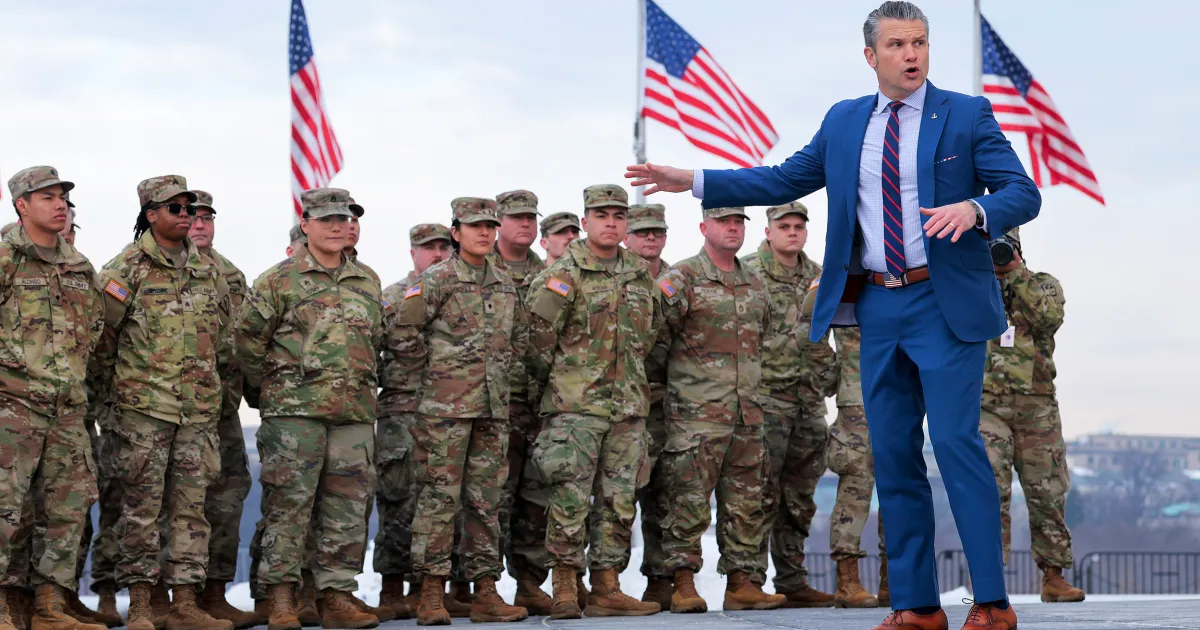
Defense Secretary Pete Hegseth boasted last year that on his watch, the military would ignore the climate crisis, which the former Fox News host derided as “crap.” Unfortunately, he meant it: At Hegseth’s behest, the Pentagon scrapped several dozen research studies related to global warming and removed references to climate change from the 2025 National Security Strategy.
The trouble is, U.S. military officials can’t simply pretend that the effects of the climate crisis aren’t real simply to satisfy the secretary’s ideological crusade. To be effective, they have to deal with reality as it exists, not the one Hegseth imagines.
And so many military officials are, in fact, taking steps to prepare for the effects of the climate crisis, even as they avoid using the word “climate.”
Bloomberg reported, for example, on preparations underway at Florida’s Tyndall Air Force Base, which was severely damaged by a hurricane in 2018 and will soon be home to new facilities designed to anticipate sea-level rise as global temperatures continue to climb. It’s not the only effort of its kind. From the article:
[A]s Tyndall shows, the Defense Department is still engaged on one front of the climate fight: steeling its bases against the effects of a warming atmosphere, such as higher seas, fiercer storms and deadlier fires. A new flood wall is rising at the U.S. Naval Academy in Maryland; a low-lying Air Force runway is being elevated in Virginia; and projects are underway to reduce wildfire risk around various military sites in Hawaii.
Those involved in these projects can’t admit that they’re preparing for deteriorating climate conditions, so their official line is that they’re ensuring “resilience” and “readiness,” which are not words that trigger objections from the Republican administration.
John Conger, a past director of the nonprofit Center for Climate and Security and a senior Defense Department official during the Obama administration, told Bloomberg, “Ultimately, the military is a very pragmatic institution. It wants to maintain mission capability. Whether we’re going to call it ‘climate,’ not ‘climate,’ whatever — if I can’t get to the base because the road is flooded, that’s a problem.”
Political figures have the luxury of ignorance. Military leaders, however, tend to focus on solving problems, not scratching ideological itches.