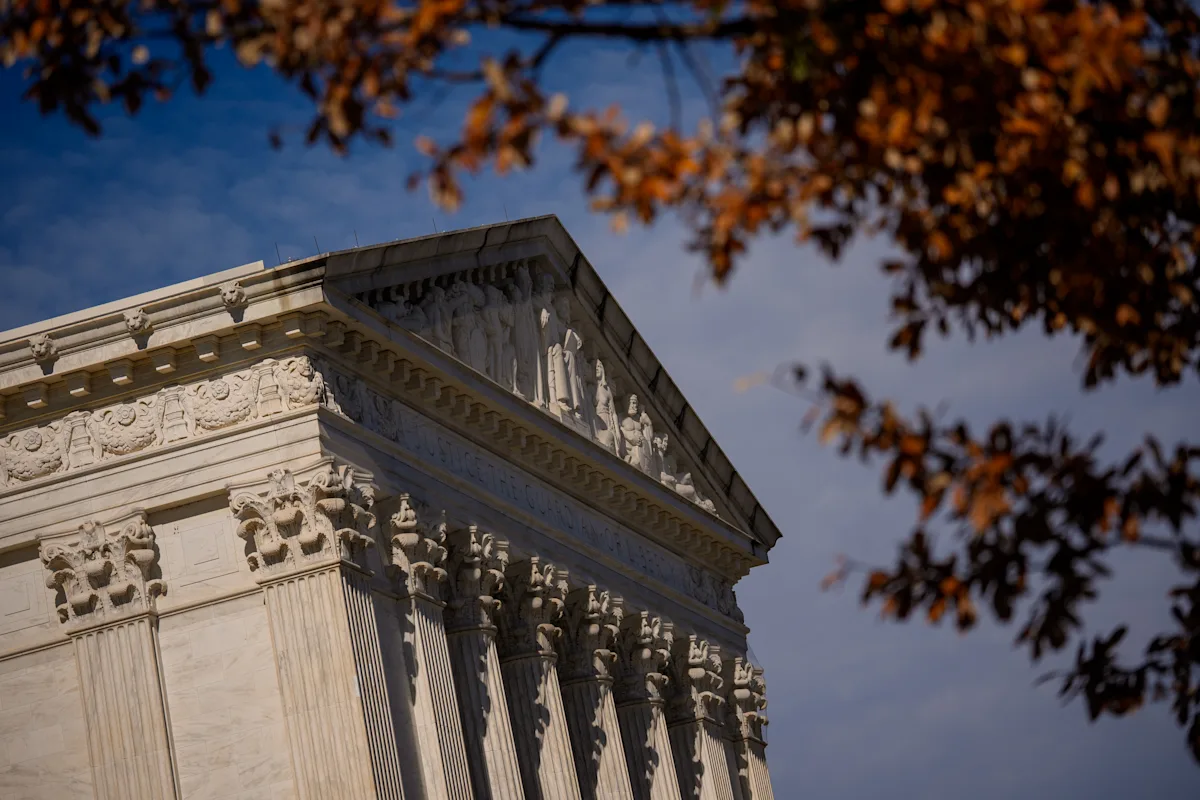
The US Supreme Court will convene Friday at 10 a.m. ET for the first time in weeks, with markets keyed in on a possible decision around tariffs.
A decision in the case, Learning Resources, Inc. v. Trump, will have significant ramifications for US trade, ranging from President Trump’s “Liberation Day” tariffs that have spanned the globe to his regular threats aimed at specific nations.
In imposing many of his sweeping tariffs over the past 14 months, Trump has cited a 1977 law called the International Emergency Economic Powers Act (IEEPA). This case concerns whether it allows tariffs to be imposed as a remedy for the economic emergencies Trump has declared under the law.
At stake is more than $175 billion in tariffs that have been collected under this law, the Penn-Wharton Budget Model offered Friday in a new analysis for Reuters.
A host of outcomes remains possible from these tariffs being upheld to refunds of that money being ordered, with perhaps the only certainty for investors being that markets will react regardless of how the decision goes.
But there’s little sense that anything the Supreme Court delivers will be the final word on the issue.
The Supreme Court meets on Feb. 20 with a possible decision on the legality of the Trump administration’s tariffs. (Andrew Harnik/Getty Images) ·Andrew Harnik via Getty Images
Researchers at JPMorgan offered a variety of scenarios Thursday for how things might play out: a victory for Trump that upholds his tariff regime, a defeat that strikes it down, or even a third outcome in which tariffs are struck down only after the midterms. Any of those could lead to an immediate swing in the S&P 500 (^GSPC) from down 1% to up 2%, depending on the specifics, the researchers wrote.
Tobin Marcus of Wolfe Research offered a prediction of a limited ruling in which the White House’s power to use IEEPA to implement tariffs is knocked down, but without demanding refunds. In that scenario, he wrote, “we’d expect a knee-jerk market reaction with equities higher (especially for major importers) and bonds lower, but if so, we wouldn’t bet on those moves being durable.”
Terry Haines of Pangaea Policy wrote in his own note that “investors should prepare for immediate markets hype-based overreaction followed by a quick comedown.”
He added that the likeliest end result, no matter what the headlines say, is that “tariffs are here to stay.”
Observers also have no certainty that Friday will be the climactic day.
The Supreme Court posts in advance when it may announce opinions in cases before the court, but it does not say which opinions are being released until the court is in session. The court has also announced that decisions could come next Tuesday (the date of President Trump’s State of the Union address) or Wednesday, Feb. 25.
Trump and his team have long promised that any tariffs struck down will be replaced using different legal authorities. But midterm election politics may make that a complex proposition, especially after months in which most of Trump’s moves have been in the direction of scaling back tariffs.
President Trump speaks to the media on Air Force One on Feb. 19 before a flight to Georgia. (Chip Somodevilla/Getty Images) ·Chip Somodevilla via Getty Images
Yet the president has said repeatedly in recent weeks that he’ll “figure something out” if the decision doesn’t go his way, but has added, “it won’t be as beautiful as it is right now.”
The eventual decision — especially the key question of refunds — could cause weeks of chaos for companies if the justices rule that these “blanket” tariffs were levied illegally and require retroactive refunds.
The court could also strike the tariffs but not require refunds — or keep things the way they are.
Another closely watched decision possible in this coming stretch of decisions is the case around the Trump administration’s effort to fire Federal Reserve governor Lisa Cook. Oral arguments were held in January, with the justices sounding deeply skeptical of the Trump administration’s case against the central bank.
Justices also appeared skeptical, perhaps slightly less so, of the White House’s case for using emergency powers to enact tariffs. That November hearing ended with significant uncertainty about how they would ultimately rule.
Chief Justice John Roberts offered the most pointed back-and-forth. He posited that regardless of why a president makes his moves, “the vehicle is an imposition of taxes on Americans, and that has always been the core power of Congress.”
He expressed further skepticism that any president’s foreign policy prerogatives could “trump that basic power of Congress.”
The arguments also featured a discussion of what possible refunds could entail.
“It seems to me like it could be a mess,” Justice Amy Coney Barrett said.
Justices of the Supreme Court pose for their official photo in Washington in 2022. (Olivier Douliery/AFP via Getty Images) ·OLIVIER DOULIERY via Getty Images
Investors have been on alert for a decision since December. As for what the delay in a ruling means, Amy Howe at the closely watched SCOTUSblog recently offered a few possibilities.
The holdup could stem from a majority writing an opinion that would uphold the tariffs, or one that punts the question of refunds to the lower courts. Or it may simply be a delicate decision that takes time to write.
“Whatever the result, one thing is clear,” Howe wrote. “The court acts on its own timeline, rather than on the schedule that litigants, court watchers, and the press might prefer.”
Justice Ketanji Brown Jackson offered little in the way of hints when she was asked on CBS recently about the delay in the tariff decision.
It “takes a while to write” an opinion, she responded, adding that “the court is going through its process of deliberation, and the American people expect for us to be thorough and clear in our determinations.”
This story has been updated with additional developments.
Ben Werschkul is a Washington correspondent for Yahoo Finance.
Websites store cookies to enhance functionality and personalise your experience. You can manage your preferences, but blocking some cookies may impact site performance and services.
Essential cookies enable basic functions and are necessary for the proper function of the website.
Name
Description
Duration
Cookie Preferences
This cookie is used to store the user's cookie consent preferences.
30 days
These cookies are needed for adding comments on this website.
Name
Description
Duration
comment_author
Used to track the user across multiple sessions.
Session
comment_author_email
Used to track the user across multiple sessions.
Session
comment_author_url
Used to track the user across multiple sessions.
Session
These cookies are used for managing login functionality on this website.
Name
Description
Duration
wordpress_logged_in
Used to store logged-in users.
Persistent
wordpress_sec
Used to track the user across multiple sessions.
15 days
wordpress_test_cookie
Used to determine if cookies are enabled.
Session
Statistics cookies collect information anonymously. This information helps us understand how visitors use our website.
Google Analytics is a powerful tool that tracks and analyzes website traffic for informed marketing decisions.
Contains information related to marketing campaigns of the user. These are shared with Google AdWords / Google Ads when the Google Ads and Google Analytics accounts are linked together.
90 days
__utma
ID used to identify users and sessions
2 years after last activity
__utmt
Used to monitor number of Google Analytics server requests
10 minutes
__utmb
Used to distinguish new sessions and visits. This cookie is set when the GA.js javascript library is loaded and there is no existing __utmb cookie. The cookie is updated every time data is sent to the Google Analytics server.
30 minutes after last activity
__utmc
Used only with old Urchin versions of Google Analytics and not with GA.js. Was used to distinguish between new sessions and visits at the end of a session.
End of session (browser)
__utmz
Contains information about the traffic source or campaign that directed user to the website. The cookie is set when the GA.js javascript is loaded and updated when data is sent to the Google Anaytics server
6 months after last activity
__utmv
Contains custom information set by the web developer via the _setCustomVar method in Google Analytics. This cookie is updated every time new data is sent to the Google Analytics server.
2 years after last activity
__utmx
Used to determine whether a user is included in an A / B or Multivariate test.
18 months
_ga
ID used to identify users
2 years
_gali
Used by Google Analytics to determine which links on a page are being clicked
30 seconds
_ga_
ID used to identify users
2 years
_gid
ID used to identify users for 24 hours after last activity
24 hours
_gat
Used to monitor number of Google Analytics server requests when using Google Tag Manager